
Shooting Star Identification Guide
Identify Shooting Star by its swept-back petals and forward-pointing dark beak that make each flower look like a falling meteor, rising on leafless stalks above a basal rosette.
Read the full Shooting Star encyclopedia entry →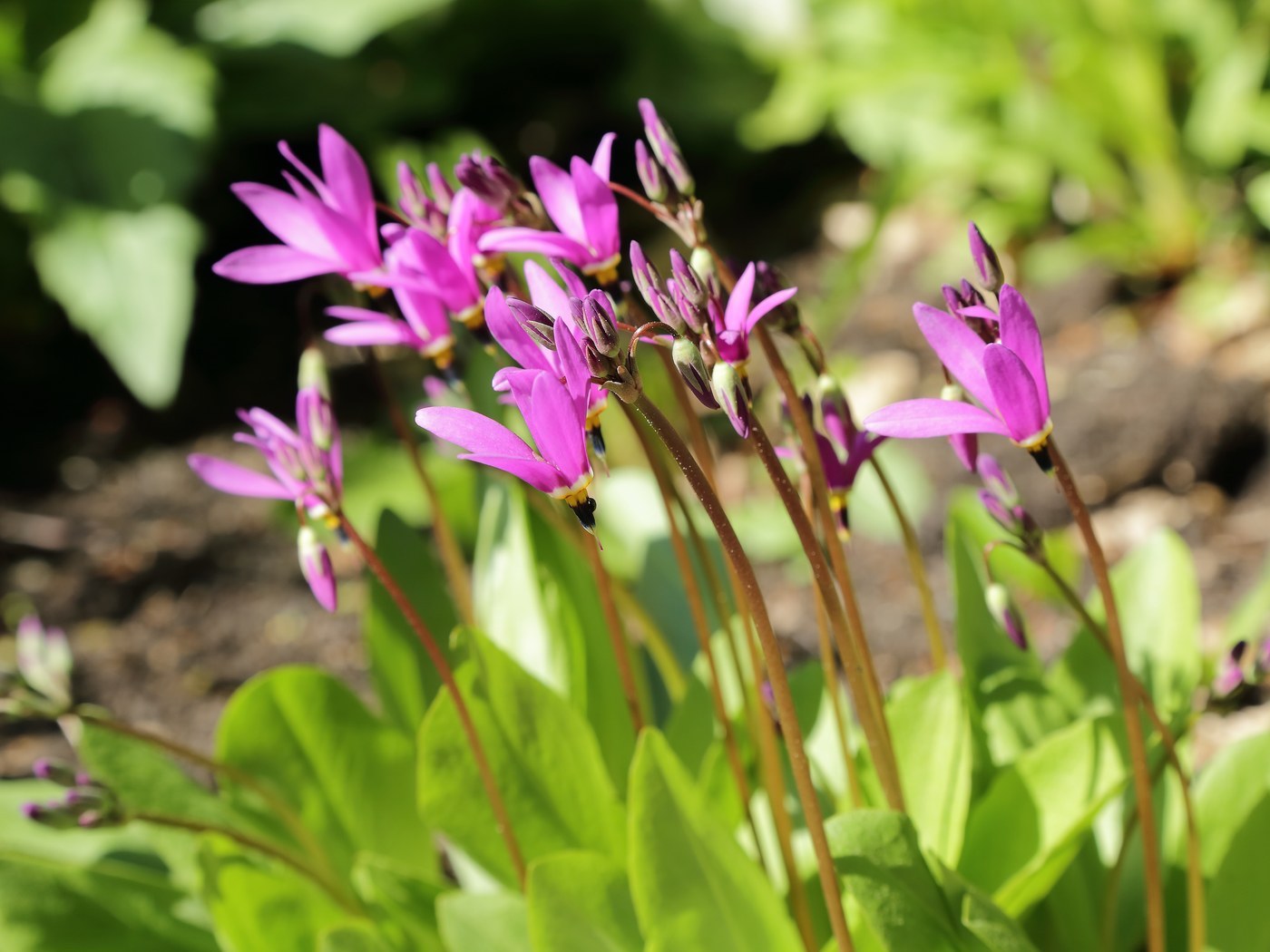
Key Identifying Features
Shooting Star (Primula meadia, formerly Dodecatheon meadia, with several related species) is a spring woodland and prairie wildflower instantly recognized by its unique flower shape:
- Nodding flowers with petals swept sharply backward, away from the pointed tip
- A dark, forward-pointing "beak" of fused yellow-and-purple stamens, giving the meteor-with-a-tail look
- Flowers in pink, lavender, or white, several to many per stalk
- A leafless flower stalk rising above a flat rosette of leaves
The reflexed-petal shape is shared by no common look-alike, making this one of the most foolproof wildflowers to name.
Leaves & Stems
All the leaves form a basal rosette at ground level. They are smooth, oblong to spoon-shaped, 3-8 inches long, with a pale midrib and often a reddish tint at the base. There are no leaves on the flowering stalk (scape), which rises 8-20 inches tall and ends in an umbel where the flower stalks radiate from a single point like spokes. Each individual flower hangs downward on its own arching stalklet.
Flowers & Fruit
Each flower has 5 backward-pointing petals (lobes) and a ring of stamens fused into a beak that points downward toward the ground. The colors shade from deep magenta-pink to soft lavender to white, usually with a yellow-and-maroon band where petals meet the beak. Bloom time is mid to late spring (April-June). Bumblebees pollinate by "buzz pollination," vibrating pollen loose from the beak. As seeds ripen, the flower stalks turn upward and the flower becomes an erect, urn-shaped capsule that splits at the tip to release seeds, after which the foliage usually goes dormant.
How to Tell It Apart from Look-Alikes
- Cyclamen: garden plants with similar reflexed petals but heart-shaped, marbled leaves and solitary flowers, not a basal rosette with an umbel of many flowers.
- American Bittersweet or nightshade flowers: superficially reflexed but are vines/herbs with very different leaves and growth.
No native meadow or woodland wildflower matches the leafless scape + umbel of reflexed-petal, beaked, nodding flowers.
Where You'll Find It
Depending on species, Shooting Stars grow in moist prairies, open woods, glades, bluff slopes, and meadows across much of North America. Primula meadia favors rich, partly shaded woodlands and prairies of the central and eastern U.S.; western species occupy mountain meadows and grasslands. They often appear in scattered colonies.
Quick ID Checklist
- Petals swept fully backward, away from a downward-pointing beak
- Dark beak of fused yellow-and-purple stamens
- Pink, lavender, or white nodding flowers
- Leafless stalk rising from a flat basal rosette
- Flowers in an umbel radiating from one point
- Spring bloom in prairies, glades, or open woods
Frequently asked questions
Why is it called Shooting Star?
The petals sweep backward while the fused stamens form a pointed beak, so each downward-hanging flower looks like a meteor or shooting star streaking through the sky with a tail behind it.
Has the scientific name changed?
Yes. Shooting Stars were long placed in the genus Dodecatheon but are now classified within Primula, so you may see Primula meadia and Dodecatheon meadia used for the same plant.
How is Shooting Star pollinated?
Mainly by bumblebees using buzz pollination: they grip the beak and vibrate their flight muscles to shake pollen loose from the anthers, which release it through pores.
Where do the leaves go after flowering?
After the flowers set seed, the basal rosette often yellows and the plant goes dormant for summer, especially in drier prairie sites, regrowing the following spring.