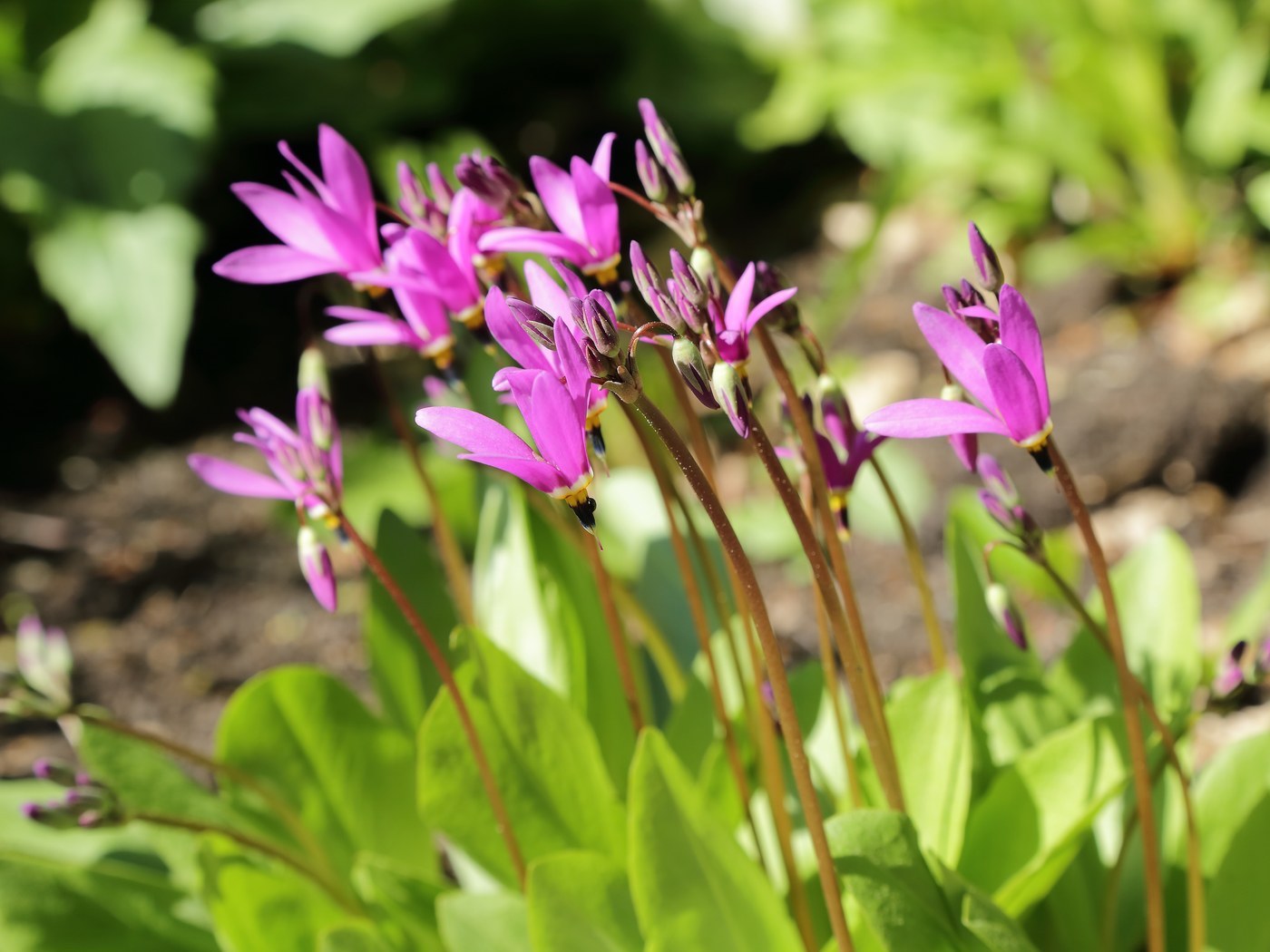
Shooting Star
Dodecatheon meadia
A spring-blooming North American wildflower whose swept-back petals and pointed, downward-facing flowers resemble tiny shooting stars or shuttlecocks. It goes dormant by midsummer.
- Light
- Partial shade to full sun
- Water
- Moderate in spring; dry summer dormancy
- Difficulty
- Moderate
Got a plant like this?
Identify any plant from a photo, free.
Overview
Shooting star is a charming spring ephemeral native to North American prairies and woodlands. Its distinctive flowers nod downward, with petals swept sharply backward and the stamens pointed forward like the tail of a comet, giving the plant its evocative name.
The flowers are pollinated mainly through buzz pollination by bumblebees, which vibrate the anthers to release pollen. After blooming and setting seed, the plant retreats into dormancy for the summer.
How to identify it
- Flowers: Nodding, with 5 strongly reflexed petals in pink, lavender, or white, and a forward-pointing cone of yellow stamens
- Inflorescence: Several flowers in an umbel atop a leafless stalk 8-20 inches tall
- Leaves: Smooth, oblong, in a low basal rosette
- Habit: Clump-forming spring perennial that dies back after seeding
- Bloom time: Mid to late spring
Care & growing
Shooting star rewards patience but resents disturbance once established.
- Light: Partial shade to full sun; appreciates spring sun before tree canopy fills in
- Water: Moist soil during spring growth, then tolerates dry conditions in summer dormancy
- Soil: Humus-rich, well-drained soil
- Temperature: Hardy in USDA zones 4-8
- Feeding: Light topdressing of compost
- Propagation: By seed with cold stratification, or careful division of dormant crowns
Habitat & origin
Dodecatheon meadia is native to central and eastern North America, ranging across the prairies and open woodlands from the Great Plains to the Appalachians.
It grows in moist prairies, open woods, glades, rocky slopes, and along bluffs. It is well adapted to habitats that are moist in spring but dry out as summer progresses, completing its growth cycle before the dry season.
Frequently asked questions
Why do the petals point backward?
The swept-back petals expose a forward-pointing cone of stamens, an adaptation for buzz pollination by bumblebees that vibrate the flower to shake pollen loose.
Where did my shooting star plant go in summer?
It is a spring ephemeral that naturally goes dormant after flowering and setting seed, disappearing until the following spring. This is normal, not a sign of death.
Is shooting star easy to grow?
It is moderately challenging; it needs the right seasonal moisture rhythm and dislikes being disturbed, but once settled in a suitable spot it is long-lived.
How do I propagate it?
Sow seed in fall for natural cold stratification, or carefully divide established crowns while the plant is dormant.
Shooting Star guides
In-depth guides for identifying, growing, and caring for Shooting Star.
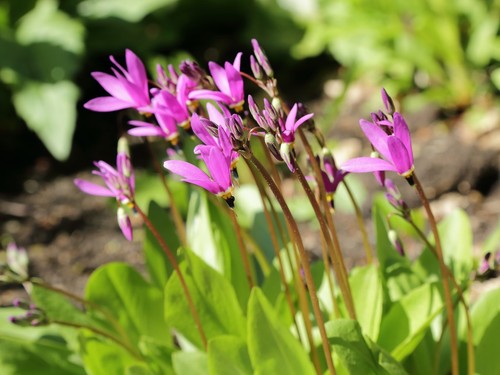
How to Care for Shooting Star
Grow the delicate native wildflower Shooting Star with this guide to light, spring moisture, summer dormancy, and woodland-garden care.
Shooting Star Identification Guide
Identify Shooting Star by its swept-back petals and forward-pointing dark beak that make each flower look like a falling meteor, rising on leafless stalks above a basal rosette.