
Siberian Bugloss Identification Guide
Identify Brunnera macrophylla by its big heart-shaped leaves and sprays of tiny blue forget-me-not flowers.
Read the full Siberian Bugloss encyclopedia entry →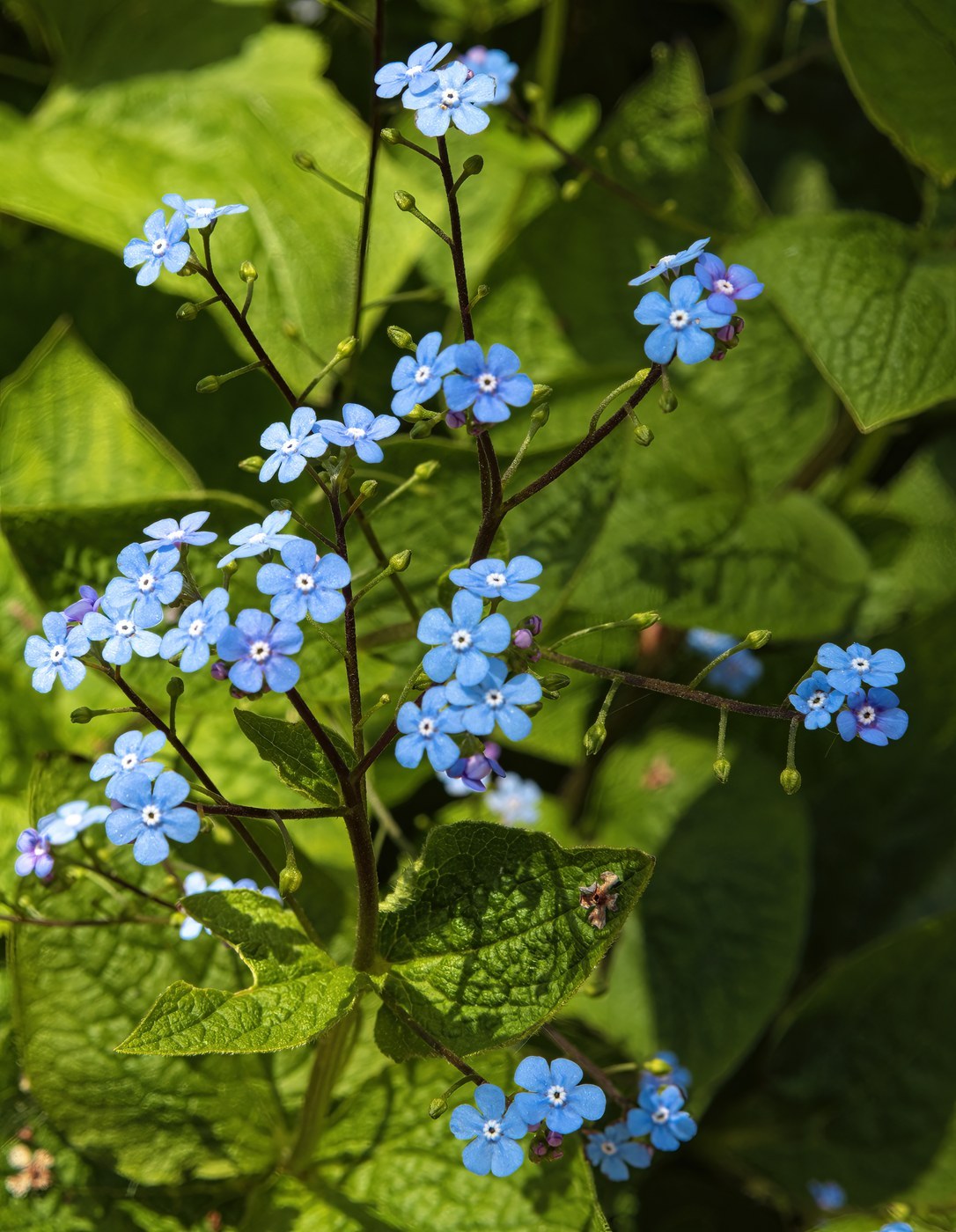
Key Identifying Features
Siberian bugloss (Brunnera macrophylla) is a shade-loving perennial often grown for both flower and foliage. Look for:
- Large, heart-shaped basal leaves, sometimes silver-frosted or variegated
- Airy sprays of tiny sky-blue, forget-me-not-style flowers in spring
- A mounded, clumping habit about 1-1.5 ft tall and wide
- A slightly rough, hairy texture to leaves and stems
Leaves & Stems
The bold heart-shaped (cordate) leaves are the standout feature: 3-8 in across, with a pointed tip, prominent veins, and a rough, slightly bristly surface. They are borne on long stalks from a basal clump. In wild plants they're plain green, but popular cultivars show silver overlay ('Jack Frost', 'Looking Glass') or cream variegation ('Variegata'). The leaves enlarge after flowering. Flower stems are slender, branching, and hairy, rising above the foliage.
Flowers & Fruit
Blooming in early to mid-spring, the flowers are tiny (about 1/4 in), five-lobed, and bright sky-blue with a small white/yellow eye — virtually identical to true forget-me-nots. They are carried in loose, branching, airy sprays (cymes) held just above the emerging leaves. The effect is a delicate blue haze over bold foliage. Seeds form small, rough nutlets. Unlike annual forget-me-nots, Brunnera is a long-lived perennial.
How to Tell It Apart from Look-Alikes
- True forget-me-not (Myosotis) — nearly identical flowers, but Myosotis has small, narrow, oblong leaves, not big heart-shaped ones; Brunnera's foliage is much larger and bolder.
- Hosta — similar heart-shaped leaf shape and shade habit, but hosta leaves are smooth/waxy and flowers are tubular lavender/white on tall spikes.
- Bergenia — bold rounded leaves, but thick, glossy, and evergreen with pink flower clusters.
- Anchusa / borage relatives — blue flowers, but lack the broad heart-shaped basal foliage.
The combination of big rough heart-shaped leaves plus forget-me-not blue sprays confirms Siberian bugloss.
Where You'll Find It
Native to woodlands of the Caucasus and Western Siberia, it thrives in moist, shady, woodland conditions. In gardens it's a top groundcover and edging plant for shade and woodland borders, valued for season-long foliage. Look for its blue spring haze in dappled shade.
Quick ID Checklist
- Large, rough, heart-shaped basal leaves (often silver or variegated in cultivars)
- Mounded clump ~1-1.5 ft tall
- Airy sprays of tiny sky-blue forget-me-not flowers in spring
- Flowers with a small pale eye
- Moist, shaded habitat
Big heart-shaped leaves under a cloud of little blue flowers in shade is Siberian bugloss.
Frequently asked questions
Is Siberian bugloss a forget-me-not?
It's a close relative with nearly identical blue flowers, but it's a long-lived perennial with large heart-shaped leaves, unlike the small-leaved annual or biennial Myosotis.
Why do some plants have silver leaves?
Wild Brunnera has plain green leaves, but popular cultivars like 'Jack Frost' have silver frosting or variegation bred for foliage interest in shade gardens.
When does it bloom?
Early to mid-spring, producing airy sprays of tiny sky-blue flowers above the emerging foliage.
Where does it grow best?
In moist, shaded woodland conditions, matching its native Caucasus and Siberian forest habitat; it's prized as a shade groundcover.