
Silver Fir Identification Guide
How to identify European silver fir (Abies alba) by its flat, white-banded needles, upright disintegrating cones, and tall straight trunk. Covers needles, bark, cones, and look-alikes.
Read the full Silver Fir encyclopedia entry →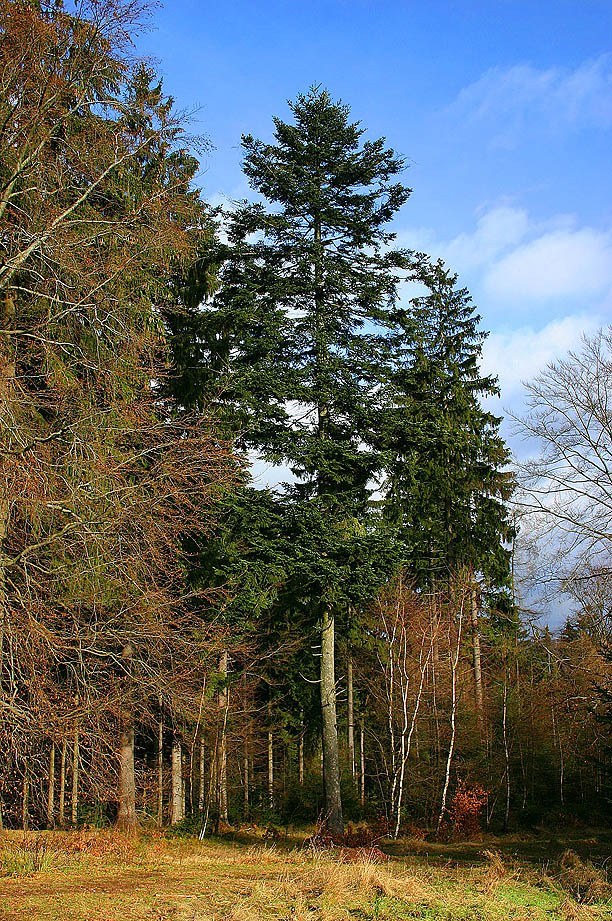
Key Identifying Features
European silver fir (Abies alba) is a tall, stately conifer of mountain forests, named for the two silvery-white bands on the underside of each needle. Its flat needles spread in two ranks and its cones stand upright and break apart on the tree, both classic true-fir traits.
- Flat needles with a notched tip, spread in two flattish rows
- Two bright white bands beneath each needle
- Smooth grey ('silver') bark with resin blisters
- Upright cones that disintegrate on the branch
Leaves & Stems
Needles are 2–3 cm long, flat and flexible, dark glossy green above with a faint groove, and the underside shows two conspicuous white stomatal bands. The tip is blunt and distinctly notched (emarginate)—a good feature separating it from spruce. Needles are arranged in two horizontal rows (combed) on either side of the shoot, often with a parting along the top. They attach by flat, round, sucker-like bases leaving smooth circular scars when pulled—so fir shoots feel smooth, unlike the rough pegs of spruce. Young shoots are greyish and minutely hairy; buds are blunt and not resinous (or only slightly so).
Flowers & Fruit
Cones are large, upright, cylindrical, 10–18 cm long, greenish then reddish-brown, with the bract scales conspicuously exserted and bent downward giving a 'mouse-tail' look. They sit erect on the upper branches and, like all firs, fall apart on the tree, scattering scales and leaving a central spike. You will not find whole cones on the ground.
How to Tell It Apart from Look-Alikes
- Spruce (Picea): Sharp four-sided needles on woody pegs; cones hang down and fall whole. Silver fir has flat, notched needles on smooth scars and upright cones.
- Nordmann fir (A. nordmanniana): Very similar; Nordmann needles are denser, longer, point forward over the shoot, and the white bands are less pronounced.
- Douglas fir (Pseudotsuga): Has soft needles too but distinctive pendulous cones with three-pronged bracts and pointed buds.
- Grand fir (A. grandis): Needles of two distinct lengths in flat rows; crushed foliage smells strongly of orange/citrus.
Where You'll Find It
Native to the mountains of central and southern Europe (Alps, Pyrenees, Carpathians, Balkans), forming tall forests up to 1,800 m. Widely planted for timber and historically as a Christmas tree. Look for a very tall, straight trunk with a flat or stork's-nest top in old age and smooth silver-grey bark.
Quick ID Checklist
- Flat needles with a notched tip
- Two white bands on the needle underside
- Needles combed into two flat rows
- Smooth grey bark with resin blisters
- Large upright cones that shatter on the tree
- Smooth round leaf scars (no pegs)
A tall mountain conifer with flat, white-backed, notched needles and erect disintegrating cones is silver fir.
Frequently asked questions
How do I tell silver fir from a spruce?
Silver fir has flat, soft needles with notched tips and two white bands beneath, attached by smooth round scars, plus upright cones that break apart on the tree. Spruces have sharp four-sided needles on woody pegs and hanging cones that fall whole.
Why is it called silver fir?
The name comes from the silvery-grey smooth bark and the two bright white stomatal bands on the underside of each needle, which give the foliage a silvery sheen.
How do I separate silver fir from Nordmann fir?
They are close relatives, but Nordmann fir needles are denser, longer, and sweep forward to cover the top of the shoot, with less obvious white banding than silver fir.
Why can't I find whole silver fir cones on the ground?
Like all true firs, its upright cones disintegrate on the branch, scattering individual scales and leaving an upright central spike, so intact cones are almost never found below the tree.