
Silver Pothos Identification Guide
Identify Silver Pothos (Scindapsus pictus) by its thick, matte heart-shaped leaves splashed with shimmering silver markings and its trailing vine habit.
Read the full Silver Pothos encyclopedia entry →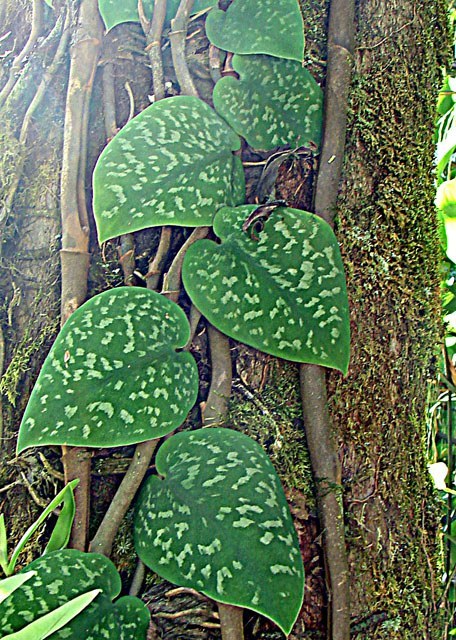
Key Identifying Features
Silver Pothos, also called Satin Pothos, is botanically Scindapsus pictus — not a true Epipremnum pothos. You identify it by thick, slightly puckered, matte heart-shaped leaves that are deep blue-green and overlaid with metallic silver-grey blotches and a silvery edge. The leaf surface has a soft, velvety sheen rather than a glossy one.
- Asymmetric heart-shaped leaves with a pointed tip
- Silver variegation: irregular splashes plus a fine silver rim
- Matte, almost suede-like texture
- Trailing or climbing vine with a single leaf per node
Leaves & Stems
Leaves are 7–15 cm long, leathery and slightly raised between the veins, giving a gently quilted look. The base is unevenly heart-shaped (one lobe larger than the other). Stems are thin, green and trail or climb by clinging aerial roots; nodes are spaced a few centimeters apart. The popular cultivar 'Exotica' has larger leaves with bigger silver patches, while 'Argyraeus' shows smaller leaves with crisp silver edges. New growth unfurls a brighter, almost mint-silver before darkening.
Flowers & Fruit
Indoors it essentially never flowers. In tropical habitat, mature climbing plants can produce the typical aroid inflorescence — a small spathe-and-spadix — but this is virtually never seen in cultivation, so flowers are not a useful ID feature.
How to Tell It Apart from Look-Alikes
- vs. true pothos (Epipremnum aureum): golden pothos has glossy, thinner leaves with yellow or cream variegation, not the matte silver of Scindapsus
- vs. Scindapsus treubii 'Moonlight': similar matte leaf but with an overall silvery sheen and little blotching
- vs. Philodendron: philodendrons have smooth-glossy leaves and a different (sheathed) new-growth habit; Scindapsus leaves are stiffer and silver-speckled
- vs. Scindapsus 'Silver Lady'/'Silvery Ann': heavier near-full silver coverage versus pictus's spotted pattern
Where You'll Find It
Almost always seen as a houseplant in hanging baskets or on shelves where its trailing vines can cascade. Native to Southeast Asia (India to Indonesia), it grows in humid forests, climbing tree trunks toward the light.
Quick ID Checklist
- Thick, matte, slightly quilted heart-shaped leaves
- Metallic silver blotches plus a silver leaf edge
- Asymmetric leaf base (lobes uneven)
- Trailing/climbing vine, one leaf per node
- Velvety (not glossy) surface — key vs. golden pothos
Frequently asked questions
Is Silver Pothos a real pothos?
No. It is Scindapsus pictus, a separate genus from the true pothos (Epipremnum aureum), though both are trailing aroids and share the common name.
How do I tell Silver Pothos from golden pothos?
Silver Pothos has thick, matte, suede-textured leaves with silver markings. Golden pothos has thinner, glossy leaves with yellow or cream variegation.
Will the silver markings appear on every leaf?
Yes, the silver blotching is a natural and consistent feature of Scindapsus pictus, though brighter light produces more pronounced silver.
Why are my Scindapsus leaves smaller than pictures online?
Leaf size depends on support and maturity. Climbing up a moss pole produces larger, more heavily variegated leaves; trailing plants stay smaller.