
Sitka Spruce Identification Guide
Recognize Sitka Spruce (Picea sitchensis) by its sharp, flattened, two-toned needles, papery pendulous cones, and coastal rainforest habitat.
Read the full Sitka Spruce encyclopedia entry →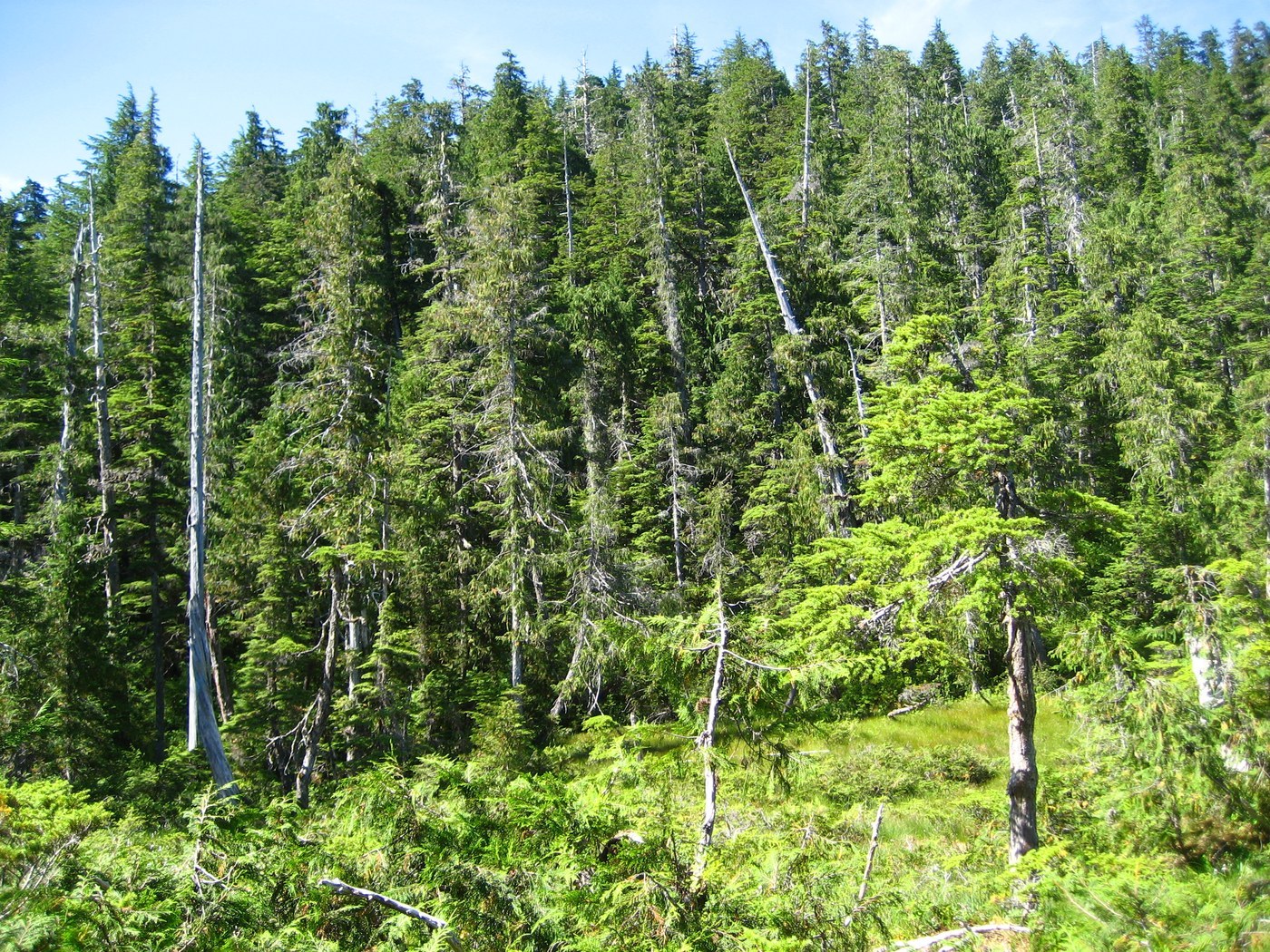
Key Identifying Features
Sitka Spruce (Picea sitchensis) is the world's largest spruce, a towering conifer of the Pacific Northwest coastal rainforest, reaching 150-200+ ft. Key clues are its very sharp, stiff needles that are flattened (not square), a distinctly two-toned look from blue-white bands beneath, and papery, hanging cones.
- Massive, straight trunk with a buttressed base
- Sharp, prickly needles set on tiny woody pegs (sterigmata)
- Thin, scaly, purplish-gray bark that flakes in rounded plates
- Conical crown, often broad and open in old trees
Leaves & Stems
Needles are 0.6-1 inch long, stiff, and end in a sharp, painful point. Unlike most spruces with four-sided needles, Sitka needles are somewhat flattened, dark green and shiny on top with two bright blue-white stomatal bands beneath, giving the foliage a silvery two-toned appearance. Needles attach singly to small woody pegs, so twigs feel rough after needles drop — a classic spruce trait. Twigs are hairless and pale brown.
Flowers & Fruit
Sitka Spruce is a conifer reproducing by cones. Pollen cones are reddish; young seed cones are reddish-purple, ripening to pale yellow-brown. Mature cones are 2-4 inches long, cylindrical, and hang downward. The cone scales are thin, papery, and irregularly toothed at the tip with a slightly crinkled edge — a useful distinguishing feature. Cones fall whole after releasing seeds.
How to Tell It Apart from Look-Alikes
- Other spruces (e.g., White, Engelmann): those have more clearly four-sided needles and stiffer cone scales; Sitka needles are flatter and exceptionally sharp.
- Western Hemlock: soft, blunt, short needles of varying length and small cones — easily separated by feel.
- Douglas-fir: soft needles and cones with three-pointed bracts sticking out.
- Grand Fir: flat, blunt, non-prickly needles attached by suction-cup bases, not pegs.
Roll a needle: if it is flat, two-toned, and stabs your fingers, and the twig has peg-like bumps, it is Sitka Spruce.
Where You'll Find It
A narrow coastal range from Alaska down through British Columbia, Washington, and Oregon to northern California — almost always within the fog belt close to the ocean. It dominates temperate rainforests, tolerating salt spray, and grows on moist, well-drained slopes and floodplains.
Quick ID Checklist
- Very sharp, stiff needles that prick the hand
- Needles flattened with blue-white bands beneath (two-toned)
- Rough twigs with woody pegs
- Hanging cones with thin, papery, crinkled scales
- Coastal Pacific Northwest fog belt
A painfully prickly, two-toned spruce by the northern Pacific coast is almost certainly Sitka Spruce.
Frequently asked questions
How can I tell Sitka Spruce from other spruces?
Sitka needles are flattened rather than square in cross-section and are exceptionally sharp, with two bright blue-white bands underneath. Its cones also have thin, papery, crinkly scales.
Why are the twigs rough after needles fall?
Like all spruces, Sitka needles attach to tiny woody pegs (sterigmata) that remain on the twig after the needle drops, leaving a sandpapery surface.
Where does Sitka Spruce grow?
It is restricted to a narrow strip of cool, moist coastal rainforest from Alaska to northern California, almost always within reach of ocean fog and salt spray.
How do I distinguish it from Western Hemlock growing alongside it?
Hemlock needles are soft, blunt, short and of uneven length with tiny cones, while Sitka Spruce needles are stiff, sharp and uniform. A quick squeeze of a branch tells them apart instantly.