
Smokebush Identification Guide
How to identify smokebush by its rounded blue-green or purple leaves and the smoky haze of fluffy flower stalks in summer.
Read the full Smokebush encyclopedia entry →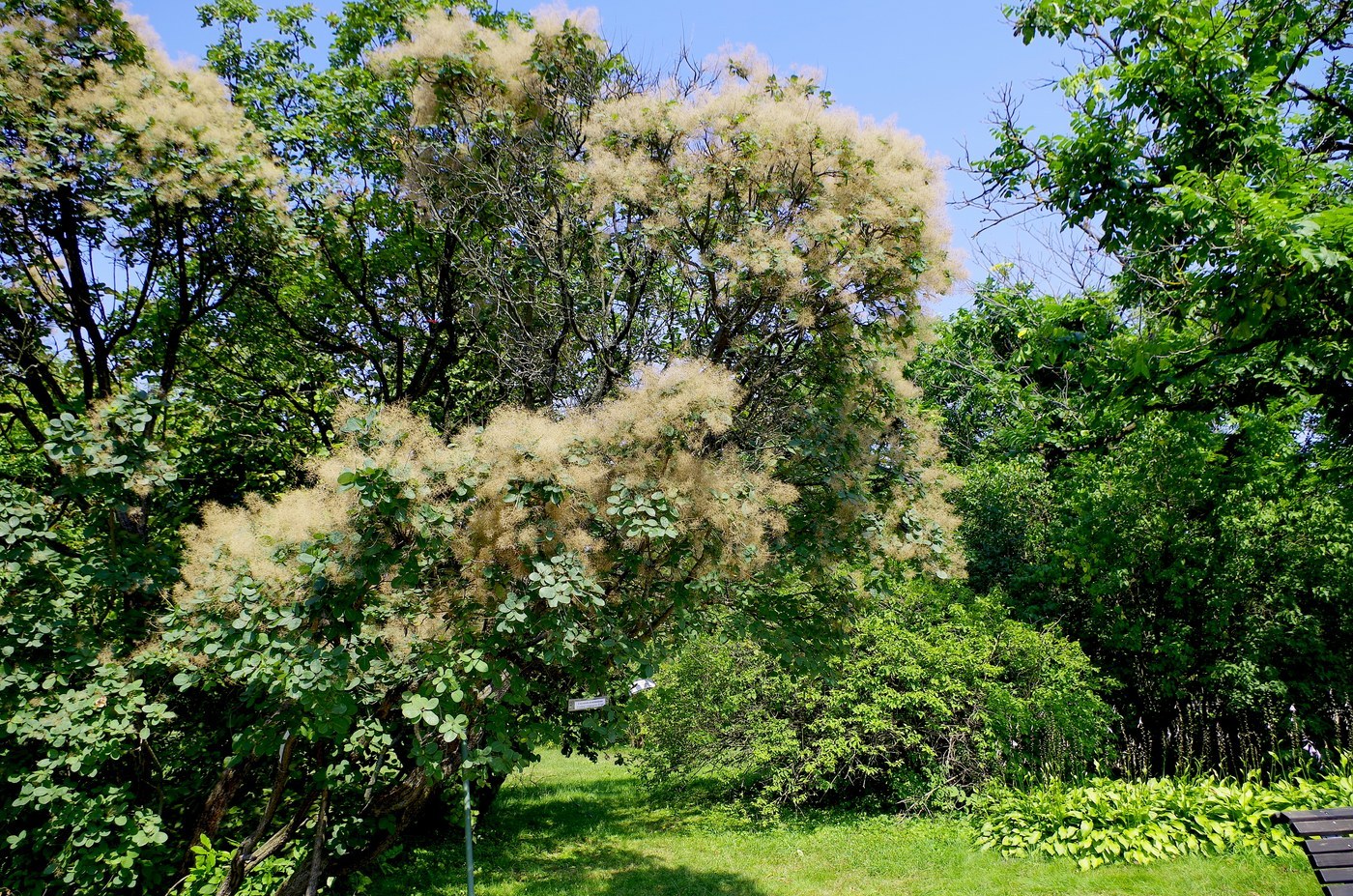
Key Identifying Features
Smokebush, or smoketree (Cotinus coggygria and C. obovatus), is a deciduous shrub or small tree famous for the billowy, smoke-like haze that envelops the plant in summer. The 'smoke' is not flowers but masses of feathery, hairy flower stalks. Identify it by its rounded oval leaves, the smoky plumes, and brilliant fall color. Crushed stems and leaves give off a faint resinous, mango-like scent (it's in the cashew family).
- Smoky pink, purple, or tan plumes of fuzzy flower stalks in summer
- Rounded to oval (obovate) leaves, blue-green or deep purple
- Multi-stemmed shrub, 10-15 ft
- Vivid orange-red-purple fall foliage
Leaves & Stems
Leaves are simple, alternate, broadly oval to nearly round (obovate), 1.5-3 inches long, with smooth margins and a slightly notched or rounded tip and prominent veins. Color is a key cultivar clue: species type is blue-green, while popular cultivars ('Royal Purple', 'Velvet Cloak', 'Grace') are deep wine-purple. In autumn the foliage turns spectacular shades of scarlet, orange, and purple. Twigs are smooth; cut stems may show an orange-tinged interior and faint turpentine-like smell.
Flowers & Fruit
The actual flowers, in early summer, are tiny, yellowish-green, and inconspicuous in loose airy clusters (panicles). What creates the 'smoke' is that most flower stalks are sterile and elongate, becoming covered in fine hairs, forming fluffy plumes of pink, purplish, or smoky-gray fuzz 6-8 inches long that drift over the shrub for weeks. Tiny kidney-shaped fruits (drupes) develop on the few fertile flowers. The smoky haze is unmistakable and unlike any common look-alike.
How to Tell It Apart from Look-Alikes
- Sumacs (Rhus, related): have pinnately compound leaves and dense upright red fruit clusters, not single rounded leaves or smoky plumes.
- Redbud: heart-shaped leaves and pea flowers, no smoke plumes.
- Purple-leaf shrubs (purple ninebark, purple barberry): lack the airy smoke and have lobed/spiny features.
- Fringe tree: has true white fringe-flowers, but opposite leaves and no fuzzy plumes.
The smoky summer plumes plus simple rounded leaves are diagnostic.
Where You'll Find It
Cotinus coggygria is native to southern Europe and Asia and widely planted in gardens; American smoketree (C. obovatus) grows wild on rocky limestone soils in parts of the south-central U.S. Both prefer full sun and well-drained soil and are valued as specimen shrubs for their summer smoke and fall color.
Quick ID Checklist
- Multi-stemmed deciduous shrub/small tree
- Smoky pink/purple/gray fuzzy plumes in summer
- Simple, alternate, rounded oval leaves (blue-green or purple)
- Brilliant orange-red-purple fall color
- Faint resinous scent in crushed stems
Frequently asked questions
What is the 'smoke' on a smokebush?
It's not flowers or seeds but masses of fine hairs that develop on the elongated, mostly sterile flower stalks after the tiny true flowers fade. These hairy plumes create a soft, smoky haze around the plant for weeks in summer.
How do I tell smokebush from sumac?
Smokebush has simple, rounded single leaves and smoky flower plumes, while sumacs (its relatives) have feather-like compound leaves and dense, cone-shaped clusters of red fruit. The leaf type is the quickest difference.
Why didn't my purple smokebush smoke this year?
Hard pruning to keep purple foliage compact removes the wood that would flower, so heavily coppiced plants produce little smoke. Smoke also varies by cultivar and is sparser on some purple-leaf forms.