
Snowbell Tree Identification Guide
Recognize the Japanese snowbell (Styrax japonicus) by its rows of small, bell-shaped white flowers dangling beneath horizontal branches in late spring.
Read the full Snowbell Tree encyclopedia entry →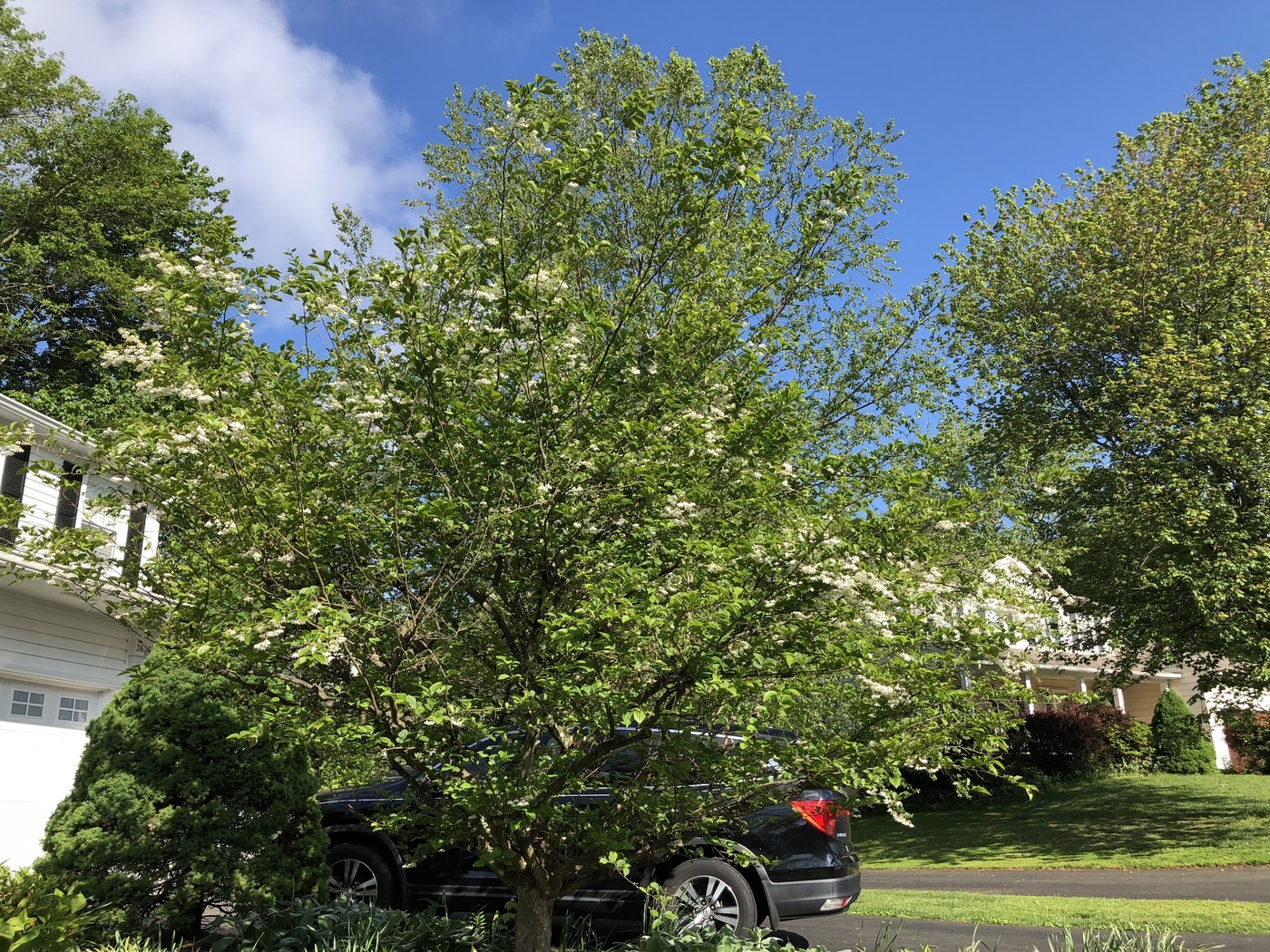
Key Identifying Features
The snowbell tree, usually the Japanese snowbell (Styrax japonicus), is a small, graceful deciduous tree grown for its display of pendant, bell-shaped white flowers hanging in neat rows beneath spreading branches. The effect is best appreciated by standing under the tree and looking up.
- Size & form: 20–30 ft tall, with a wide, layered, horizontally spreading crown, often as wide as tall.
- Bark: Smooth, gray-brown, developing attractive orange-brown fissures with age—a nice winter feature.
Leaves & Stems
Leaves are simple, alternate, oval to elliptical, 2–4 inches long, with a pointed tip and finely toothed or nearly smooth margins. They are glossy dark green, held more or less along the tops of the branches, which helps the flowers show clearly below. Fall color is modest yellow. The branching is distinctly horizontal and tiered, a key habit clue.
Flowers & Fruit
- Flowers (late spring–early summer): Lightly fragrant, bell- or star-shaped white flowers about ¾ inch across, with 5 (sometimes 6–7) petals that flare back, and a cluster of yellow stamens in the center. They dangle on slender stalks in clusters of 3–6 along the undersides of the branches—the defining display. Pink-flowered cultivars exist ('Pink Chimes').
- Fruit: Small, egg-shaped grayish drupes that hang on thin stalks after the flowers, ripening into hard capsules.
How to Tell It Apart from Look-Alikes
- Silverbell (Halesia): A relative with similar hanging white bells, but Halesia flowers are more bell-tube shaped and it produces distinctive winged seed pods.
- Fringe tree (Chionanthus): Has feathery, strap-petaled white flowers, not neat bells.
- Dogwood (Cornus): Flat showy bracts, not dangling bells.
- Mock orange (Philadelphus): A shrub with upward-facing flowers.
- Diagnostic: small bell-shaped white flowers dangling in rows under horizontal branches + alternate toothed leaves.
Where You'll Find It
Native to Japan, Korea, and China, the Japanese snowbell is planted as an ornamental specimen and patio tree in temperate gardens (USDA 5–8). It prefers part shade to full sun, moist, well-drained, slightly acidic soil, and shelter from harsh wind. It's often sited near patios or paths where its hanging flowers can be viewed from below.
Quick ID Checklist
- Small tree, wide horizontally tiered crown
- Alternate, glossy, finely toothed oval leaves
- Bell-shaped white 5-petaled flowers dangling in rows beneath branches
- Yellow stamen cluster in each flower
- Small hanging drupes; smooth fissured bark
Frequently asked questions
Why are the snowbell's flowers easy to miss?
They hang downward on the undersides of the branches while the leaves sit on top, so the best way to see them is to stand under the tree and look up into the canopy.
How is a snowbell different from a silverbell tree?
Both have hanging white bell flowers and are related, but snowbell (Styrax) has flatter, flaring star-bell flowers and round drupes, while silverbell (Halesia) has tubular bells and distinctive winged seed pods.
Are there pink-flowered snowbells?
Yes. While the species has white flowers, cultivars such as 'Pink Chimes' produce soft pink bells with the same dangling habit.
Where should I plant a Japanese snowbell?
Choose a spot with moist, well-drained, slightly acidic soil in full sun to part shade, sheltered from drying wind. Siting it near a patio or path lets you enjoy the downward-facing flowers.