
Soapwort Identification Guide
Identify soapwort (Saponaria officinalis) by its smooth paired leaves with three prominent veins and clusters of fragrant pale pink five-petaled flowers.
Read the full Soapwort encyclopedia entry →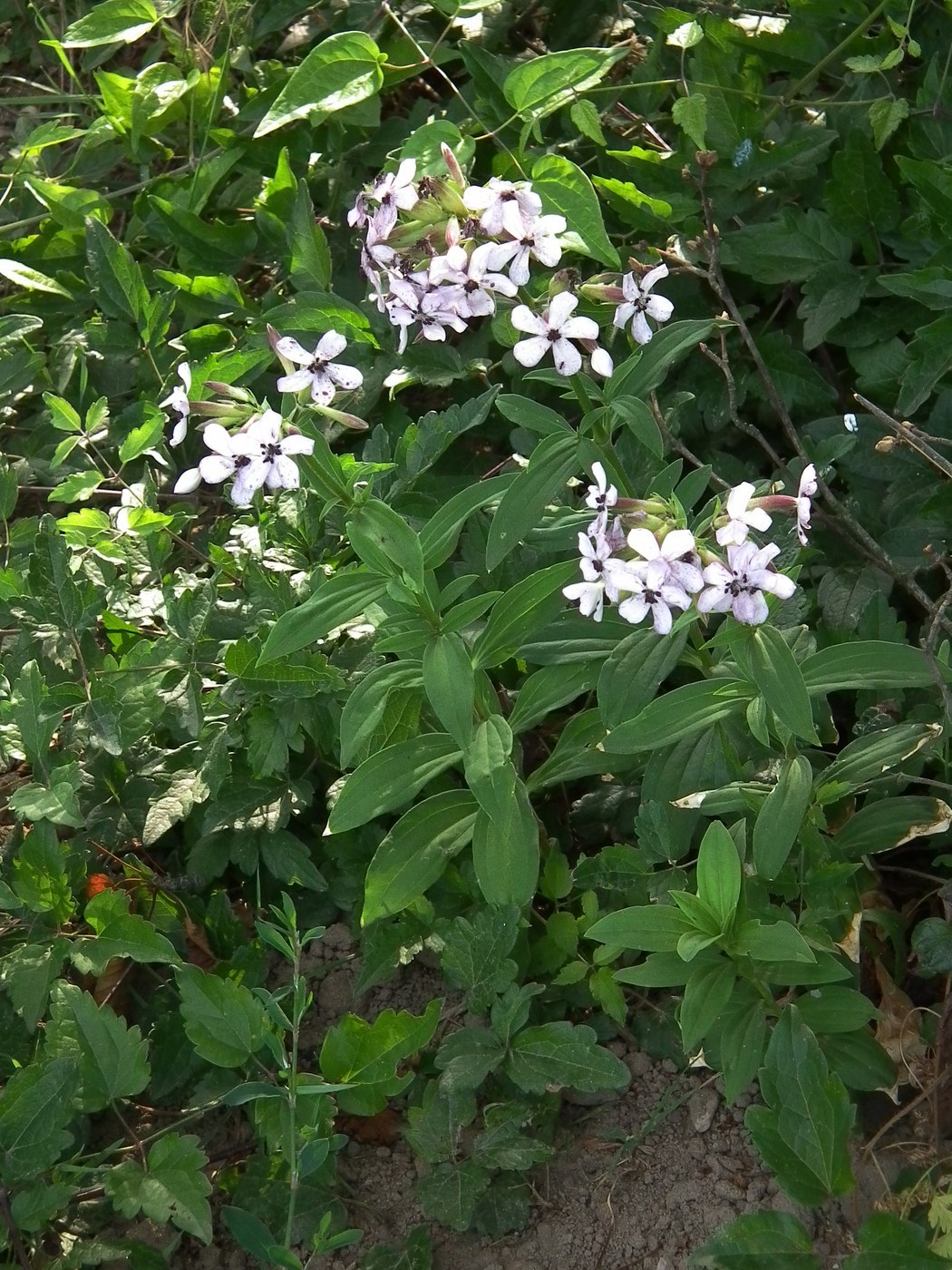
Key Identifying Features
Soapwort (Saponaria officinalis) is a spreading perennial recognized by its smooth, opposite, three-veined leaves and loose clusters of pale pink to white, five-petaled flowers that smell sweet in the evening. Crushed leaves rubbed in water produce a slippery soapy lather, the trait behind its name.
- Upright leafy stems 1-3 ft (30-90 cm) tall
- Spreads aggressively by underground runners, forming patches
- Slightly swollen stem nodes
Leaves & Stems
Leaves are opposite, oval to lance-shaped, smooth (hairless), and 2-4 in (5-10 cm) long, with three to five prominent veins running lengthwise - a key feature. They taper to a point and clasp the stem at the base. Stems are stout, often reddish at the nodes, smooth, and only branch near the top. The plant frequently grows in dense colonies from spreading rhizomes, so you usually see a patch rather than a single plant.
Flowers & Fruit
From summer into early autumn, soapwort bears terminal clusters of showy flowers. Each is about 1 in (2.5 cm) across with five flat or notched petals, pale pink fading to white, sometimes with double forms in garden escapes. The petals emerge from a long tubular calyx about 3/4 in long. Flowers are sweetly scented, especially in evening, attracting moths. The fruit is a small oblong capsule opening by teeth at the top to release many tiny seeds.
How to Tell It Apart from Look-Alikes
- Phlox: Has flat flower faces too, but petals are fused into a long narrow tube and leaves lack the three-vein pattern.
- Campions and catchflies (Silene): Related, but typically have deeply notched or fringed petals and inflated calyces.
- Bouncing bet is soapwort: Note that 'bouncing bet' is just another name for the same plant.
- The reliable cues are smooth three-veined opposite leaves, a tubular calyx, and soapy lather from crushed foliage.
Where You'll Find It
Soapwort is a Eurasian native widely naturalized along roadsides, railway embankments, riverbanks, ditches, and waste ground. It favors disturbed, moist to dry soils in full sun and often persists around old gardens and homesteads, spreading into large colonies.
Quick ID Checklist
- Smooth opposite leaves with 3-5 prominent lengthwise veins
- Crushed leaves make a soapy lather in water
- Pale pink to white 5-petaled flowers with a long tubular calyx
- Sweet evening scent
- Spreads into patches by runners
- Roadsides and disturbed moist ground in summer
Frequently asked questions
What makes soapwort easy to identify?
Its smooth, opposite leaves with three to five strong lengthwise veins, plus pale pink five-petaled flowers rising from a long tubular calyx, and the soapy lather you get when you rub crushed leaves in water.
Why is it called soapwort?
The leaves and roots contain saponins, so rubbing them in water produces a gentle soapy lather historically used for washing delicate fabrics.
Is 'bouncing bet' the same as soapwort?
Yes, bouncing bet is a common folk name for Saponaria officinalis, the same plant.
How can I tell soapwort from phlox?
Soapwort petals arise separately from a tubular calyx and its leaves have three to five distinct veins, whereas phlox has a slimmer fused flower tube and unmarked leaves.