
Solomon's Seal Identification Guide
How to identify Solomon's Seal (Polygonatum) by its gracefully arching unbranched stems, alternate ribbed leaves, and pairs of greenish-white bell flowers dangling beneath.
Read the full Solomon's Seal encyclopedia entry →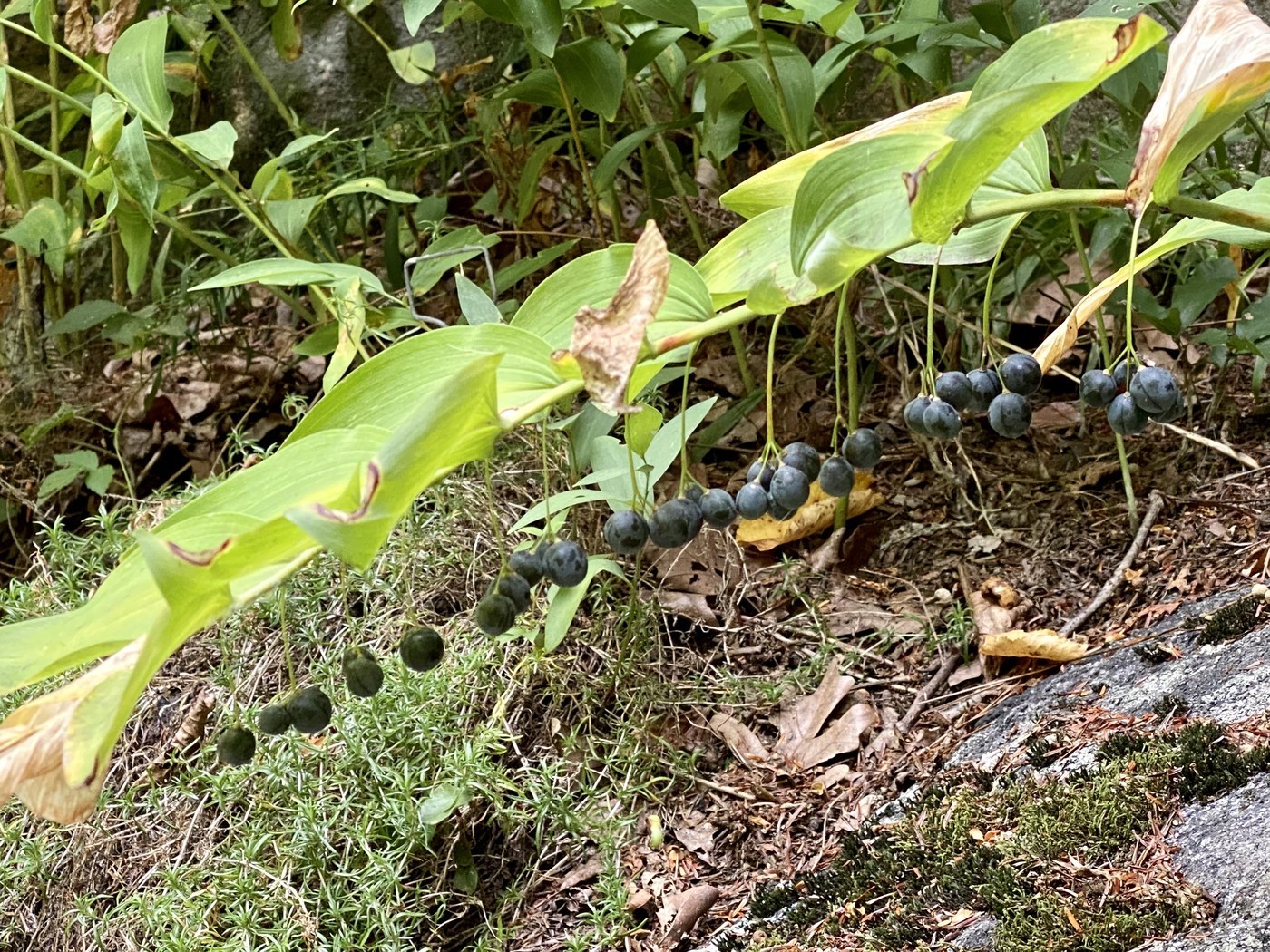
Key Identifying Features
Solomon's Seal (Polygonatum) is a woodland perennial with an elegant, unmistakable form: a single, gracefully arching stem lined with neat ribbed leaves, and small greenish-white bell-shaped flowers hanging in pairs underneath the stem. The name refers to round scars on the rhizome that resemble a wax seal.
- Arching, unbranched stems 1-5 feet long
- Flowers dangle in pairs beneath the stem
- Leaves alternate, oval, with parallel veins
- Blue-black berries in late summer
Leaves & Stems
The stem is single and unbranched, arching outward and bending under the weight of the leaves and flowers. Leaves are arranged alternately in two rows along the stem, are oval to elliptical with prominent parallel (ribbed) veins running lengthwise, smooth margins, and a pointed tip. They are usually a clean, fresh green (variegated cultivars have white leaf edges). Below ground, the thick horizontal rhizome bears circular scars, each marking a former year's stem, the "seals" of the name.
Flowers & Fruit
In late spring, small tubular, bell-shaped flowers hang down from the leaf axils, usually in pairs (sometimes 1-4), greenish-white to creamy with greenish tips. They are tucked under the arching stem, so you often have to lift it to see them. By late summer the flowers become round, dangling berries that ripen from green to dark blue-black.
How to Tell It Apart from Look-Alikes
- False Solomon's seal (Maianthemum racemosum): very similar arching leafy stem, but bears a fluffy plume of tiny white flowers at the stem TIP and red berries, not dangling paired bells along the stem.
- Solomon's plume / starry false Solomon's seal: also terminal flower clusters, not underslung bells.
- Lily of the valley (Convallaria): dangling white bells too, but on a separate leafless flower stalk beside broad basal leaves, not along an arching leafy stem.
The decisive test: true Solomon's Seal carries flowers (and berries) hanging beneath the stem in the leaf axils; false Solomon's seal carries them in a plume at the tip.
Where You'll Find It
Solomon's Seal grows in shady, moist woodlands, woodland gardens, and along shaded slopes and stream banks with rich, humusy soil. It's a favorite shade-garden plant, spreading slowly by rhizomes into graceful colonies. Look for the arching stems and hidden bell flowers in mid to late spring.
Quick ID Checklist
- Single arching, unbranched stem
- Alternate oval leaves with parallel ribbed veins
- Greenish-white bells dangling in pairs beneath the stem
- Blue-black berries in late summer
- Shady, moist woodland setting
An arching leafy stem with little bells hanging underneath (not a plume on top) is true Solomon's Seal.
Frequently asked questions
How do I tell true from false Solomon's seal?
True Solomon's seal (Polygonatum) has paired bell flowers dangling beneath the arching stem and blue-black berries, while false Solomon's seal (Maianthemum) has a fluffy plume of flowers at the stem tip and red berries.
Why is it called Solomon's seal?
The thick underground rhizome bears round, depressed scars where past years' stems were attached, resembling the impression of a wax seal, traditionally linked to King Solomon's seal.
Where does Solomon's seal grow best?
It thrives in shade to part shade in rich, moist, humusy woodland soil, making it a popular plant for shade gardens and woodland borders.