
Southern Magnolia Identification Guide
How to identify southern magnolia (Magnolia grandiflora) by its large glossy evergreen leaves and huge fragrant white flowers.
Read the full Southern Magnolia encyclopedia entry →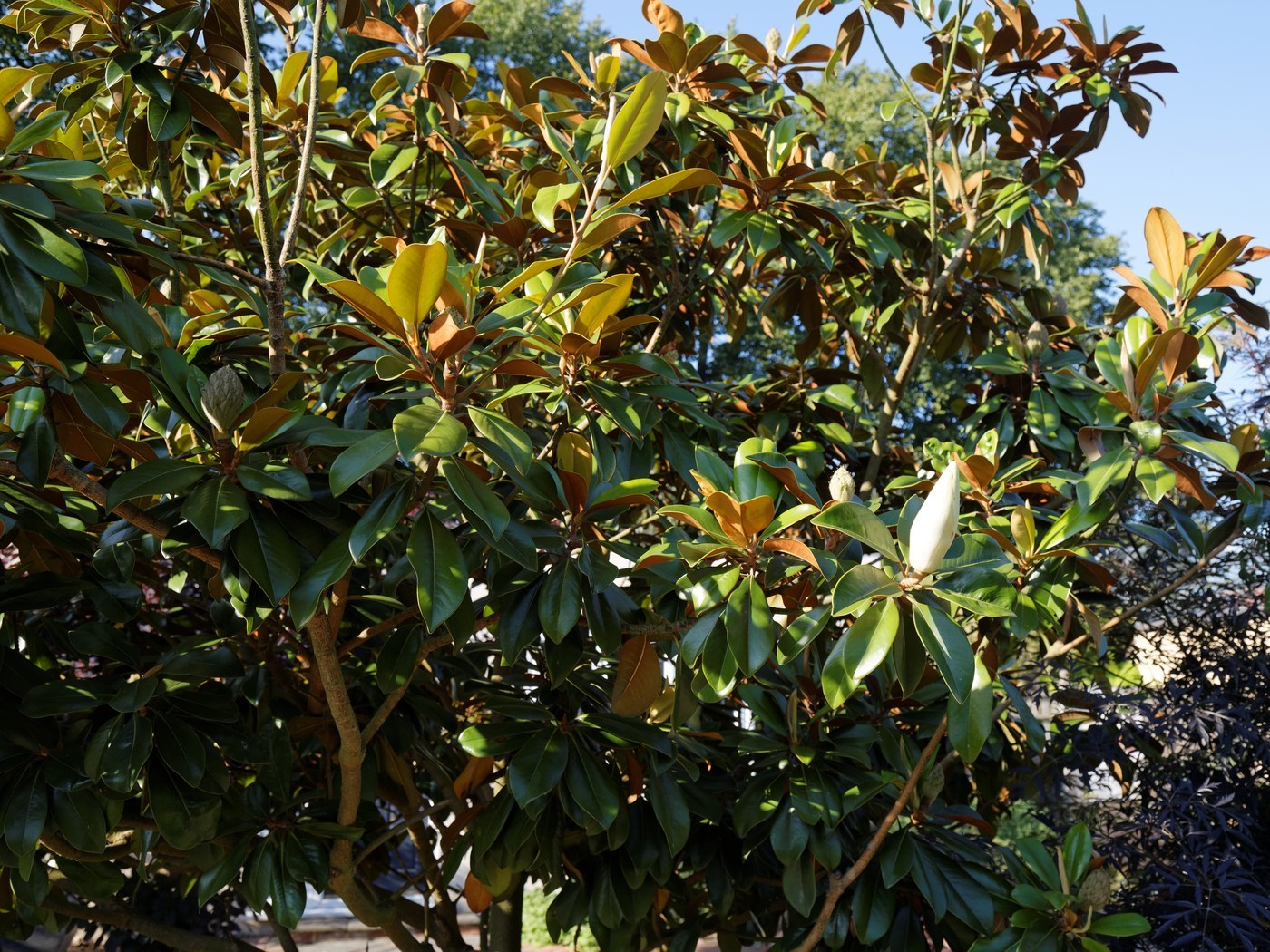
Key Identifying Features
Southern magnolia (Magnolia grandiflora) is a stately broadleaf evergreen tree of the American South, instantly recognizable by its large, leathery, glossy leaves and enormous creamy-white, lemon-scented flowers. It typically grows 60–80 feet tall with a dense, pyramidal crown that often sweeps to the ground.
- Thick, glossy, dark-green evergreen leaves with a rusty-brown felt underneath
- Huge fragrant white flowers 8–12 inches across
- Cone-like fruit that splits to reveal bright red seeds
- Smooth gray bark and a dense, low-branching crown
Leaves & Stems
The leaves are a key identifier: 5–10 inches long, oval, stiff, and leathery, with a deep glossy green upper surface and a distinctive velvety rust-brown (cinnamon) underside in many forms. They are evergreen and arranged alternately, persisting through winter and dropping gradually. Young twigs and buds are coated in the same rusty pubescence. The bark is smooth and light gray on younger trees, becoming slightly scaly with age.
Flowers & Fruit
From late spring into summer the tree bears spectacular solitary flowers, 8–12 inches across, with thick, waxy, creamy-white petals (tepals) and a powerful sweet, citrus-like fragrance. Each flower has a central cone of stamens and pistils. The flowers mature into a knobby, cone-shaped fruit that ripens reddish-brown and splits open in fall to dangle glossy scarlet seeds on thin threads.
How to Tell It Apart from Look-Alikes
The combination of large evergreen leaves with rusty undersides plus giant white flowers is diagnostic in its native range. Sweetbay magnolia (Magnolia virginiana) is similar but has thinner, smaller leaves with a silvery-white (not rust) underside and much smaller flowers, and is often semi-deciduous. Loblolly bay and bull bay confusion is resolved by the magnolia's distinctive cone fruit and red seeds. Deciduous magnolias drop all their leaves in winter, unlike this evergreen species.
Where You'll Find It
Native to the southeastern United States, from coastal Virginia and North Carolina south through Florida and west to Texas, southern magnolia grows in moist woods, bottomlands, and stream margins. It is enormously popular as an ornamental and street tree well beyond its native range and is the state flower of Mississippi and Louisiana.
Quick ID Checklist
- Leaves: large, leathery, glossy evergreen with rusty-brown underside
- Flowers: huge, creamy-white, fragrant, 8–12 inches, late spring–summer
- Fruit: knobby cone splitting to show bright red seeds
- Bark: smooth gray; dense low crown often touching the ground
- Range: southeastern U.S. woodlands and landscapes
A large tree with leathery evergreen leaves, rust-felt undersides, and dinner-plate white flowers is southern magnolia.
Frequently asked questions
How do I tell southern magnolia from sweetbay magnolia?
Southern magnolia has thick leathery leaves with a rusty-brown underside and very large flowers, and is fully evergreen. Sweetbay has thinner leaves with a silvery-white underside, smaller flowers, and is often semi-deciduous.
Are the leaf undersides always rusty brown?
Many southern magnolias have a velvety cinnamon-brown underside, but the trait varies by cultivar; some have lighter, greener undersides. Combined with the huge white flowers and evergreen habit, it remains a strong clue.
What are the red things in the cone-like fruit?
Those are the seeds. The knobby cone-shaped fruit splits open in fall to release glossy bright-red seeds that hang briefly on thin threads before dropping.
Is southern magnolia evergreen?
Yes, it is a broadleaf evergreen that keeps its leaves year-round, shedding older leaves gradually rather than all at once in autumn.