
Spanish Fir Identification Guide
How to identify Spanish fir (Abies pinsapo) by its stiff, radially arranged needles and dense, bottlebrush shoots. Covers needles, cones, bark, and comparison with other firs.
Read the full Spanish Fir encyclopedia entry →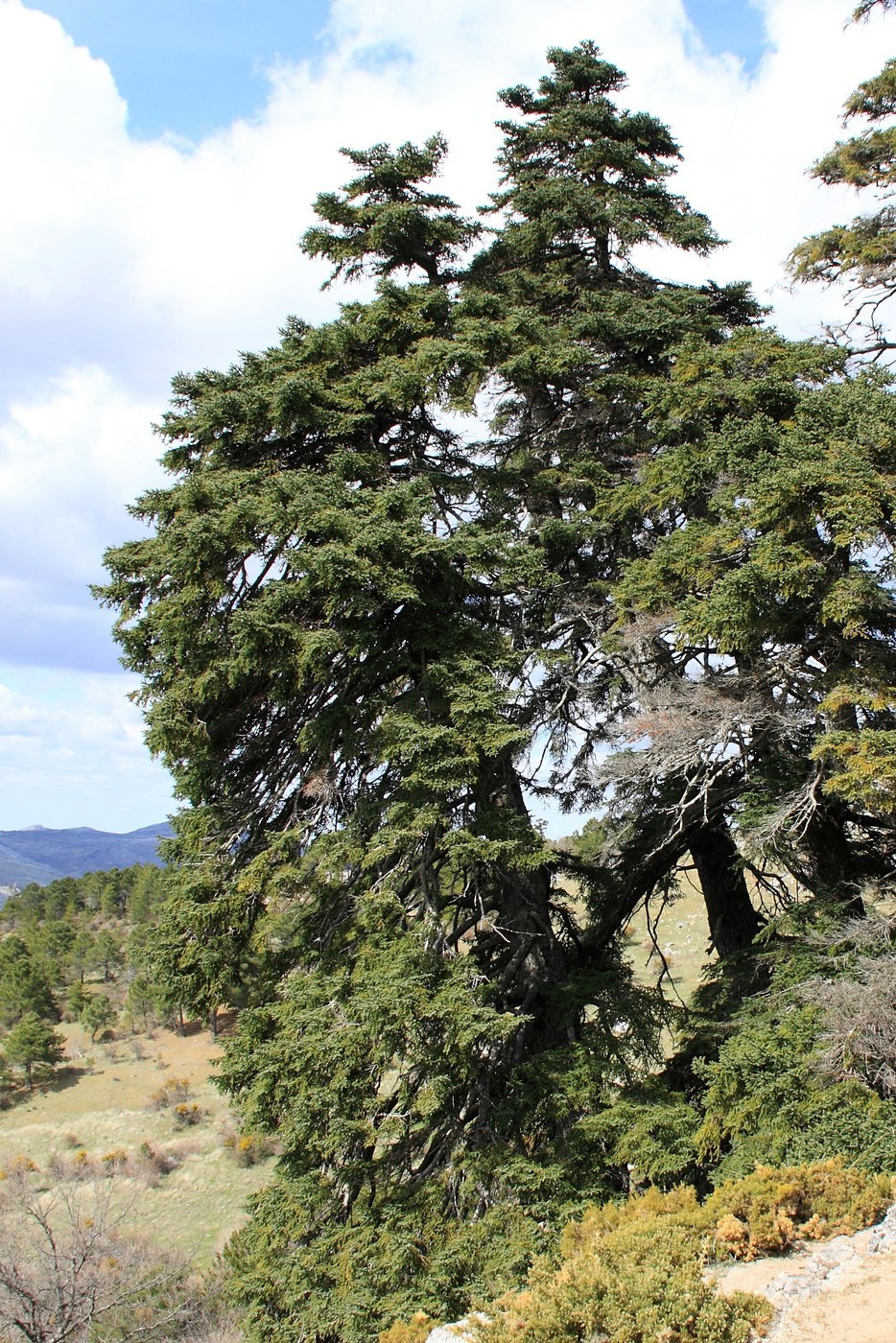
Key Identifying Features
Spanish fir (Abies pinsapo) is a distinctive Mediterranean fir instantly recognized by its stiff, short needles arranged all the way around the shoot, giving twigs a rounded, bottlebrush appearance unlike most other firs whose needles spread in two flat ranks.
- Needles radial (all around the twig), not combed flat
- Needles very short and rigid, only 1–2 cm long
- Blunt or slightly pointed tips, blue-green to grey-green color
- Dense, compact conical crown when young
Leaves & Stems
The needles are the single best clue. Each needle is short (1–2 cm), thick, stiff and curved upward, and stands out radially around the shoot like the bristles of a brush. They are grey-green to bluish-green with two pale stomatal bands on the underside and often whitish lines above as well. Crushed foliage gives a mild resinous scent. Shoots are stout and pale brown to greyish, with the circular leaf scars typical of firs (no peg-like bases). Bark is smooth and grey on young trees, becoming cracked and plated with age.
Flowers & Fruit
Like all firs, Spanish fir bears upright cones that sit on top of the branches and disintegrate on the tree rather than falling whole. Cones are cylindrical, 9–15 cm long, greenish to purplish-brown, with smooth (not exserted) bracts hidden by the scales. Male pollen cones are small, reddish, clustered on the undersides of shoots in spring. You almost never find an intact mature cone on the ground beneath a fir—only scattered scales and the central spike.
How to Tell It Apart from Look-Alikes
- Other firs (Abies): Most firs (silver fir, Nordmann, Korean) have flat-spreading needles; Spanish fir's needles radiating all around the shoot are diagnostic.
- Blue spruce (Picea pungens): Also blue and stiff, but spruce needles are four-sided, sharply pointed, and sit on woody pegs; cones hang down and fall whole.
- Cedar (Cedrus): Needles in tufted rosettes on spur shoots, not single radial needles.
- Greek fir (Abies cephalonica): Needles more spreading and spine-tipped; less perfectly radial.
Where You'll Find It
In the wild, Spanish fir is rare and restricted to a few mountain ranges in southern Spain (Andalusia), growing on limestone and dolomite slopes at 1,000–1,800 m. It is widely planted as an ornamental in parks and large gardens across temperate Europe and North America, where the blue-grey 'Glauca' selection is especially common. Look for it as a neat, dense, symmetrical specimen tree.
Quick ID Checklist
- Short (1–2 cm), stiff needles standing all around the shoot
- Grey-green to bright blue-green foliage
- Bottlebrush, rounded twig profile
- Upright cylindrical cones that break apart on the tree
- Smooth grey bark; dense conical habit
- Circular flat leaf scars (no pegs)
If you see a fir with short rigid needles radiating evenly around stout shoots and a blue cast, you are almost certainly looking at Spanish fir.
Frequently asked questions
Why do Spanish fir needles look so different from other firs?
Most firs hold their needles in two flat ranks, but Spanish fir's short, stiff needles radiate all the way around the shoot, creating a dense bottlebrush look that is its most reliable field mark.
Is Spanish fir the same as blue spruce?
No. Both can be blue, but spruce needles are sharp, four-sided, and sit on tiny woody pegs with hanging cones, while Spanish fir has blunt radial needles, smooth leaf scars, and upright cones that disintegrate on the tree.
Will I find cones on the ground under a Spanish fir?
Rarely intact. Like all true firs, the upright cones break apart on the branch, so you typically only find loose scales and a bare central spike beneath the tree.
Where does Spanish fir grow naturally?
It is native to a few limestone mountains in southern Spain (Andalusia) but is widely planted as an ornamental, especially the blue-grey 'Glauca' form.