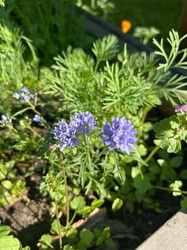
Speedwell Identification Guide
How to recognize speedwell (Veronica), from the low creeping lawn weeds to the upright spiked garden perennials, by their tiny four-lobed flowers and paired leaves.
Read the full Speedwell encyclopedia entry →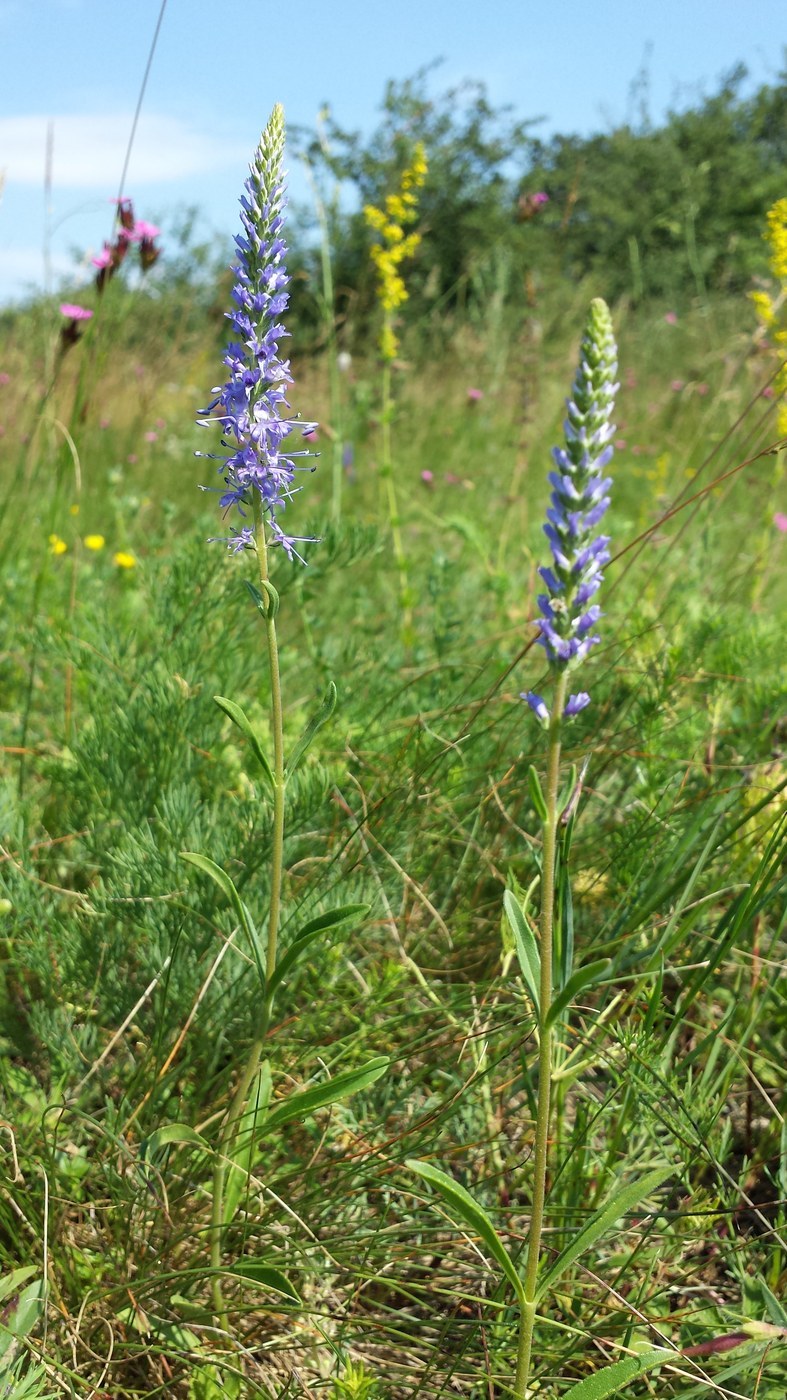
Key Identifying Features
Speedwell is the common name for Veronica, a large genus of low to medium herbs in the plantain family (Plantaginaceae). The single most reliable clue is the flower: a small, flat, four-lobed corolla (the lowest lobe usually narrower than the other three) with just two stamens that flare out to the sides like tiny antennae. Flowers are typically blue to violet, sometimes pink or white, with darker veining.
- Tiny flowers, usually under 1 cm across, with 4 unequal lobes and 2 protruding stamens
- Leaves arranged in opposite pairs (at least on the lower stem)
- Fruit a flattened, heart-shaped (notched) capsule
- Habit ranges from creeping lawn-huggers to clumps with erect flower spikes
Leaves & Stems
Leaves are small, simple, and often toothed or scalloped, ranging from rounded to lance-shaped depending on species. On creeping species (Veronica filiformis, V. persica) leaves are kidney-shaped to oval and the stems root at the nodes as they sprawl. On upright garden types (Veronica spicata, V. longifolia) leaves are narrower and lance-shaped, and the stems stand erect to bear the flower spike. Stems are slender, often with a fine line of hairs.
Flowers & Fruit
Garden spike speedwells (V. spicata) carry their flowers in a dense, slender, upward-pointing raceme that opens from the bottom up, in blue, purple, pink, or white. Weedy speedwells instead bear flowers singly in the leaf axils on thread-like stalks. After flowering, look for the characteristic flattened, two-lobed capsule, wider than tall and clearly notched at the top — a hallmark of the genus.
How to Tell It Apart from Look-Alikes
- Forget-me-not (Myosotis): also has small blue flowers, but they have 5 rounded lobes and a yellow eye, versus speedwell's 4 lobes and 2 stamens.
- Field pansy / violets: flowers are larger and bilaterally symmetric with a spur, not flat and 4-lobed.
- Ground ivy (Glechoma): has a square stem, scalloped leaves, and tubular two-lipped flowers — not the open 4-lobed disk of speedwell.
- Bittercress / chickweed: white-flowered weeds, but lack the blue 4-lobed corolla.
Where You'll Find It
Weedy speedwells (germander, slender, common field speedwell) are abundant in lawns, lawn edges, paths, and disturbed soil, often forming bright blue carpets in spring. Upright ornamental Veronica species are sold for borders and pollinator gardens and thrive in full sun with average soil. The genus is found across temperate Europe, Asia, and North America.
Quick ID Checklist
- Small flower with 4 lobes (lowest narrowest) and 2 spreading stamens
- Color usually blue/violet with darker veins
- Opposite, toothed or scalloped leaves
- Heart-shaped, flattened notched capsule fruit
- Either a creeping lawn mat or an erect flower spike
Frequently asked questions
How can I be sure a blue lawn flower is speedwell and not forget-me-not?
Count the petals and stamens. Speedwell has 4 lobes and 2 obvious protruding stamens, while forget-me-not has 5 lobes and a distinct yellow center ring.
Why is my speedwell creeping while my neighbor's stands upright?
There are many Veronica species. Lawn weeds like slender and creeping speedwell sprawl and root at the nodes, while garden ornamentals such as spike speedwell (V. spicata) grow upright with tall flower spikes.
Is speedwell the same plant in lawns and garden borders?
They are the same genus, Veronica, but different species. They share the 4-lobed flower and notched capsule, so the family resemblance holds even though the growth forms differ.
What does the seed capsule look like?
Look for a small, flattened capsule that is wider than it is tall and clearly notched (heart-shaped) at the top. This shape is a dependable genus-level identifier.
Speedwell identified by the community
Recent Speedwell specimens identified with Plant Identifier.