
Spiderwort Identification Guide
How to identify Spiderwort (Tradescantia) by its three-petaled blue-purple flowers, grass-like folded leaves, and the jelly-like threads in its broken stems.
Read the full Spiderwort encyclopedia entry →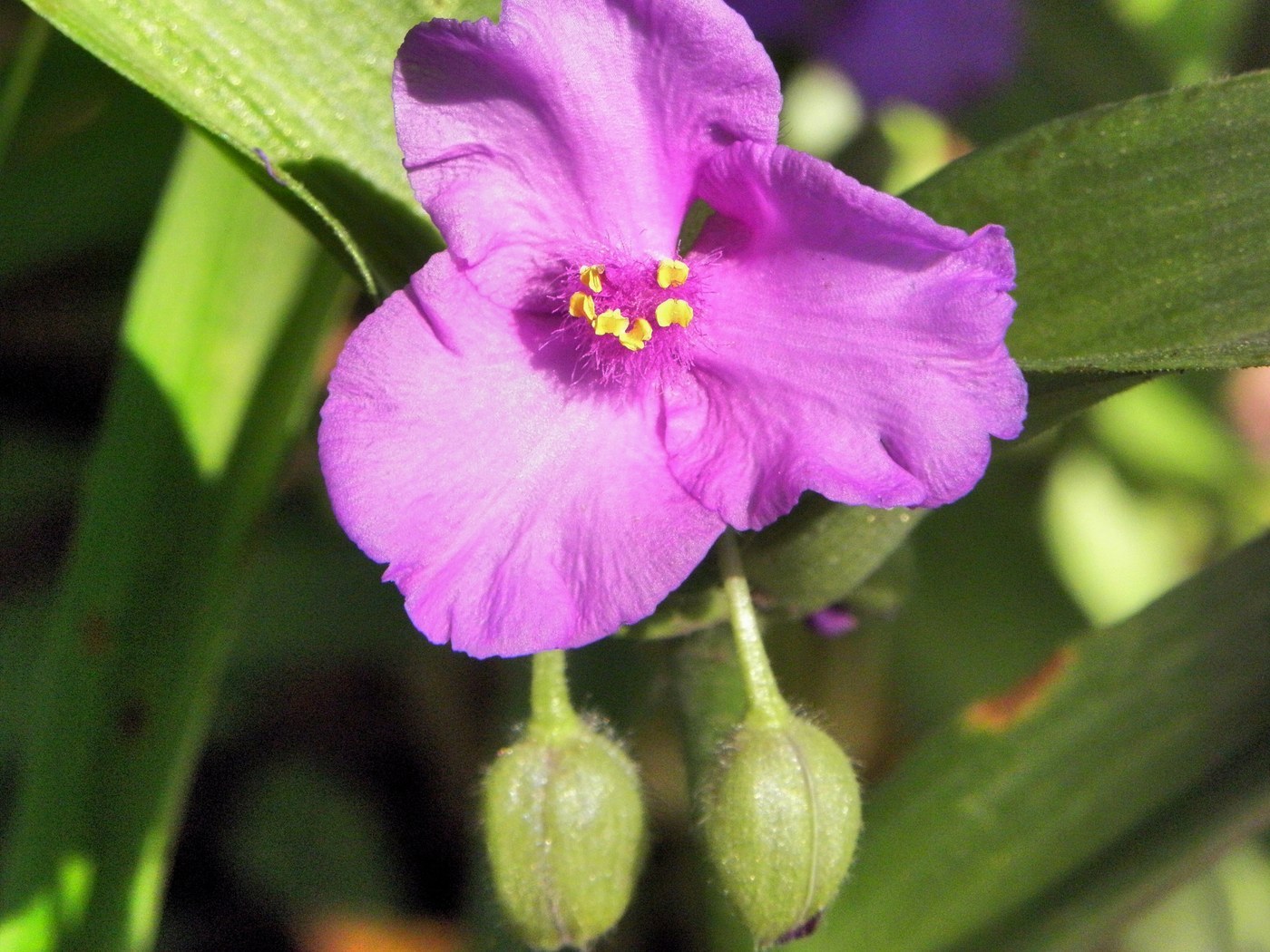
Key Identifying Features
Spiderwort (Tradescantia) is a clump-forming perennial recognized by its three-petaled flowers (usually blue, purple, or magenta) and long, grass-like, arching leaves. Each flower lasts only a day, but the plant blooms over many weeks. The genus belongs to the dayflower family (Commelinaceae).
- Three rounded petals per flower, blue to violet-purple (or pink/white)
- Fuzzy yellow stamens with hairy blue filaments at the center
- Grass-like, folded leaves clasping the stem
- Clump-forming, 1-2 feet tall
Leaves & Stems
Leaves are long, narrow, and strap- or grass-like, often folded lengthwise along a central crease (V-shaped channel) and arching gracefully. Where the leaf meets the stem it wraps around (sheathes) the stem. Stems are somewhat fleshy and jointed; when you snap one, a stretchy, mucilaginous (spider-web-like) thread of sap can be drawn out, which is the source of the name "spiderwort."
Flowers & Fruit
Flowers cluster at the stem tips, cradled by two leaf-like bracts, and open a few at a time. Each bloom has three equal, rounded petals in vivid blue, violet, magenta, or sometimes pink or white. The six stamens carry bright yellow anthers on filaments fringed with fine hairs (often blue or purple), giving the flower center a fuzzy, jeweled look. Each flower opens in the morning and wilts to a jelly-like blob by afternoon. Fruit is a small capsule.
How to Tell It Apart from Look-Alikes
- Dayflower (Commelina): same family and also blue-flowered with a one-day bloom, but dayflowers usually have two showy upper petals and one tiny lower petal (asymmetric), not three equal petals.
- Iris or daylily seedlings: similar strap leaves, but no three-petaled spiderwort flowers and no mucilaginous threads.
- Grasses and sedges: leaves look alike, but grasses never produce three-petaled purple flowers or fuzzy-filament stamens.
The three equal petals with hairy-filament stamens, grass-like folded leaves, and stretchy sap threads together are diagnostic.
Where You'll Find It
Native spiderworts grow in woodland edges, prairies, meadows, roadsides, and stream banks, and garden hybrids (Tradescantia x andersoniana) are common in borders in sun to part shade and average to moist soil. Look for the blue-purple flowers in late spring through summer, usually open only in the cooler morning hours.
Quick ID Checklist
- Three equal, rounded petals, blue/violet/magenta
- Fuzzy yellow stamens with hairy filaments at center
- Grass-like, V-folded, stem-clasping leaves
- Stretchy thread of sap from broken stems
- Each flower lasts one morning; clump-forming
A clump with grass-like folded leaves and three-petaled blue flowers that wilt by afternoon, plus sticky threads in the stem, is Spiderwort.
Frequently asked questions
Why is it called spiderwort?
When you break a stem, the sap forms thin, stretchy, web-like threads as it dries, resembling spider silk, which is one likely origin of the name.
Why do spiderwort flowers only last a day?
Each bloom opens in the morning and, by afternoon, the petals dissolve into a jelly-like fluid. The plant keeps flowering for weeks because many buds open in succession.
How do I tell spiderwort from a dayflower?
Spiderwort flowers have three equal rounded petals, while dayflowers (Commelina) typically have two large upper petals and one small lower petal, making them asymmetric.
Are spiderwort leaves like grass?
They are long, narrow, and grass-like, but they are folded lengthwise into a V and sheath the stem, and the plant produces three-petaled flowers that grasses never have.