
Spring Beauty Identification Guide
Identify Spring Beauty by its small five-petaled white-to-pink flowers with candy-stripe pink veins, its single pair of narrow grass-like leaves, and its early woodland bloom.
Read the full Spring Beauty encyclopedia entry →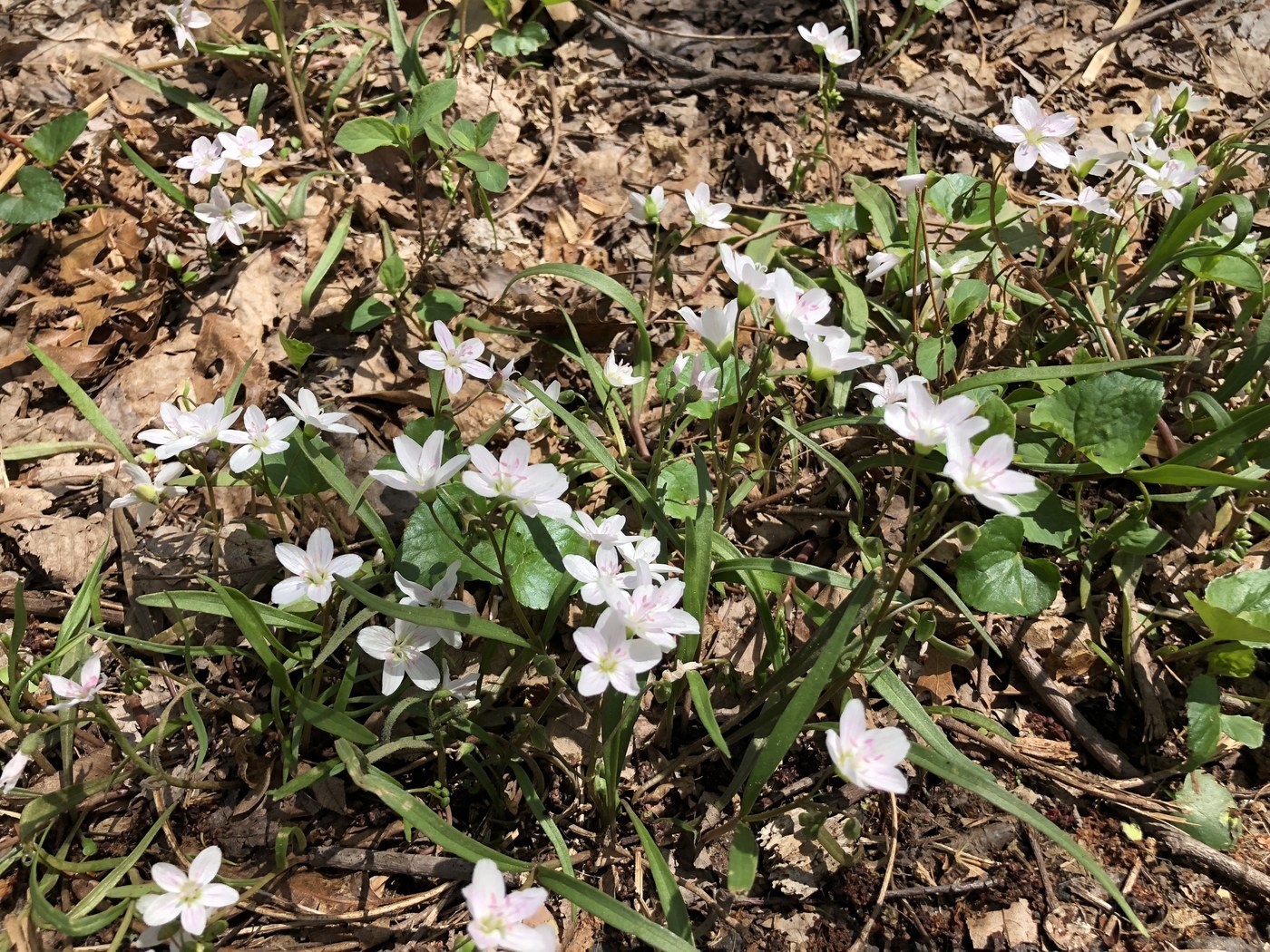
Key Identifying Features
Spring Beauty (Claytonia virginica, and the broader-leaved Claytonia caroliniana) is a tiny, charming spring ephemeral that carpets eastern North American woods and lawns in early spring. Recognize it by:
- Small flowers (about 1/2-3/4 in) with 5 white-to-pale-pink petals
- Fine pink "candy-stripe" veins running along each petal
- Pink anthers in the center
- A single pair of opposite, narrow leaves midway up a weak stem
- Low, delicate plants 4-8 inches tall, often in large drifts
Leaves & Stems
The leaves are distinctive for their scarcity: typically just one pair of opposite leaves partway up each flowering stem, plus sometimes a basal leaf. In C. virginica the leaves are narrow, grass-like, and linear; in C. caroliniana they are wider, lance- to spoon-shaped. The leaves are smooth and a bit fleshy. The slender, weak stem arises from a small round underground corm (the source of the nickname "fairy spud"). The plant is a spring ephemeral, vanishing by late spring.
Flowers & Fruit
Flowers open in a small loose cluster (raceme) at the stem tip, blooming a few at a time. Each has 5 petals that range from nearly white to deep pink, all etched with darker pink nectar-guide lines, and 5 pink stamens. Flowers open in sun and close at night or in cloudy weather. Bloom is early spring (March-May), often among the first woodland flowers. The fruit is a tiny capsule releasing shiny black seeds that ants disperse. Small native bees, especially the specialist Spring Beauty bee (Andrena erigeniae), are key pollinators.
How to Tell It Apart from Look-Alikes
- Chickweed (Stellaria): white flowers but petals are deeply notched (look like 10) and there are no pink veins or pink anthers.
- Wood anemone: white flowers with no pink stripes and deeply divided leaves.
- Other Claytonia (e.g., C. caroliniana): differs mainly in broader leaves; both are "Spring Beauty."
The pink-striped 5-petaled flower + single opposite leaf pair + pink anthers combination is diagnostic.
Where You'll Find It
Spring Beauty grows in rich deciduous woods, floodplains, thickets, clearings, and even shady lawns and parks, in moist humus-rich soil. It often forms extensive carpets in early spring across the eastern and central U.S. and southern Canada, retreating underground by summer.
Quick ID Checklist
- Small 5-petaled white-to-pink flower with pink candy-stripe veins
- Pink anthers in the center
- One pair of opposite leaves on the stem (narrow or lance-shaped)
- Delicate plant 4-8 in tall, often in drifts
- Grows from a small underground corm
- Early-spring woodland ephemeral
Frequently asked questions
Why do Spring Beauty flowers vary from white to pink?
Flower color naturally ranges from nearly white to deep pink within a population, but all share the fine darker pink veins on the petals and pink anthers, which help identify the plant regardless of base color.
How is it different from chickweed?
Chickweed has white petals so deeply notched they look like ten, with no pink veins or pink anthers. Spring Beauty has five clean petals striped with pink and distinctive pink stamens.
When does Spring Beauty bloom?
It is one of the earliest spring wildflowers, blooming roughly March through May depending on region, then dying back to its corm as a spring ephemeral by early summer.