Spring Beauty
Claytonia virginica
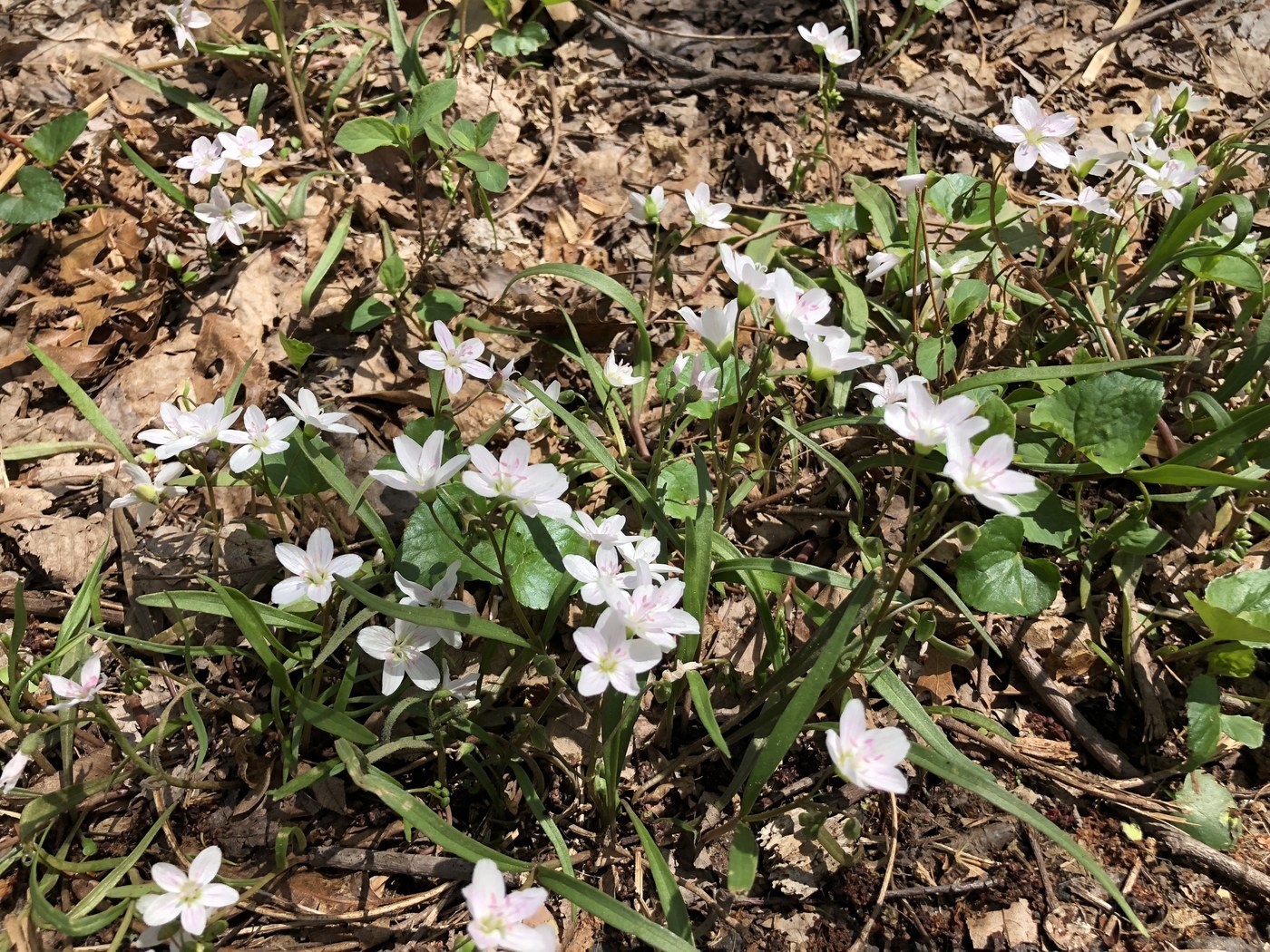
A tiny spring ephemeral carpeting woodlands and lawns with starry white-to-pink flowers delicately striped in darker pink.
- Light
- Partial shade to full sun
- Water
- Moderate; moist in spring
- Difficulty
- Easy
Got a plant like this?
Identify any plant from a photo, free.
Overview
Spring beauty is one of the earliest and most charming spring ephemerals of eastern North American woodlands. Its low clumps produce dainty five-petaled flowers, white to pale pink and veined with deeper pink stripes that guide pollinators to nectar.
The plant grows from a small underground tuber. Like other ephemerals, it blooms early and then goes dormant as the forest canopy closes in.
How to identify it
- Flowers: Star-shaped, about half an inch across, white to pink with darker pink veins, opening in sun
- Leaves: A single pair of narrow, grass-like, somewhat fleshy leaves on each stem
- Habit: Low, delicate, 4-8 inches tall, growing from a small round tuber
- Bloom time: Early spring
- Dormancy: Withers and disappears by late spring
Care & growing
Spring beauty is easy and naturalizes freely in suitable shade.
- Light: Partial shade to spring sun; often grows in lawns and open woods
- Water: Moist soil during spring growth; tolerates summer dryness when dormant
- Soil: Rich, moist, humusy woodland soil
- Temperature: Hardy in USDA zones 4-8
- Feeding: None needed; leaf litter suffices
- Propagation: Self-seeds readily and spreads by tubers; divide or move when dormant
Habitat & origin
Claytonia virginica is native to eastern North America, ranging from Canada south to the Gulf states and west to the Great Plains.
It grows in moist deciduous woodlands, thickets, clearings, and increasingly in shady lawns and parks. It often forms extensive carpets of bloom in early spring before trees leaf out.
Frequently asked questions
Why does it disappear in summer?
It is a spring ephemeral that completes its life cycle early and goes dormant underground for the rest of the year, reappearing the next spring.
Are the pink stripes important?
Yes, the darker pink veins act as nectar guides that direct pollinating bees toward the center of the flower.
Is spring beauty good for pollinators?
Very much so; it is a key early-season food source for native bees, including a specialist mining bee that depends on its pollen.
How do I recognize spring beauty?
Look for low, 4-8 inch clumps with a single pair of narrow grass-like leaves and star-shaped white-to-pink flowers veined with darker pink, blooming very early in spring.
Spring Beauty guides
In-depth guides for identifying, growing, and caring for Spring Beauty.
How to Care for Spring Beauty
Grow Spring Beauty (Claytonia virginica), a dainty spring ephemeral, in dappled woodland soil that stays moist while it blooms and flowers.
Spring Beauty Identification Guide
Identify Spring Beauty by its small five-petaled white-to-pink flowers with candy-stripe pink veins, its single pair of narrow grass-like leaves, and its early woodland bloom.