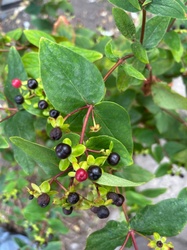
St. John's Wort Identification Guide
Identify common St. John's wort by its bright yellow five-petaled flowers with black-dotted edges, translucent 'perforated' leaves, and reddish two-ridged stems.
Read the full St. John's Wort encyclopedia entry →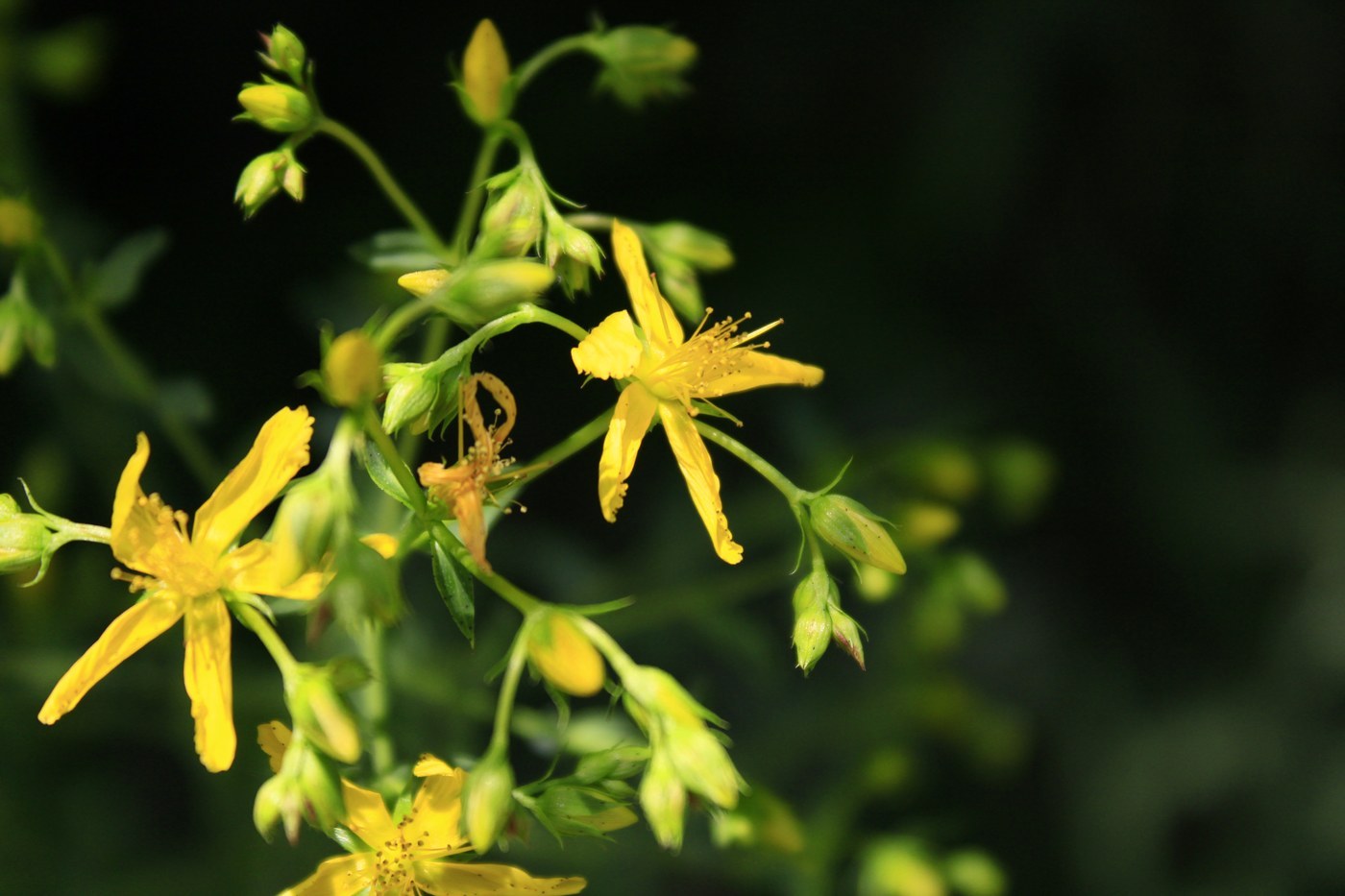
Key Identifying Features
Common St. John's wort (Hypericum perforatum) is an upright perennial herb known for two diagnostic features: leaves dotted with tiny translucent 'perforations' (oil glands you can see by holding a leaf to light) and bright yellow flowers whose petals are edged with tiny black dots. The species name perforatum refers to these see-through leaf glands.
- Erect, branching plant 30–90 cm (1–3 ft) tall
- Bright yellow, five-petaled star-shaped flowers with bushy stamens
- Black dots along petal edges; black/clear dots on leaves
- Translucent-dotted ('perforated') leaves
- Stems with two raised ridges (lines)
Leaves & Stems
Leaves are small, oblong to elliptic (1–3 cm), stalkless, smooth-edged, and arranged in opposite pairs. Held up to the light, they show many tiny translucent dots — these are oil glands that look like pinholes. The stems are woody at the base and bear two distinct longitudinal ridges, often with a reddish tinge — a useful confirming detail. Crushing flower buds can release a reddish pigment that stains the fingers.
Flowers & Fruit
Blooming around midsummer (traditionally St. John's Day, June 24), the flowers are bright yellow, about 2 cm across, with five petals and numerous prominent stamens forming a fuzzy center. The petals often have black or dark glandular dots along their margins. After flowering, small reddish-brown three-chambered seed capsules form.
How to Tell It Apart from Look-Alikes
- Other Hypericum species: many shrubby ornamentals (e.g., H. calycinum, rose-of-Sharon) have far larger flowers and lack the perforated leaves and twin-ridged stems of H. perforatum.
- Other yellow wildflowers (e.g., cinquefoils, agrimony): lack translucent leaf dots and the black-dotted petals.
The combination of translucent perforated leaves, black-dotted yellow petals, and two-ridged stems is conclusive for common St. John's wort.
Where You'll Find It
Native to Europe and Asia and naturalized widely (including across North America and Australia, where it is often a weed), it grows in dry, sunny, disturbed ground: roadsides, meadows, pastures, railway banks, and waste places. It tolerates poor soils and full sun.
Quick ID Checklist
- Bright yellow 5-petaled flowers with many stamens
- Black dots along petal edges
- Leaves with translucent 'perforated' dots (hold to light)
- Two raised ridges running along the stem
- Small, stalkless, opposite, smooth-edged leaves
A sunny-meadow plant with yellow black-dotted flowers and see-through dotted leaves on twin-ridged stems is common St. John's wort.
Frequently asked questions
Why are the leaves described as 'perforated'?
When you hold a leaf up to the light, it appears dotted with tiny translucent pinholes. These are oil glands, not actual holes, and they give the species its name perforatum. It's the single most reliable ID feature.
What do the flowers look like?
Bright yellow, star-shaped, about 2 cm across, with five petals and a prominent bushy cluster of stamens. The petal edges typically carry tiny black glandular dots.
How can I distinguish it from ornamental Hypericum shrubs?
Garden Hypericums like rose-of-Sharon have much larger flowers and lack both the translucent perforated leaves and the two-ridged stems characteristic of common St. John's wort.
Where does the name come from?
It traditionally flowers around St. John's Day (June 24), and 'wort' is an old word for a plant. Crushing the buds also releases a red pigment historically linked to the saint.
St. John's Wort identified by the community
Recent St. John's Wort specimens identified with Plant Identifier.