
Star Cactus Identification Guide
Identify the Star Cactus (Astrophytum asterias) by its flat, spineless, button-shaped body divided into segments like a sand dollar.
Read the full Star Cactus encyclopedia entry →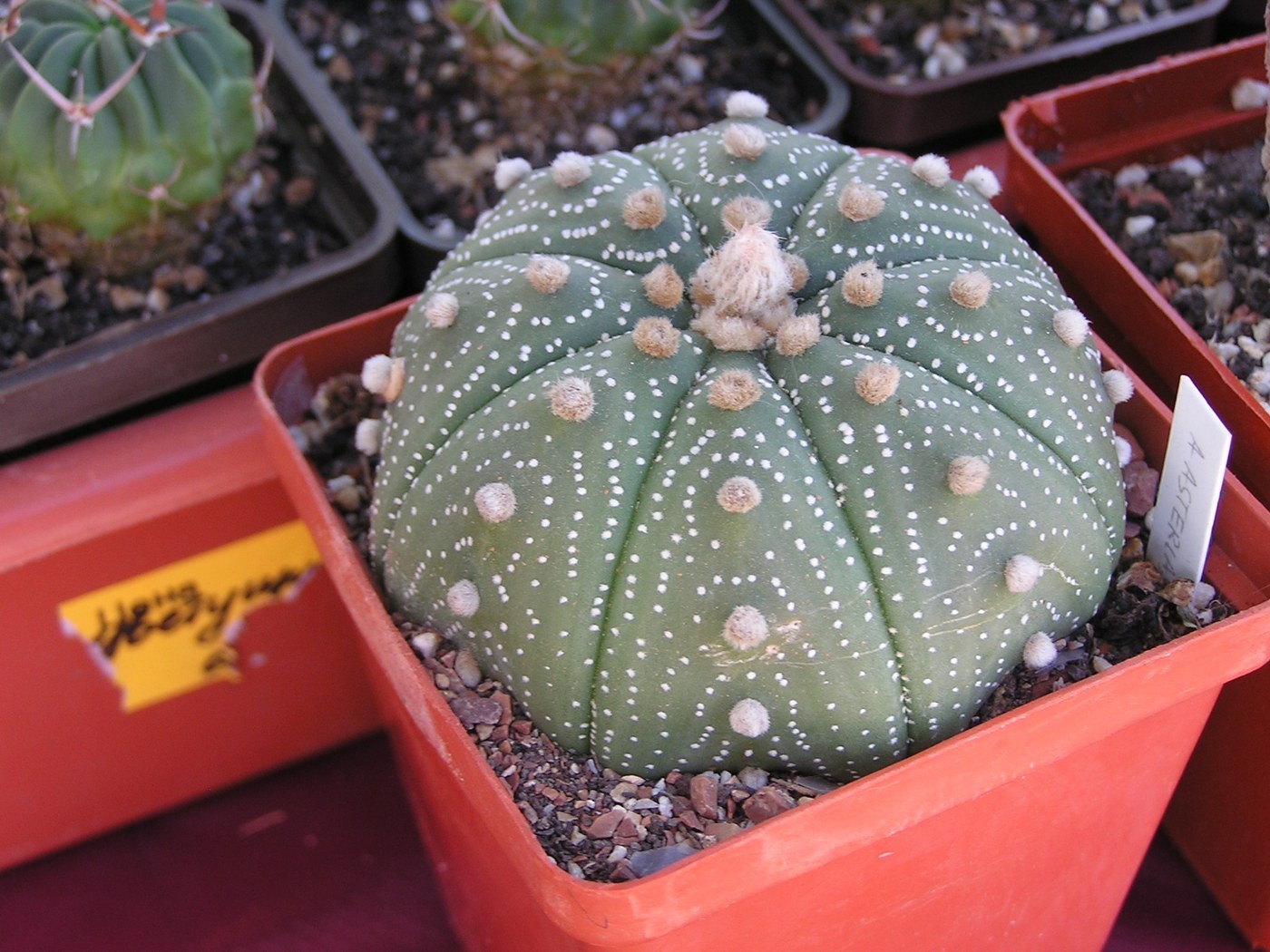
Key Identifying Features
The Star Cactus (Astrophytum asterias), also called Sand Dollar or Sea Urchin Cactus, is a small, flat, spineless cactus shaped like a round button or sand dollar. Viewed from above, its body is divided into segments radiating from the center like a star. It rarely exceeds 2–3 inches tall and a few inches wide.
- Flat, disc/dome-shaped body sitting low to the ground
- Usually 8 broad, low ribs dividing it into pie-slice segments
- Completely spineless, with rows of white woolly areole dots down the rib centers
- Surface speckled with tiny white scales/flecks
Leaves & Stems
Leafless and nearly stemless. The body is firm and flattened, gray-green to brown-green, with shallow ribs (typically 8) separated by narrow grooves. Along the center of each rib sit evenly spaced white woolly tufts (areoles) — but no spines at all, which is a hallmark of the species. The minute white scales dusting the surface are characteristic of the genus Astrophytum.
Flowers & Fruit
From the woolly crown it produces relatively large, yellow, daisy-like flowers with an orange-red center/throat, often nearly as wide as the plant itself. Blooming occurs in the warm growing season on mature plants. Fruit is a small grayish-pink woolly berry.
How to Tell It Apart from Look-Alikes
- Bishop's Cap (Astrophytum myriostigma): Also spineless and white-flecked but has raised, sharply angled star ribs and grows taller/columnar; Star Cactus is flat and button-like with low ribs.
- Peyote (Lophophora williamsii): Superficially similar spineless button, but peyote is blue-green, has tufts of wool and no distinct ribbing pattern; Star Cactus has clear 8-rib segmentation and white scales.
- Other Astrophytum: Most have spines; the flat, spineless, dotted disc identifies asterias.
Where You'll Find It
Native to a small area of southern Texas and northeastern Mexico (Tamaulipas, Nuevo León), where it is endangered in the wild. It is widely propagated by collectors, grown in bright light, very gritty/alkaline soil, and dry conditions. Hardy to about USDA zones 9–11; elsewhere a windowsill specimen.
Quick ID Checklist
- Flat, round, button/sand-dollar body, very low-growing
- ~8 low ribs segmenting it like a star
- No spines; rows of white woolly dots along ribs
- Surface dusted with tiny white scales
- Yellow flower with red center from the woolly crown
Frequently asked questions
Does Star Cactus have spines?
No. It is entirely spineless, with only rows of small white woolly tufts running down the centers of its ribs, which helps distinguish it from most cacti.
How is it different from Bishop's Cap?
Both are spineless and white-flecked, but Star Cactus is flat and button-shaped with low ribs, while Bishop's Cap has raised, sharply angled star ribs and grows taller and more columnar.
Is it the same as peyote?
No. Peyote (Lophophora) is a separate plant. Star Cactus has a clear 8-rib star segmentation and tiny white scales, while peyote is a ribless blue-green button with wool tufts.
Is it rare?
Yes. In the wild Astrophytum asterias is endangered and restricted to a small area of south Texas and northeastern Mexico, though it is widely propagated by hobbyists.