
String of Bananas Identification Guide
A practical guide to identifying String of Bananas (Curio radicans / Senecio radicans) by its banana-shaped leaves, trailing stems, and growth habit.
Read the full String of Bananas encyclopedia entry →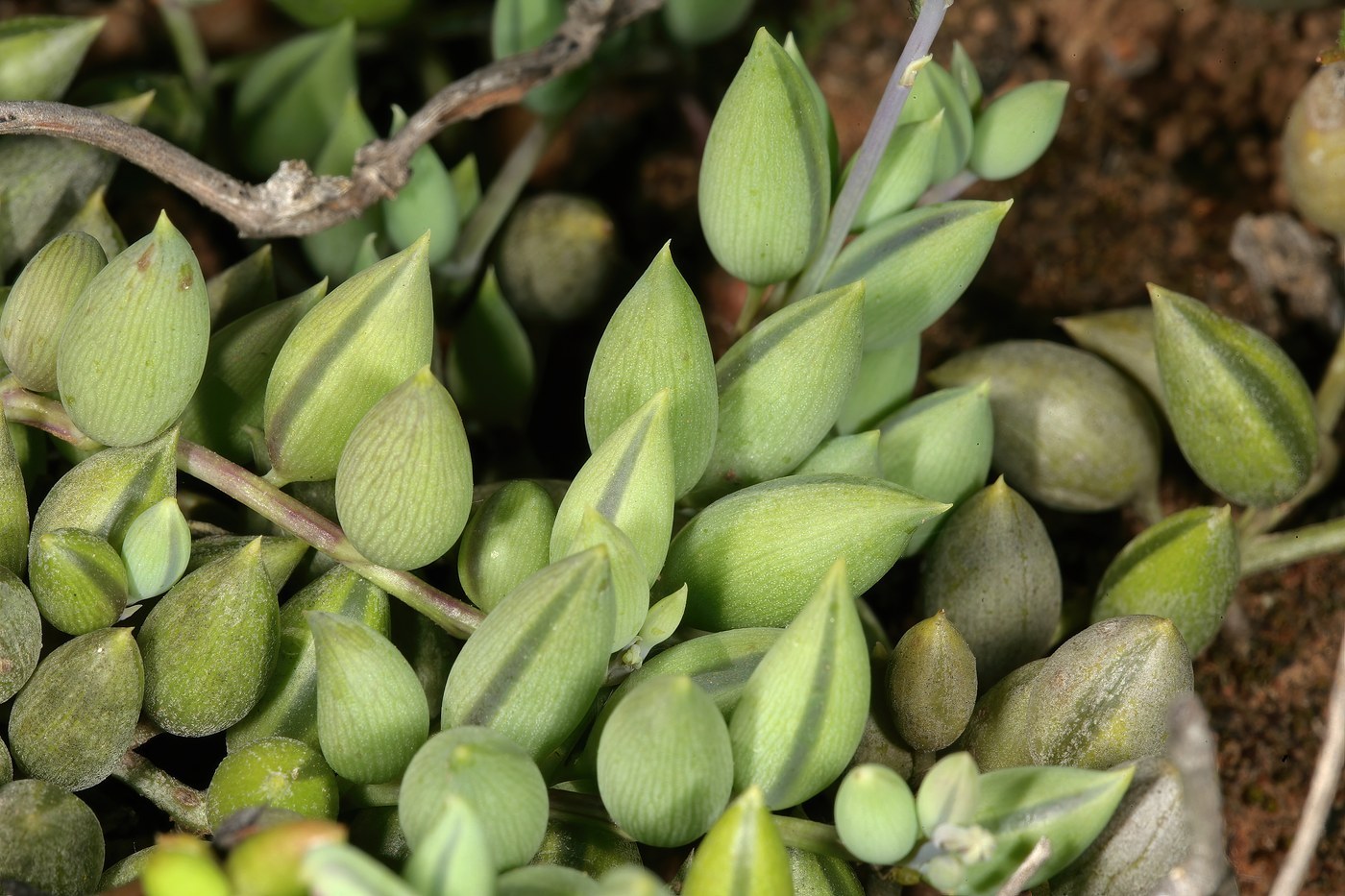
Key Identifying Features
String of Bananas (Curio radicans, formerly Senecio radicans) is a trailing succulent named for its plump, curved leaves that look like tiny green bananas. Look for:
- Banana-shaped leaves: glossy, fleshy, tapered at both ends and curved, roughly 1.5-2.5 cm long
- Long trailing stems that can cascade 60-90 cm (2-3 ft) over a pot edge
- A translucent "window" line running along each leaf, a feature shared with relatives like String of Pearls
- Fast, vigorous growth compared to its rounder-leaved cousin
Leaves & Stems
The leaves are the single most reliable ID trait. Each is smooth, firm, and pointed at the tip, with a slight inward curve, giving the classic banana silhouette. They are a bright to mid-green and arranged alternately along thin, wiry stems. Hold a leaf to the light and you'll see a faint clear stripe (the epidermal window) that helps the plant photosynthesize internally.
Stems are thin, green, and slightly rubbery. Where they touch soil they readily root, which is why the species spreads quickly and propagates so easily from cuttings.
Flowers & Fruit
Under good light and a cool winter rest, mature plants produce small, fuzzy white flowers in tight clusters, often tinged with lavender or pale yellow stamens. The blooms have a distinct cinnamon-like scent. Flowering is uncommon indoors but confirms ID when present. Fruit is a small dandelion-like seed head with fine bristles.
How to Tell It Apart from Look-Alikes
- String of Pearls (Curio rowleyanus): leaves are round, pea-like spheres, not elongated bananas. If beads are spherical, it's Pearls.
- String of Tears (Curio herreanus): leaves are oval/teardrop, fatter and shorter than bananas, often more translucent.
- String of Dolphins (Senecio peregrinus): leaves have little "wings" so each resembles a leaping dolphin; bananas are smooth crescents with no wings.
- String of Fishhooks (Senecio radicans 'Fishhooks'): a closely related cultivar/form with longer, more strongly hooked leaves; essentially a slimmer version of String of Bananas.
The quickest test: smooth crescent with a point = Bananas; round bead = Pearls; winged = Dolphins.
Where You'll Find It
Native to dry regions of southern Africa, String of Bananas is grown almost exclusively as a houseplant or in hanging baskets, prized for cascading over shelves and macrame hangers. It thrives in bright indirect light, gritty fast-draining soil, and infrequent watering. In frost-free climates (USDA zone 10-11) it can grow outdoors as a trailing groundcover or in containers.
Quick ID Checklist
- Leaves shaped like small curved bananas, pointed at the tip
- Faint translucent window line along each leaf
- Thin, wiry trailing stems that root where they touch soil
- Fast-growing, cascading habit in a hanging pot
- Optional: fuzzy white, cinnamon-scented flowers
Frequently asked questions
How do I tell String of Bananas from String of Pearls?
Look at the leaf shape. String of Bananas has elongated, curved, pointed leaves like tiny bananas, while String of Pearls has perfectly round, pea-sized spheres. They are close relatives but the bead shape is the giveaway.
Why do the leaves have a clear stripe?
That translucent line is an epidermal 'window' that lets light into the interior of the leaf for photosynthesis. It is a normal, healthy feature shared across the Curio group, not a sign of damage.
Does it really flower?
It can. Mature, well-lit plants given a cool winter rest produce small fuzzy white flowers with a cinnamon-like fragrance, though blooming is uncommon indoors.