String of Bananas
Senecio radicans
A fast-growing trailing succulent whose curved, banana-shaped leaves cascade in long strands, making it a popular hanging-basket plant. It is hardier and quicker to fill out than its cousin the string of pearls.
- Light
- Bright indirect to some direct light
- Water
- Every 2-3 weeks; let soil dry fully
- Difficulty
- Easy
Got a plant like this?
Identify any plant from a photo, free.
Overview
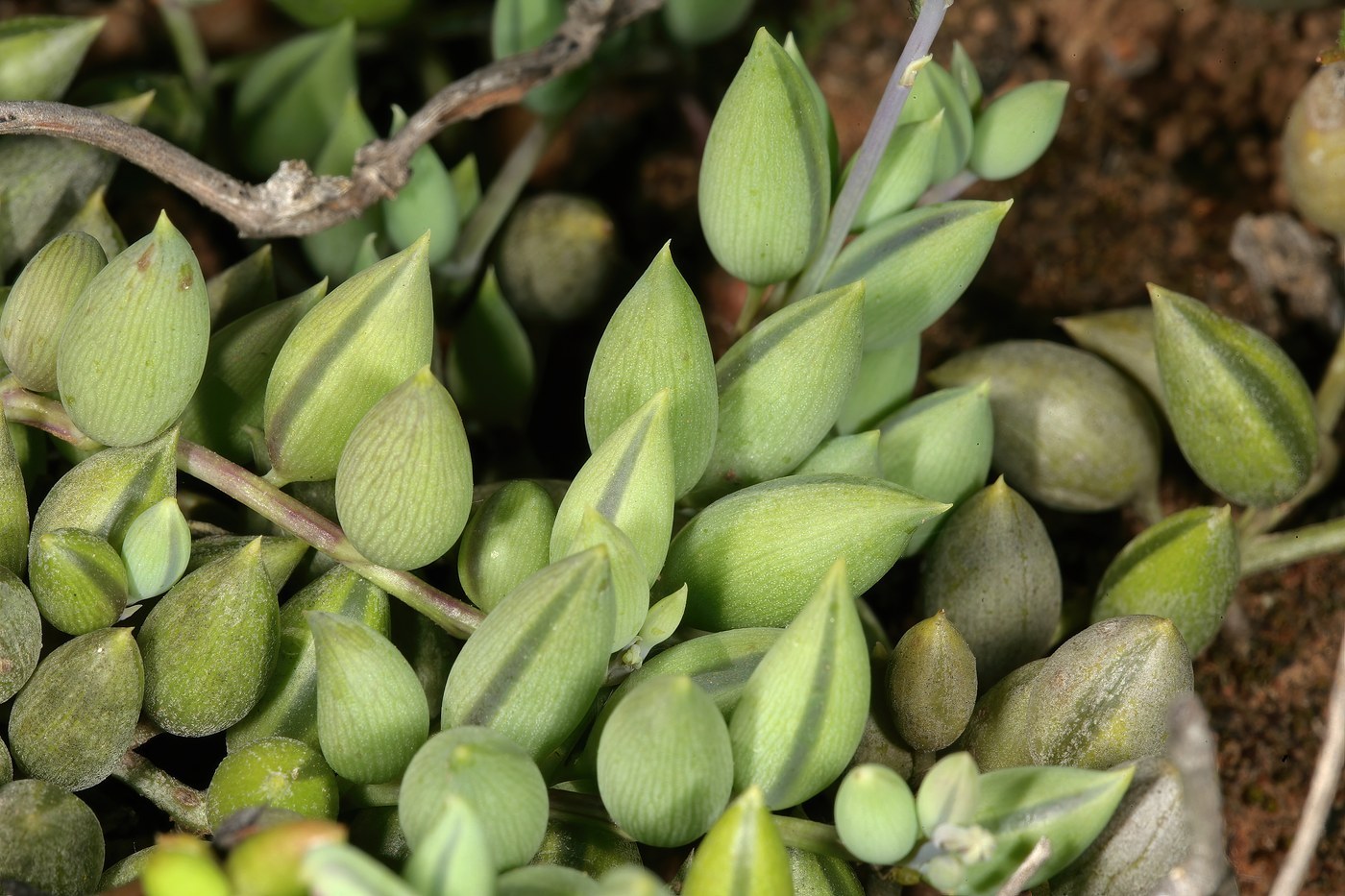
String of Bananas is a trailing succulent in the daisy family (Asteraceae), prized for its glossy, crescent-shaped leaves that resemble tiny green bananas threaded along slender stems. Native to the dry regions of southern Africa, it stores water in its fleshy leaves to survive drought.
It is often compared to Senecio rowleyanus (string of pearls) but is considered more forgiving and significantly faster-growing, with stems that can trail several feet. It is a favorite for hanging baskets and high shelves where the strands can dangle freely.
How to identify it
Look for these features to distinguish it:
- Leaves: Glossy, curved, banana- or fishhook-shaped, about 1 inch long, with a faint translucent stripe (window) running down each leaf
- Stems: Thin, trailing or creeping, reaching 2-3 feet or more
- Color: Bright to deep green, sometimes with a slight blue cast in strong light
- Flowers: Small, white to off-white puffball blooms with a cinnamon-like scent, appearing in cooler months
- Habit: Vining and cascading; roots readily where stems touch soil
Care & growing
- Light: Bright indirect light with some direct sun; tolerates more sun than string of pearls
- Water: Drench, then allow the soil to dry completely; water roughly every 2-3 weeks and less in winter
- Soil: Fast-draining cactus or succulent mix
- Temperature: 70-80F (21-27C) ideal; protect from frost
- Feeding: Light feeding with diluted succulent fertilizer in spring and summer
- Propagation: Extremely easy from stem cuttings laid on or pressed into soil; they root quickly
Habitat & origin
Native to southern Africa, where it grows as a ground-creeping succulent in arid, rocky terrain, rooting along its stems to form dense mats.
Worldwide it is grown almost exclusively as an indoor or greenhouse houseplant, or outdoors in frost-free climates (USDA zones 10-11) where it spreads as a drought-tolerant groundcover.
Frequently asked questions
How is it different from string of pearls?
String of bananas has elongated, curved leaves rather than round beads, grows faster, and is generally more tolerant of light and watering mistakes.
Why are the leaves shriveling?
Slightly shriveled, soft leaves usually signal underwatering, while mushy, translucent leaves indicate overwatering. Adjust based on how dry the soil is.
How do I propagate it?
Snip a few inches of stem, lay it on top of dry succulent soil, and lightly water once it begins to root. Cuttings establish within a couple of weeks.
How big does it get?
Its thin trailing stems can cascade 2-3 feet or more, making it ideal for hanging baskets and high shelves.
String of Bananas guides
In-depth guides for identifying, growing, and caring for String of Bananas.
How to Care for String of Bananas
Grow String of Bananas (Senecio radicans), a fast-trailing succulent with glossy banana-shaped leaves perfect for hanging baskets.
String of Bananas Identification Guide
A practical guide to identifying String of Bananas (Curio radicans / Senecio radicans) by its banana-shaped leaves, trailing stems, and growth habit.