
String of Buttons Identification Guide
Recognize String of Buttons (Crassula perforata) by its stacked, triangular leaves that appear threaded onto upright square stems like beads on a string.
Read the full String of Buttons encyclopedia entry →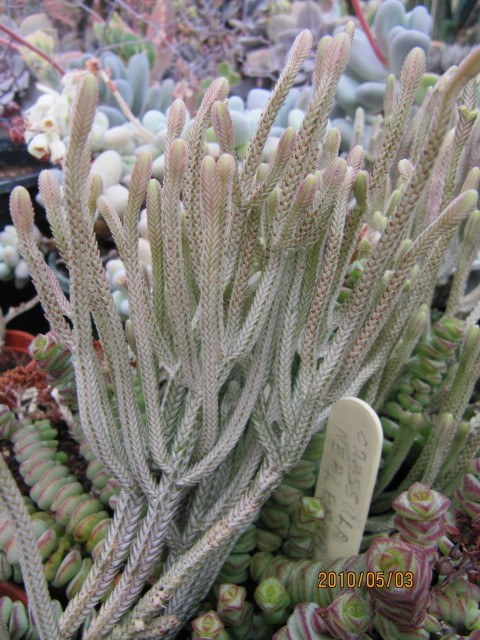
Key Identifying Features
String of Buttons (Crassula perforata) is a distinctive upright succulent whose pairs of triangular leaves stack tightly around the stem, making the stem look as if it's been threaded straight through the center of each leaf pair, like beads or buttons on a string. It is also sold as "Necklace Vine" or "Pagoda Plant."
- Opposite triangular leaves that clasp and fully surround the stem
- Leaves stacked in spiraling tiers up the stem
- Gray-green leaves with pink or red margins in bright light
- Sprawling-to-upright stems that lengthen and topple with age
Leaves & Stems
Each leaf is roughly triangular to ovate, gray-green, fleshy, and often dusted with a fine powdery bloom (farina). The leaves come in opposite pairs fused at the base, and each successive pair is rotated about 90 degrees, producing a square, geometric, stacked appearance up the stem. Edges typically blush rosy pink to red under sun stress. The species name perforata refers to the way the stem appears to perforate the joined leaf bases.
The stems start upright but elongate and trail or lean as they grow, often forming clumps. Older stems become woody at the base.
Flowers & Fruit
In spring, String of Buttons produces small, pale yellow to creamy-white star-shaped flowers in clusters at or near the stem tips. The flowers are modest but add a soft frosting of color. Fruit is a tiny inconspicuous capsule.
How to Tell It Apart from Look-Alikes
- Crassula rupestris (Baby's Necklace / Rosary Vine): very similar stacking, but its leaves are more rounded/bead-like and plumper, whereas String of Buttons has flatter, distinctly triangular leaves.
- Crassula 'Buddha's Temple' and pagoda hybrids: these stack into a tighter, denser column; String of Buttons is looser and more open with visible stem between the wider-spaced pairs.
- String of Pearls/Bananas (Senecio): trailing with round or banana beads on thin vines, not stacked triangular pairs hugging an upright stem.
Where You'll Find It
Native to South Africa, String of Buttons is grown as a popular indoor and outdoor ornamental succulent in USDA zones 9-11. It thrives in bright light and well-drained soil, and is common in hanging baskets, rock gardens, and mixed succulent arrangements where its stacked stems can drape over edges.
Quick ID Checklist
- Triangular leaf pairs clasping and stacked up the stem
- Stem appears to run through the center of joined leaves
- Successive pairs rotated ~90 degrees (square/geometric look)
- Gray-green leaves with pink/red margins in sun
- Powdery bloom on leaves
- Small pale-yellow star flowers in spring
Tip: If your plant gets leggy with wide gaps between leaf pairs, it needs more light; tightly stacked tiers indicate happy, well-lit growth.
Frequently asked questions
Why does the stem look like it goes through the leaves?
The opposite leaves are fused at their bases and wrap completely around the stem, so the stem appears to perforate each leaf pair, which is exactly what the species name perforata describes.
How do I tell String of Buttons from Crassula rupestris?
String of Buttons has flatter, clearly triangular leaves, while Crassula rupestris (Baby's Necklace) has plumper, more rounded bead-like leaves. Both stack on the stem, but the leaf shape is the giveaway.
Why are the leaf edges turning pink or red?
Pink and red margins are a healthy sun-stress response. Bright light intensifies the coloring; in shade the leaves stay plain gray-green.
Why is my plant stretched out with gaps between leaves?
Wide spacing and leggy growth signal insufficient light. Move it to a brighter location to encourage the tight, stacked button appearance.