Sugar Maple Identification Guide
Identify sugar maple (Acer saccharum) by its five-lobed leaves with smooth-edged lobes and rounded sinuses, U-shaped notches, and sharp-tipped brown buds.
Read the full Sugar Maple encyclopedia entry →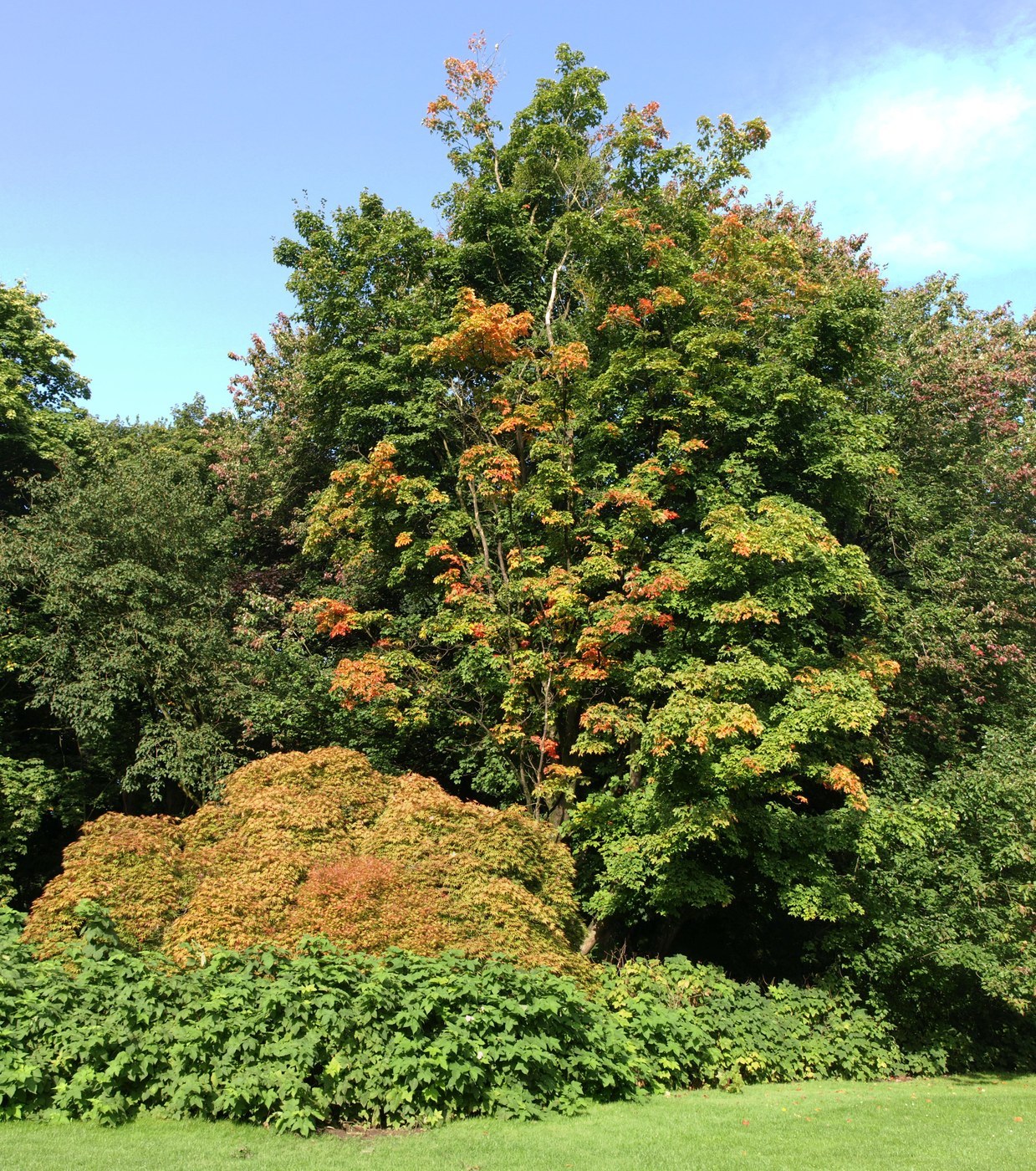
Key Identifying Features
Sugar maple (Acer saccharum) is the classic maple of the Canadian flag and of New England fall color. Identify it by its five-lobed leaves with smooth, untoothed lobe edges, rounded U-shaped notches between lobes, and a stately, rounded crown. It is the source of maple syrup.
- Large tree, 60-100 ft (18-30 m) tall
- Opposite leaves and buds
- Leaf lobes without fine teeth, edges smooth and wavy
Leaves & Stems
Leaves are 3-6 in across with typically five lobes. The hallmark is the smooth (entire) margins of the lobes with a few large blunt teeth or wavy points but no fine serrations, and the rounded, U-shaped sinuses between lobes. The underside is pale green but not whitish. Leaf stalks are not milky (no white sap). Twigs are slender, reddish-brown to gray, and bear sharply pointed, brown, scaly buds - a key winter feature distinguishing it from red maple's rounded red buds.
Flowers & Fruit
Sugar maple flowers in spring as leaves emerge, producing drooping clusters of small, greenish-yellow flowers on long thread-like stalks - much less showy and later than red maple's bright red blooms. The fruit is a paired, horseshoe-shaped samara about 1 in long; the two wings are nearly parallel or only slightly spread. Seeds mature in autumn.
How to Tell It Apart from Look-Alikes
- Red maple (Acer rubrum): Toothed lobe margins, whitish leaf undersides, red buds; sugar maple has smooth margins and brown pointed buds.
- Norway maple (Acer platanoides): Very similar leaf shape, but broken leaf stalks ooze milky white sap, and its samara wings spread wide nearly horizontally. Sugar maple has clear sap and narrowly angled samaras.
- Black maple (Acer nigrum): A close relative with drooping, often three-lobed leaves and downy undersides.
- The decisive cues: smooth-edged lobes, U-shaped sinuses, clear (non-milky) sap, and sharp brown buds.
Where You'll Find It
Sugar maple is a dominant hardwood of cool, moist, well-drained upland forests in northeastern North America and the Great Lakes region. It prefers rich soils and is shade-tolerant, common in mature deciduous and mixed forests and widely planted as a shade and street tree.
Quick ID Checklist
- 5-lobed leaves with smooth (untoothed) lobe margins
- Rounded U-shaped notches between lobes
- Leaf underside pale green, not whitish
- Clear sap (snap the stalk - no milky liquid)
- Sharp-pointed brown buds
- Samaras nearly parallel, ripening in fall; orange-red fall color
Frequently asked questions
What is the key difference between sugar maple and Norway maple?
Break a leaf stalk - Norway maple oozes milky white sap while sugar maple's sap is clear. Norway maple samaras also spread nearly horizontally, while sugar maple's hang in a narrow angle.
How can I identify sugar maple in winter?
Look at the buds: sugar maple has sharply pointed, brown, scaly buds, unlike red maple's small rounded red buds.
Why are sugar maple leaf edges important for ID?
Sugar maple lobes have smooth, untoothed margins with rounded U-shaped notches, whereas red and silver maples have finely toothed lobe edges.
Is sugar maple really the source of maple syrup?
Yes, its high sugar content sap makes it the primary tree tapped for maple syrup, though some other maples are tapped as well.
Sugar Maple identified by the community
Recent Sugar Maple specimens identified with Plant Identifier.