
Sugar Pine Identification Guide
How to identify Sugar Pine (Pinus lambertiana), the world's tallest pine, by its enormous hanging cones, five-needle bundles, and long horizontal branches. Covers separation from western white pine.
Read the full Sugar Pine encyclopedia entry →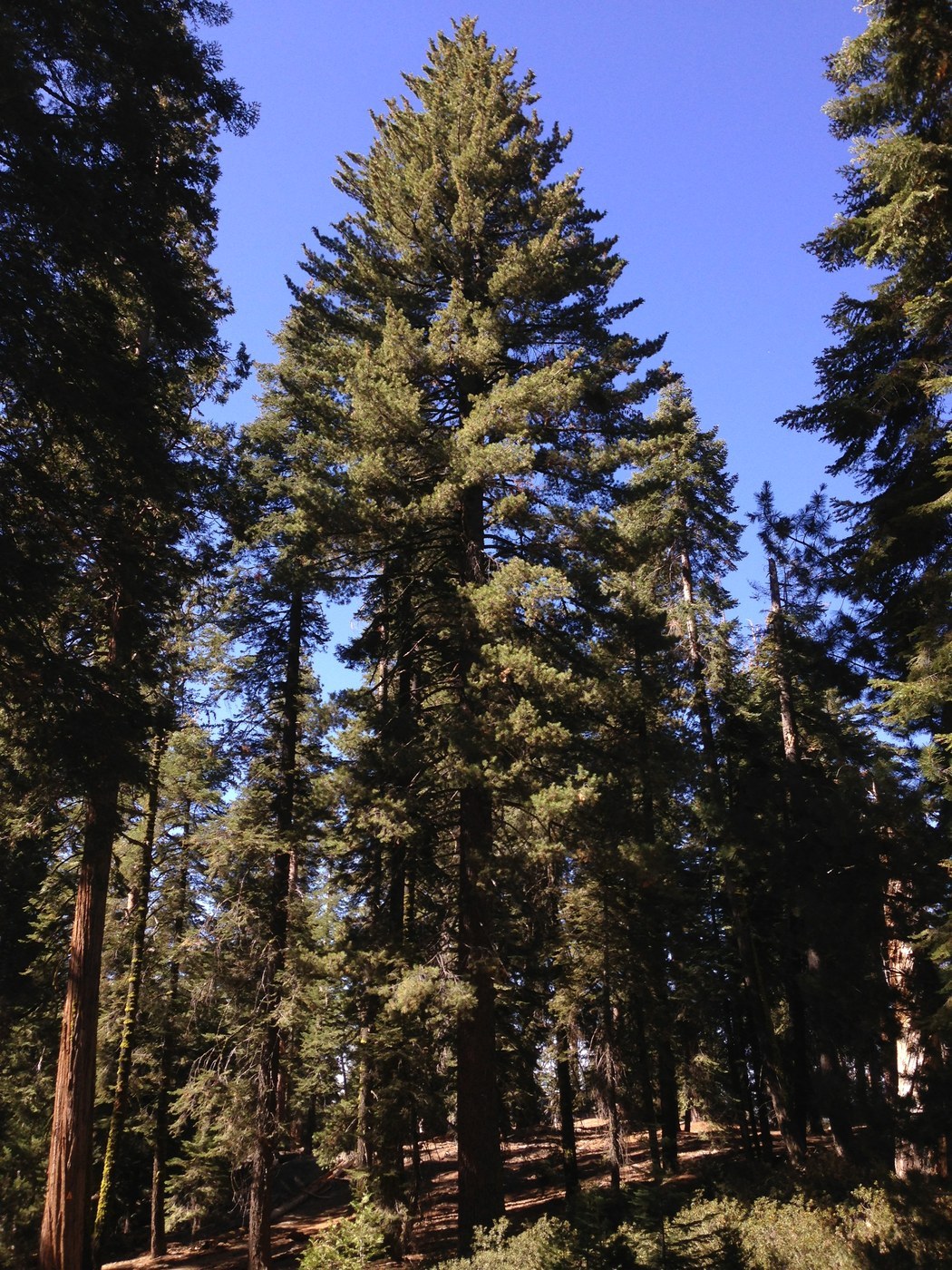
Key Identifying Features
Sugar Pine (Pinus lambertiana) is the largest pine species on Earth and bears the longest cones of any conifer. The unmistakable signature is its massive cylindrical cones, 10 to 20+ inches long, dangling from the tips of long, nearly horizontal upper branches. Needles come in bundles of five. Mature trees are towering, with a distinctive asymmetric crown of out-flung limbs.
Leaves & Stems
- Needles in bundles of five (fascicles of 5), 2.5 to 4 inches long, blue-green, stiffish, often slightly twisted, with fine white stomatal lines.
- Twigs stout; the crown carries long, straight branches that reach out horizontally, giving older trees a candelabra silhouette with cones hung at the tips.
- Bark on mature trunks grayish-brown to cinnamon, broken into long plated ridges; younger bark smoother and gray.
- Trunks are immense — often clear and branch-free for much of their height.
Flowers & Fruit
- The defining feature: pendant cones 10 to 20 inches (sometimes to 26 in) long, cylindrical, hanging from branch tips.
- Cone scales are thin, unarmed (no prickles), with large seeds.
- Sticky white resin droplets exude where the bark is wounded; the dried resin is the source of the common name.
How to Tell It Apart from Look-Alikes
- Western white pine (Pinus monticola) also has five needles but its cones are much shorter (5 to 10 in) and slimmer, and its bark forms small squarish gray plates.
- Limber pine and whitebark pine have five needles but short, rounded cones and shrubbier high-elevation forms.
- Ponderosa and Jeffrey pine have needles in bundles of three and prickly cones.
- If a Pacific-slope five-needle pine has cones over a foot long, it is Sugar Pine.
Where You'll Find It
Mountains of the Pacific Coast: the Sierra Nevada, Cascades of Oregon, Klamath ranges, and mountains of southern California into Baja, generally at mid elevations (2,000 to 7,500 ft) in mixed-conifer forest. Look for the giant cones littering the ground beneath tall trees.
Quick ID Checklist
- Needles in bundles of five, blue-green, 2.5 to 4 inches
- Enormous cones 10 to 20+ inches, hanging from branch tips
- Cone scales without prickles
- Long horizontal upper branches; very tall trunk
- Pacific mountain mixed-conifer forests
Frequently asked questions
How do I know if a cone is from Sugar Pine?
Sugar Pine cones are unmistakable: cylindrical, 10 to 20 inches or more long, the longest of any conifer. No other pine on the Pacific slope produces cones that size.
How many needles per bundle does Sugar Pine have?
Five. They are blue-green, 2.5 to 4 inches long, with fine white lines.
How is Sugar Pine different from western white pine?
Both have five needles, but Sugar Pine cones are far longer (often over a foot) and the trees are larger with long horizontal branches. Western white pine cones are 5 to 10 inches.
Why is it called Sugar Pine?
The dried resin that oozes from wounds in the bark is the source of the tree's common name.