
Sweet Potato Vine Identification Guide
Identify ornamental Sweet Potato Vine by its trailing stems, heart-shaped or lobed leaves in chartreuse to near-black, and milky sap.
Read the full Sweet Potato Vine encyclopedia entry →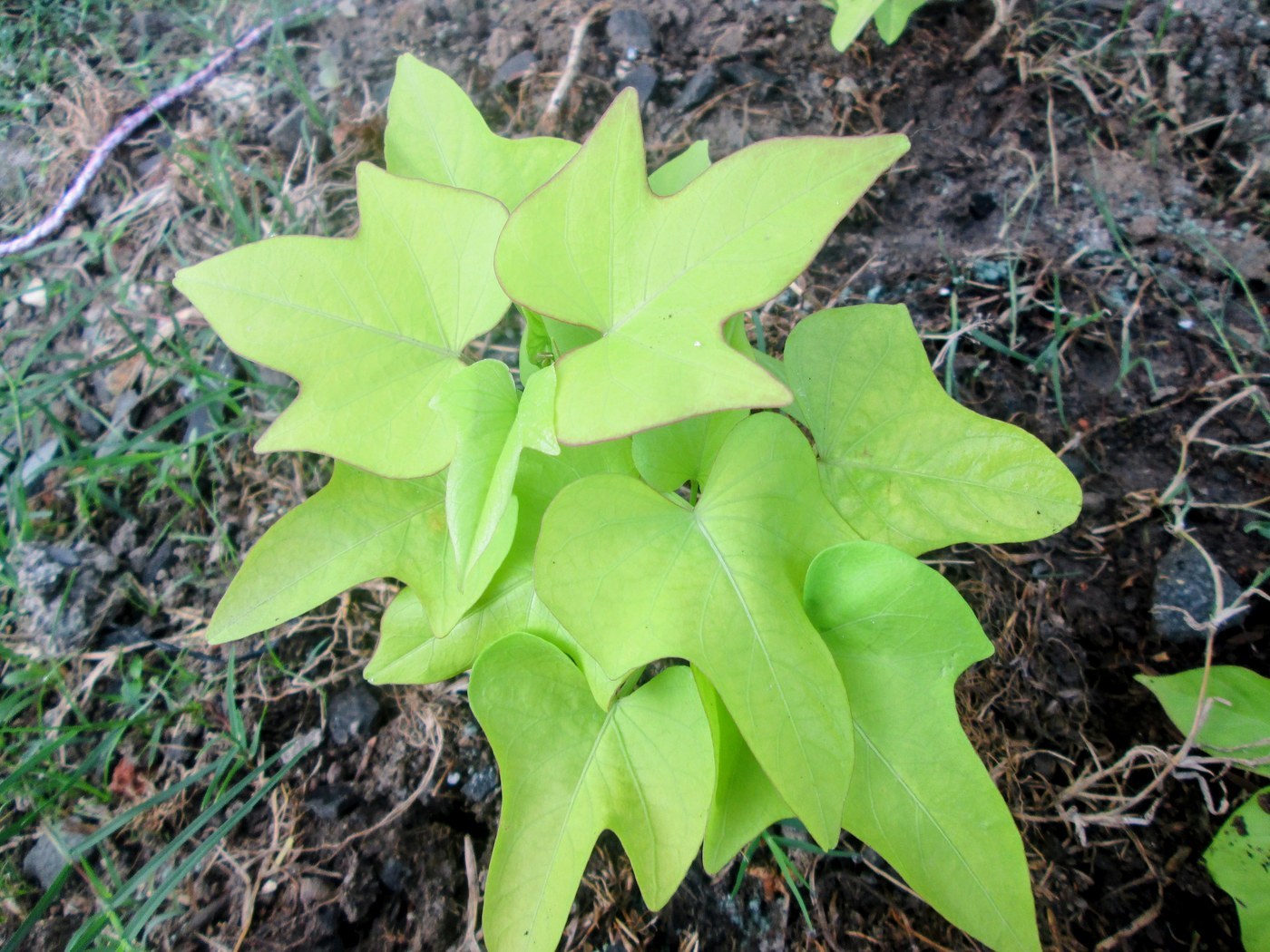
Key Identifying Features
Sweet Potato Vine (Ipomoea batatas) is the ornamental form of the species, grown as a vigorous trailing annual for its bold, colorful foliage rather than flowers. The standout clues are the fast-growing trailing stems and large heart-shaped or deeply lobed leaves in striking colors.
- Trailing/cascading habit, spilling 2-6 ft (0.6-1.8 m) from a pot
- Leaves heart-shaped or palmately 3-5 lobed, 3-6 in long
- Foliage colors: chartreuse-lime, deep purple-black, bronze, and variegated
- Stems exude a milky sap when broken
- Forms tuberous roots underground
Leaves & Stems
Leaves are the main feature: alternate, broadly heart-shaped (cordate) or cut into 3-5 finger-like lobes depending on the cultivar, with smooth margins and a pointed tip. Popular varieties are bright chartreuse ('Marguerite'), near-black purple ('Blackie'), or tricolor variegated. Stems are soft, trailing, and rooting at the nodes, releasing milky white sap when cut — a clue to its morning-glory family kinship.
Flowers & Fruit
Though grown for leaves, sweet potato vine occasionally produces funnel-shaped lavender to pale-purple flowers typical of the morning glory family (Convolvulaceae) — confirming the relationship if you spot them. Underground it forms tuberous roots, which you may find when lifting a container at season's end. Seeds and pods are rarely seen in ornamental use.
How to Tell It Apart from Look-Alikes
- Morning glory / moonflower (Ipomoea spp.): close relatives that climb and bloom showily rather than trail for foliage; if it twines up a support with big trumpet flowers, it's a flowering Ipomoea, not the foliage vine.
- Caladium / coleus: also grown for colorful leaves, but those are upright clumpers, not trailing vines, and lack milky sap.
- The trailing habit + heart/lobed colorful leaves + milky sap + tuberous roots is diagnostic for ornamental sweet potato vine.
Where You'll Find It
Sweet potato vine is a staple "spiller" in containers, hanging baskets, and mixed plantings, where its chartreuse or black foliage contrasts with flowers. It grows fast in full sun to part shade and warm weather, and is also planted as a quick-spreading groundcover in summer beds. Tubers can be overwintered to regrow the next year.
Quick ID Checklist
- Vigorous trailing/cascading stems
- Heart-shaped or 3-5 lobed leaves
- Bold foliage color: lime-chartreuse, purple-black, bronze, or variegated
- Milky sap from cut stems
- Occasional lavender funnel-shaped morning-glory flowers
- Tuberous roots underground
Frequently asked questions
Is ornamental sweet potato vine the same species as the food sweet potato?
Yes, both are Ipomoea batatas. Ornamental cultivars are bred for colorful foliage, but they still form tuberous roots underground like the food crop.
Does sweet potato vine flower?
Occasionally. It can produce lavender to pale-purple funnel-shaped flowers typical of the morning glory family, which confirm its identity even though it's grown mainly for leaves.
Why do the stems leak milky sap?
Sweet potato vine is in the morning glory family (Convolvulaceae), whose members exude milky sap when cut. Seeing this sap helps distinguish it from unrelated foliage plants like coleus.
How do I tell it from a climbing morning glory?
Sweet potato vine trails and is grown for bold-colored foliage, while ornamental morning glories twine up supports and are grown for their large showy trumpet flowers.