
Sweet William Identification Guide
Identify Sweet William by its dense, flat-topped clusters of fringed, often bicolored flowers and paired lance-shaped leaves.
Read the full Sweet William encyclopedia entry →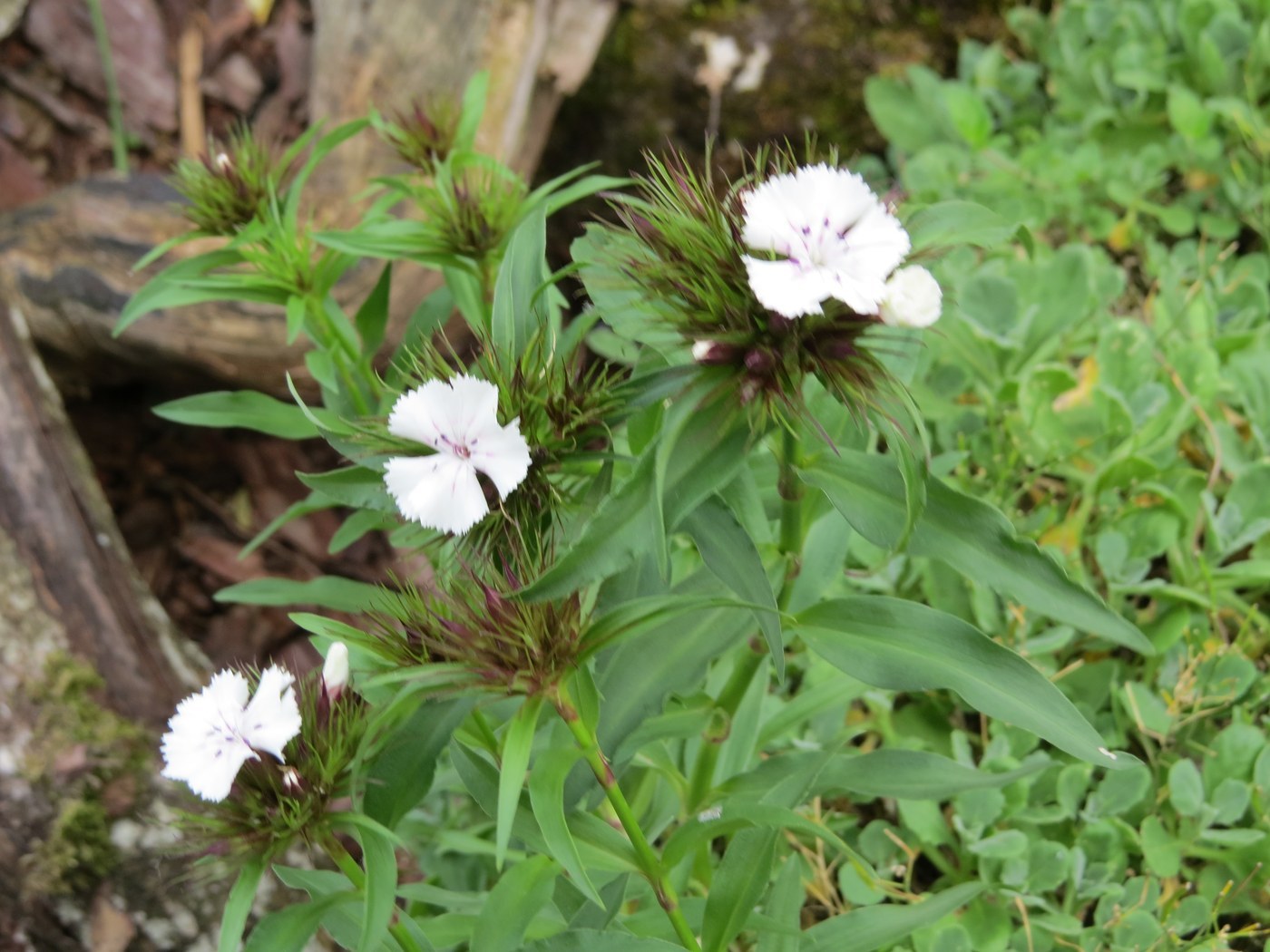
Key Identifying Features
Sweet William (Dianthus barbatus) stands out for its dense, flat-topped clusters of small flowers packed tightly at the top of each stem. Individual flowers are often bicolored with a contrasting eye or zone, and the petal edges are fringed or toothed. It belongs to the pink family, so it shares that group's spicy-clove scent and jointed stems.
- Flat-topped, crowded flower heads of many small blooms
- Flowers commonly bicolored or zoned (white, pink, red, maroon)
- Fringed/serrated petal edges
- Swollen, jointed nodes on the stems
Leaves & Stems
Leaves are lance-shaped to oblong, flat, and opposite (paired), wider than most other dianthus species. They are green to bronze-green, sometimes flushed red, and clasp the stem at distinctly swollen nodes — a classic pink-family trait. Stems are stiff, upright, and smooth, growing 30–60 cm (1–2 ft) tall. The plant is usually a short-lived perennial or biennial, forming a leafy basal clump the first year and flowering the next.
Flowers & Fruit
Each flower has five petals with toothed (bearded) margins and a flat face, fused at the base into a short tube held in a green tubular calyx with leaf-like bracts. What makes Sweet William unique among dianthus is that dozens of flowers bunch into a single dense, domed head rather than appearing singly. Colors include white, pink, salmon, crimson, and deep maroon, frequently with a white-edged eye or contrasting ring. Bloom is late spring into summer. Fruit is a small dry capsule splitting at the top to release flat black seeds.
How to Tell It Apart from Look-Alikes
- Garden pinks / carnations (other Dianthus): Flowers are borne singly or in loose few-flowered sprays, not crammed into flat heads, and leaves are narrow and grassy/blue-grey.
- Phlox: Also forms flower clusters, but phlox flowers have smooth (not fringed) petals and a long narrow tube, and leaves are not swollen at the nodes.
- Verbena: Similar flat clusters but tiny tubular flowers, and lacks the jointed nodes and clove scent.
The packed flat head + fringed bicolor petals + jointed stems confirm Sweet William.
Where You'll Find It
A cottage-garden classic, Sweet William is grown in borders, cutting gardens, and containers worldwide. It thrives in full sun and well-drained, slightly alkaline soil, self-seeds freely, and sometimes naturalizes along roadsides and field edges in temperate regions.
Quick ID Checklist
- Dense, flat-topped cluster of many small flowers
- Flowers often bicolored with a contrasting eye
- Fringed or toothed petal edges
- Opposite, lance-shaped leaves wider than typical dianthus
- Swollen, jointed stem nodes
- Spicy-clove fragrance
Frequently asked questions
How is Sweet William different from regular garden pinks?
Both are Dianthus, but Sweet William crowds dozens of flowers into a dense flat-topped head, while garden pinks and carnations bloom singly or in small sprays. Sweet William also has broader, flatter green leaves.
Why are the flowers two-toned?
Many Sweet William varieties are naturally bicolored, with a contrasting eye, ring, or white-fringed edge. This zoned patterning combined with the fringed petals is a hallmark of the species.
Is Sweet William a perennial or biennial?
It's usually grown as a short-lived perennial or biennial — it forms a leafy clump the first year and flowers the next, then often self-seeds to replace itself.
What confirms it's in the pink family?
The swollen, jointed stem nodes where the paired leaves attach, the fringed five-petaled flowers, and the spicy clove-like fragrance are all classic Dianthus (pink family) traits.