
Sweet Woodruff Identification Guide
How to identify sweet woodruff (Galium odoratum) by its whorls of narrow leaves arranged like wheel spokes, tiny four-petaled white star flowers, and hay-like vanilla scent when dried.
Read the full Sweet Woodruff encyclopedia entry →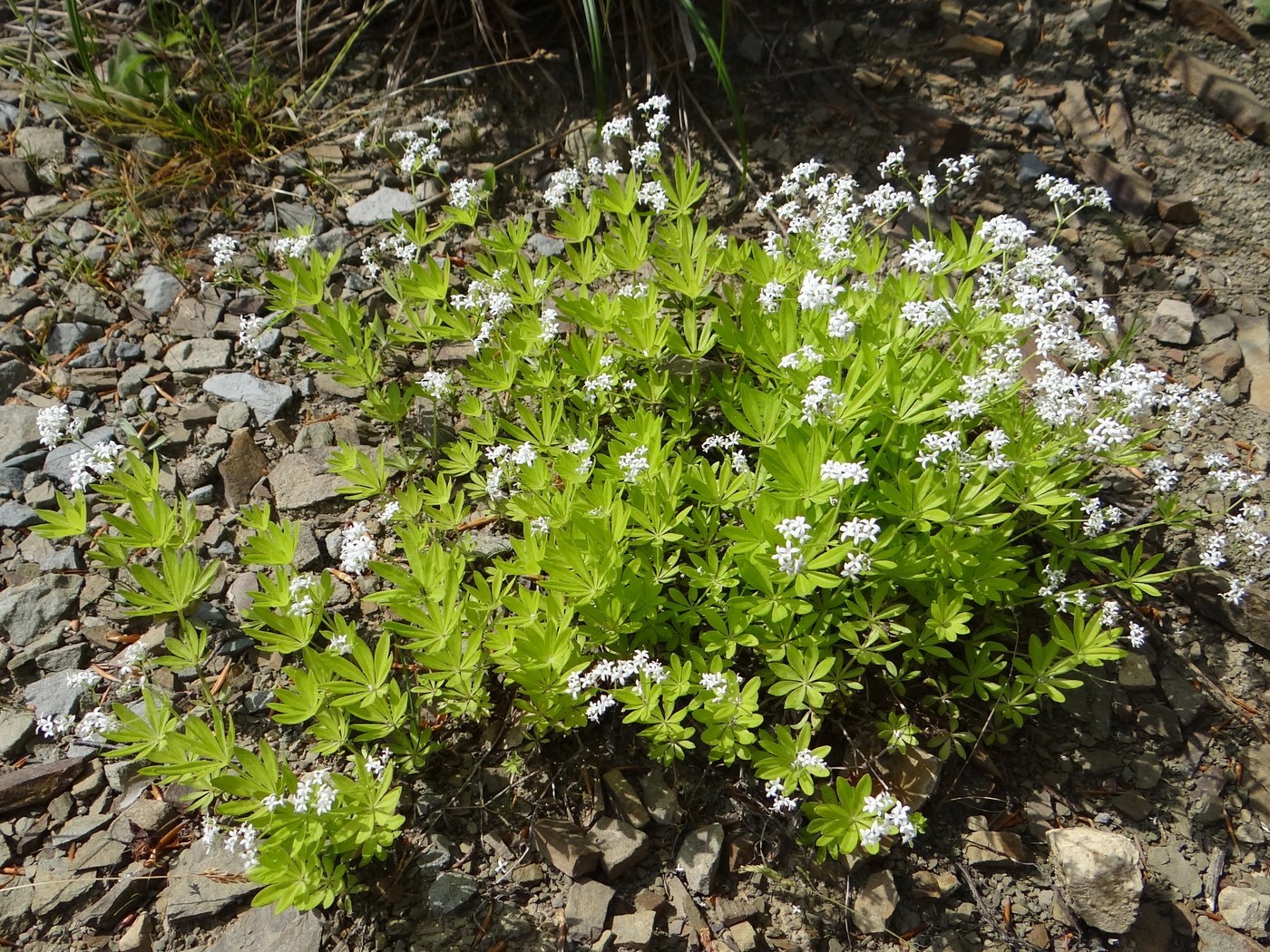
Key Identifying Features
Sweet woodruff (Galium odoratum) is a low, spreading woodland ground cover in the madder/bedstraw family (Rubiaceae). Its standout feature is the whorls of 6–9 narrow leaves arranged like the spokes of a wheel at intervals up a slender square stem, topped in spring by clusters of tiny, four-petaled, pure-white star flowers. When dried (or wilted), the plant gives off a sweet, hay-and-vanilla scent (coumarin).
- Leaves in whorls (wheel-like ruffs) of 6–9 around the stem
- Leaves narrow, lance-shaped, with a tiny bristle tip and rough edges
- Flowers tiny, white, 4-petaled stars in loose clusters
- Square stems; sweet vanilla/new-mown-hay fragrance when dried
Leaves & Stems
Stems are slender, square in cross-section, and weak, forming low spreading mats 15–30 cm tall. At regular nodes the narrow, elliptic to lance-shaped leaves radiate in flat whorls, usually 6 to 9 per whorl (more than most bedstraws), each leaf with a small pointed tip and finely rough margins. The plant spreads by creeping rhizomes into dense carpets. Fresh foliage is nearly scentless; the famous fragrance develops as it wilts or dries.
Flowers & Fruit
Flowers appear in late spring, in loose, branched clusters (cymes) at the stem tips. Each is small (4–6 mm), white, with four spreading pointed lobes forming a neat star and a short tube. Fruit is a small, dry, bristly two-part nutlet covered in tiny hooked hairs that cling to fur and clothing — a bedstraw-family trait. The combination of leaf whorls, white 4-petaled stars, and coumarin scent is conclusive.
How to Tell It Apart from Look-Alikes
- Cleavers / goosegrass (Galium aparine): same genus and whorled leaves, but a sprawling, clingy, sticky climber with backward hooks all over; sweet woodruff is neat, soft, and ground-covering.
- Lady's bedstraw (Galium verum): whorled leaves too, but yellow flowers and very narrow leaves.
- Crosswort / other bedstraws: check leaf count per whorl and flower color; sweet woodruff has the broadest leaves and white stars.
- Sweet violet / wild strawberry: also woodland ground covers, but lack the whorled spoke leaves entirely.
Where You'll Find It
Sweet woodruff carpets shady deciduous woodlands, especially on chalky or moist humus-rich soil, across Europe, North Africa, and western Asia, and is widely planted as a shade ground cover in gardens. The dried herb is traditionally used to flavor May wine and as a fragrant strewing herb.
Quick ID Checklist
- Leaves in whorls of 6–9 like wheel spokes
- Square stems, low spreading mat
- Tiny white 4-petaled star flowers in spring
- Vanilla/hay scent when wilted or dried
- Bristly clinging seed nutlets; shade woodland habitat
Frequently asked questions
What is the easiest way to identify sweet woodruff?
Look for whorls of 6 to 9 narrow leaves arranged like wheel spokes around a square stem, topped with tiny white four-petaled star flowers. A sweet hay-and-vanilla scent when the foliage dries confirms it.
Why doesn't my fresh sweet woodruff smell of anything?
The vanilla-like coumarin fragrance only develops as the leaves wilt or dry. Fresh, intact foliage is nearly odorless, which is normal and not a sign of the wrong plant.
How is it different from cleavers, which also has whorled leaves?
Cleavers (goosegrass) is a sprawling, sticky climber covered in tiny hooks that cling to everything. Sweet woodruff forms a neat, soft, low ground-covering mat and has the sweet dried scent.
Is sweet woodruff safe to use in food and drink?
It is traditionally used in small amounts to flavor May wine and desserts, but its coumarin content means it should be used sparingly. For identification, the scent and leaf whorls are the key features, not tasting it.