
Tamarack Identification Guide
How to identify tamarack / eastern larch (Larix laricina) by its deciduous soft needle tufts, tiny rounded cones, and boreal bog habitat. Covers needles, cones, bark, and look-alikes.
Read the full Tamarack encyclopedia entry →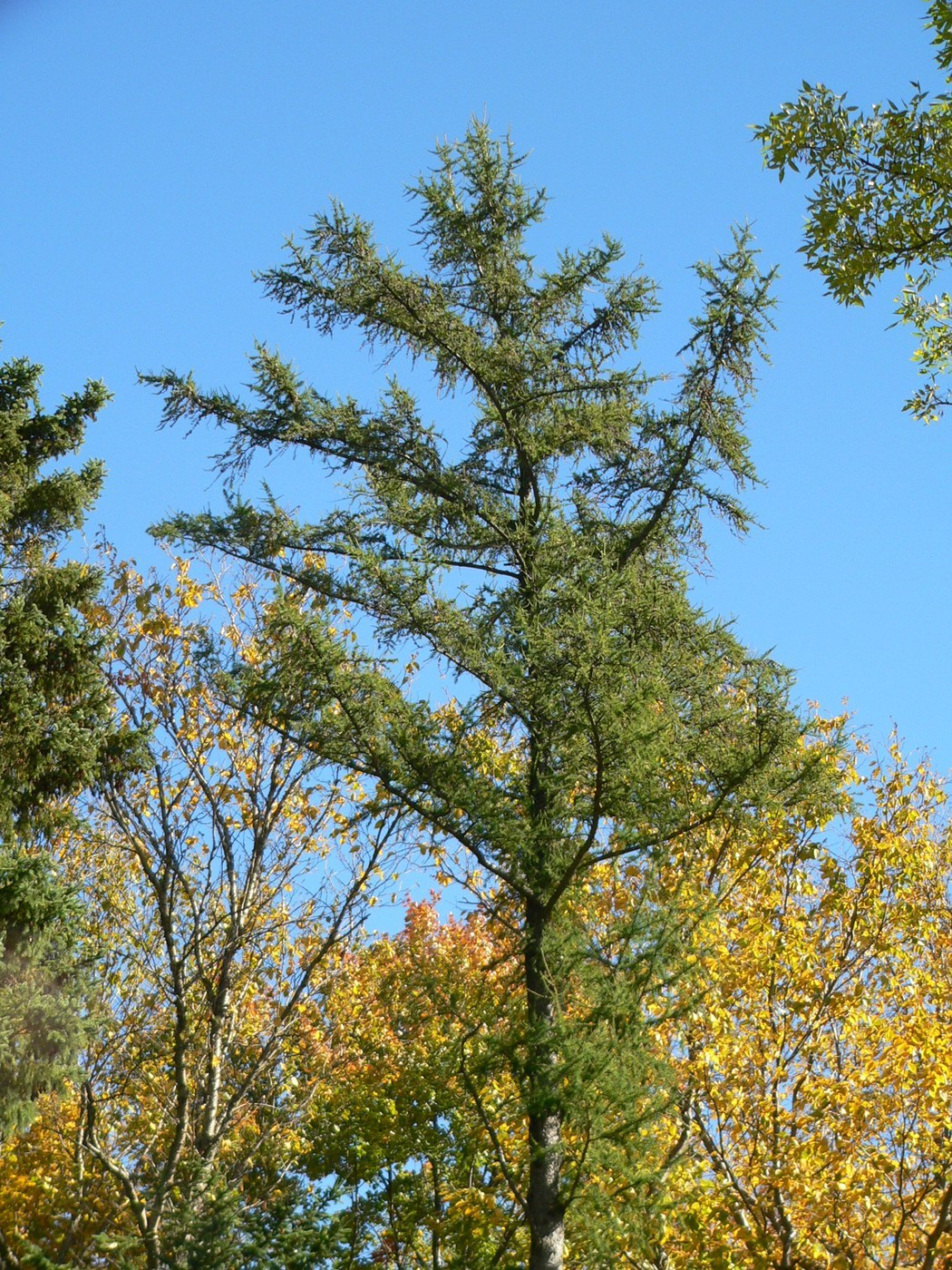
Key Identifying Features
Tamarack (Larix laricina), also called eastern larch or hackmatack, is North America's native deciduous conifer, instantly suspected when you see a needled tree that turns gold and goes bare in winter, especially in a bog or wet northern site. Its needles are soft and grow in tufts, and its cones are the smallest of any larch.
- Deciduous: soft needles turn yellow and drop in fall
- Needles in tufts of 10–20 on short spurs, single on new shoots
- Tiny cones (1–2 cm), rounded, with few scales
- Common in bogs, muskeg, and cold wet ground
Leaves & Stems
Needles are short (1–3 cm), very soft, slender, and pale blue-green, three-sided in cross-section, with whitish lines beneath. They appear in dense rosette clusters on woody short shoots (spurs) along the twigs, while elongating new growth carries them singly and spirally. The autumn color is a clear golden-yellow, after which the tree stands bare with knobby spur-studded twigs through winter. Young twigs are slender, pinkish to orange-brown and hairless, often glaucous. Bark is thin, scaly, grey to reddish-brown, flaking in small rounded plates.
Flowers & Fruit
Cones are very small (1–2 cm), egg-shaped, with only about 12–25 scales, the fewest of the larches. They are reddish when young, ripening light brown, held upright on short curved stalks, and persist on the bare twigs over winter. In spring the tree bears small yellow male cones and pinkish-red female 'larch roses'.
How to Tell It Apart from Look-Alikes
- Other larches (European, Japanese): Larger cones (2.5+ cm) with more scales; tamarack's tiny few-scaled cones are diagnostic, and it is the native larch of North American bogs.
- Black spruce (Picea mariana): Shares boggy habitat but is evergreen with stiff four-sided needles and hanging cones.
- Pines: Needles in bundles of 2–5, evergreen; tamarack needles are in many-needled soft tufts and deciduous.
Where You'll Find It
Native across the boreal forest of Canada and the northern United States, from Alaska to the Atlantic. It thrives in sphagnum bogs, muskeg, and cold poorly drained soils where few trees compete, but also grows on better-drained uplands. A slender tree turning gold over a northern wetland in October is almost always tamarack.
Quick ID Checklist
- Deciduous conifer, golden then bare in winter
- Soft pale blue-green needles in tufts on spurs
- Very small (1–2 cm) rounded cones, few scales
- Pinkish-orange, hairless young twigs
- Often in bogs / muskeg / cold wet ground
A slender, soft-needled deciduous conifer with tiny cones in a northern bog is tamarack.
Frequently asked questions
Why does tamarack lose its needles in winter?
Tamarack is a deciduous conifer; shedding its soft needles each autumn (after turning gold) helps it survive extreme cold and waterlogged boreal conditions, then it re-leafs in spring.
How do I tell tamarack from black spruce in a bog?
Both grow in bogs, but tamarack is deciduous with soft needle tufts and tiny rounded cones, while black spruce is evergreen with stiff, sharp four-sided needles and small hanging cones.
How is tamarack different from European or Japanese larch?
Tamarack has the smallest cones of the larches, only 1–2 cm with few scales, and is the native larch of North American wetlands; the introduced larches have larger cones.
Where is the best place to find tamarack?
Look in cold northern wetlands, sphagnum bogs, and muskeg across Canada and the northern U.S., especially striking in autumn when it glows golden among dark evergreens.