
Teasel Identification Guide
Identify common teasel (Dipsacus fullonum) by its spiny egg-shaped flower heads, prickly stems, and water-cupping fused leaves.
Read the full Teasel encyclopedia entry →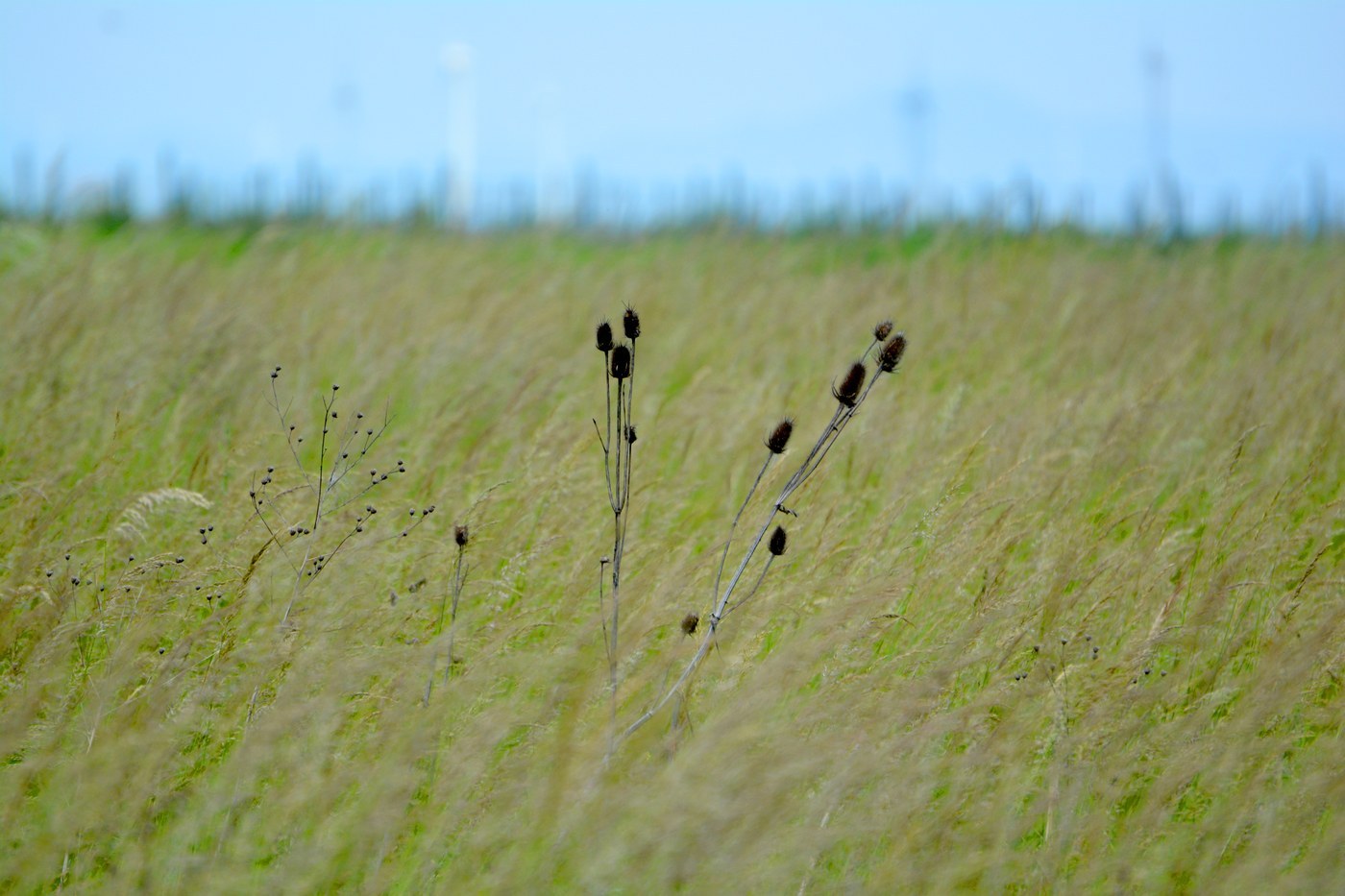
Key Identifying Features
Teasel (Dipsacus fullonum, also D. sylvestris) is a tall, prickly Eurasian biennial now widespread as an invasive in North America. Recognize it by:
- Egg-shaped to cylindrical, spiny flower heads ringed with stiff, upward-curving bracts
- A band of small pale-lavender flowers that opens in a ring around the head
- Stout, ridged stems armed with prickles
- A dead, bleafless skeleton that persists tan-brown through winter
The armored cone-like seed head on a spiny stalk is unmistakable in old fields and roadsides.
Leaves & Stems
First-year plants form a basal rosette of large, wrinkled, scalloped leaves with prickly midribs. In the second year a tall flowering stem rises 3-7 feet, deeply grooved and lined with downward- or outward-pointing prickles. The stem leaves are opposite and fused at the base around the stem, forming a cup that collects rainwater — a classic teasel trait. Leaves are lance-shaped and prickly along the underside midrib.
Flowers & Fruit
Blooming mid-to-late summer, each head is a dense, oval, spiny cone 1.5-4 inches long. The tiny tubular flowers are pale purple to lilac (sometimes white) and famously open in a ring around the middle first, then spread upward and downward in two bands. Long, stiff, upcurved bracts project from the base and among the flowers. After bloom the head dries to a hard, persistent brown seed cone full of small achenes.
How to Tell It Apart from Look-Alikes
- Cutleaf teasel (Dipsacus laciniatus) is very similar but has deeply lobed (cut) leaves and white flowers.
- Thistles (Cirsium, Carduus) have soft, fluffy purple flower heads and spiny leaf margins, but lack the rigid bristly bracts and the water-cupping fused leaves.
- Burdock (Arctium) has round burs with hooked spines and huge basal leaves, not the symmetrical spiny cone.
The rigid spiny cone plus paired water-holding leaves confirm teasel over any thistle or burdock.
Where You'll Find It
Teasel colonizes disturbed, sunny ground: roadsides, ditches, old fields, pastures, railway banks, and stream margins. It spreads aggressively across temperate North America and is considered a noxious weed in many states. Dead winter stalks with spiny heads make it easy to map populations year-round.
Quick ID Checklist
- Tall (3-7 ft) ridged, prickly stem
- Opposite stem leaves fused into a water-holding cup
- Egg-shaped spiny flower cone 1.5-4 in long
- Pale-lilac flowers opening in a ring around the head
- Long stiff upcurved bracts around the cone
- Persistent brown dried head in winter
Match these and you have common teasel. Because it is invasive, consider cutting and bagging seed heads rather than spreading them; the dried cones are popular in floral crafts.
Frequently asked questions
What is the easiest way to recognize teasel?
Its stiff, egg-shaped spiny flower cone surrounded by long upcurved bracts, on a prickly stem with paired leaves that fuse to hold rainwater, is unmistakable.
How do its flowers bloom?
The small lilac flowers open first in a ring around the middle of the cone, then progress upward and downward in two separate bands.
How is common teasel different from cutleaf teasel?
Cutleaf teasel has deeply lobed leaves and white flowers, while common teasel has unlobed leaves and pale purple flowers.
Is teasel invasive?
Yes. It is an introduced Eurasian biennial classed as a noxious or invasive weed in many parts of North America, spreading on disturbed sunny ground.
Why do its leaves hold water?
The opposite stem leaves are fused at their bases to form a cup that traps rainwater, a defining feature thought to discourage climbing insects.