
Thimbleberry Identification Guide
Identifying thimbleberry by its large fuzzy maple-shaped leaves, thornless stems, white flowers, and shallow thimble-like red fruit.
Read the full Thimbleberry encyclopedia entry →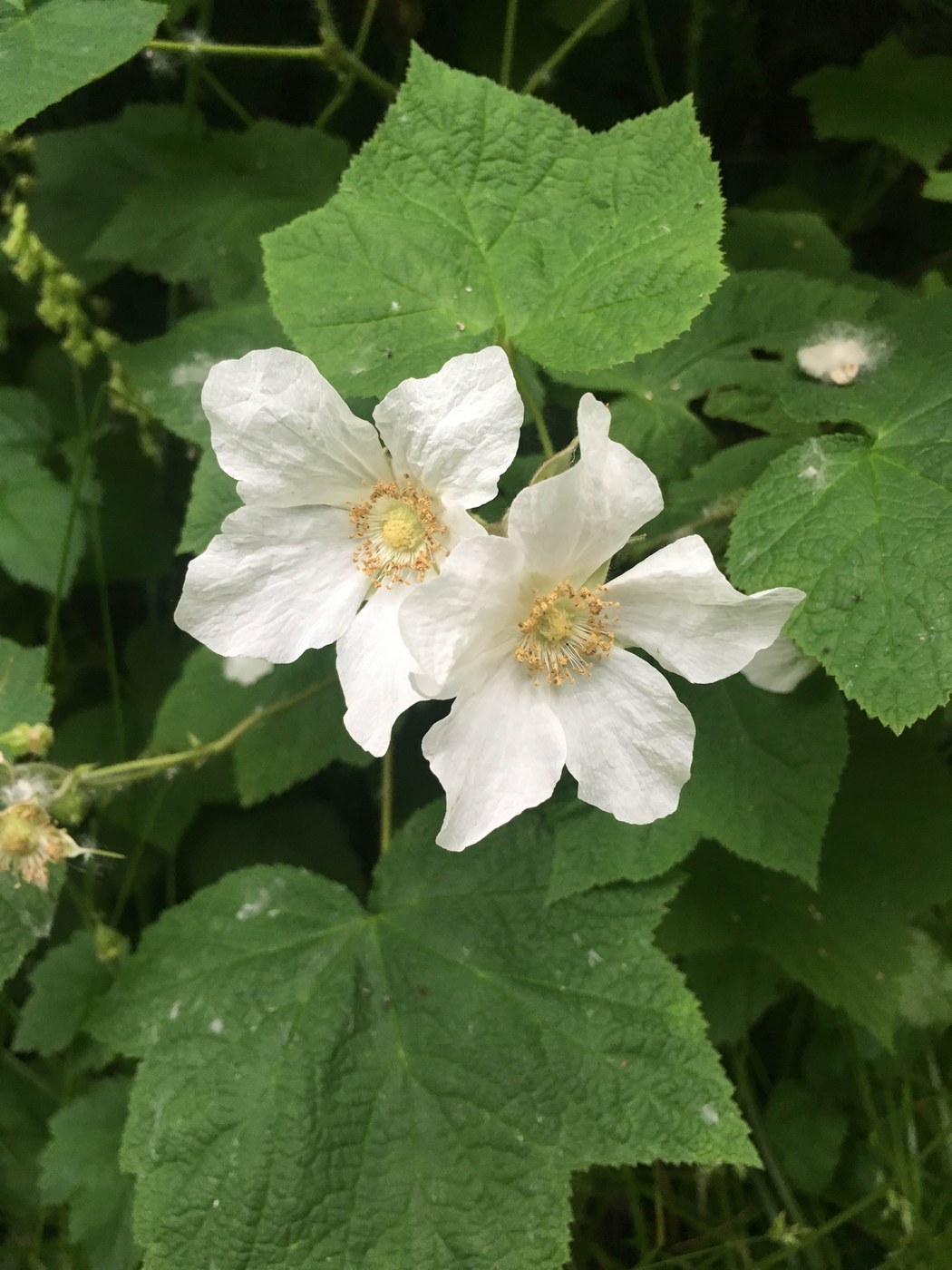
Key Identifying Features
Thimbleberry (Rubus parviflorus) is a thornless, thicket-forming shrub of western and northern North America, instantly recognized by its large, soft, maple-leaf-shaped foliage and its shallow, dome-shaped red fruit that pulls off like a thimble cap. Unlike most brambles, it has no prickles at all.
- Erect deciduous shrub, 0.5–2.5 m tall, forming colonies
- Big, fuzzy, palmate (maple-like) leaves — its best field mark
- Thornless stems with peeling, papery bark
Leaves & Stems
Leaves are simple (not compound), large (up to 20 cm wide), and palmately 5-lobed, resembling a maple or grape leaf, with a soft, velvety, slightly fuzzy texture and toothed margins. They are arranged alternately on unarmed, erect canes whose bark becomes gray-brown and shreds in thin papery strips with age. The absence of thorns combined with the maple-shaped leaf separates it at a glance from raspberries and blackberries.
Flowers & Fruit
Flowers are white (occasionally pink-tinged), large (2.5–4 cm), with five crinkly papery petals and a yellow center, borne in small clusters at branch tips. The fruit is an aggregate of drupelets like a raspberry, but broad, shallow, and dome- or cap-shaped rather than rounded — when picked it leaves a hollow center, so it resembles a thimble. Ripe fruit is bright scarlet-red, soft, and somewhat fuzzy, fragile and seedy.
How to Tell It Apart from Look-Alikes
- Salmonberry (Rubus spectabilis): has three-leaflet compound leaves, pink flowers, and prickly canes; thimbleberry has single maple-shaped leaves and white flowers and no thorns.
- Red raspberry: compound leaves and prickly canes; fruit is deeper and firmer.
- Maples/currants: have similar leaf shapes but lack the raspberry-like aggregate fruit and white five-petal flowers.
- The large fuzzy maple-shaped leaf + thornless cane + flat thimble-shaped red fruit is conclusive.
Where You'll Find It
Native across western North America and the Great Lakes region, from Alaska to Mexico and east to Michigan. Look along forest edges, roadsides, clearings, streambanks, and disturbed openings, often in partial shade. It spreads aggressively by rhizomes to form large patches.
Quick ID Checklist
- Erect thornless shrub forming thickets
- Large, soft, maple-shaped (palmate) leaves
- Papery shredding bark on older stems
- Large white crinkly-petaled flowers
- Shallow, thimble-shaped, fuzzy red fruit
- Forest edges and clearings of western/northern N. America
Frequently asked questions
What makes thimbleberry easy to identify?
Its large, soft, maple-shaped leaves on completely thornless stems are distinctive — no raspberry or blackberry shares that combination of broad palmate leaves and no prickles.
Why is it called thimbleberry?
When you pick the ripe red fruit it slips off a central core leaving a hollow, dome-shaped cap that looks and fits like a thimble.
How do I tell thimbleberry from salmonberry?
Thimbleberry has single maple-shaped leaves, white flowers, and no thorns; salmonberry has three-leaflet compound leaves, pink flowers, and weak prickles.
Where does thimbleberry grow?
It is native across western North America and the Great Lakes region, from Alaska to Mexico and east to Michigan, along forest edges, roadsides, clearings, and streambanks, often spreading into large patches by rhizomes.