
Tickseed Identification Guide
Identify Tickseed (Coreopsis) by its cheerful yellow daisy flowers with toothed ray tips and the flat, tick-like seeds that give it its name.
Read the full Tickseed encyclopedia entry →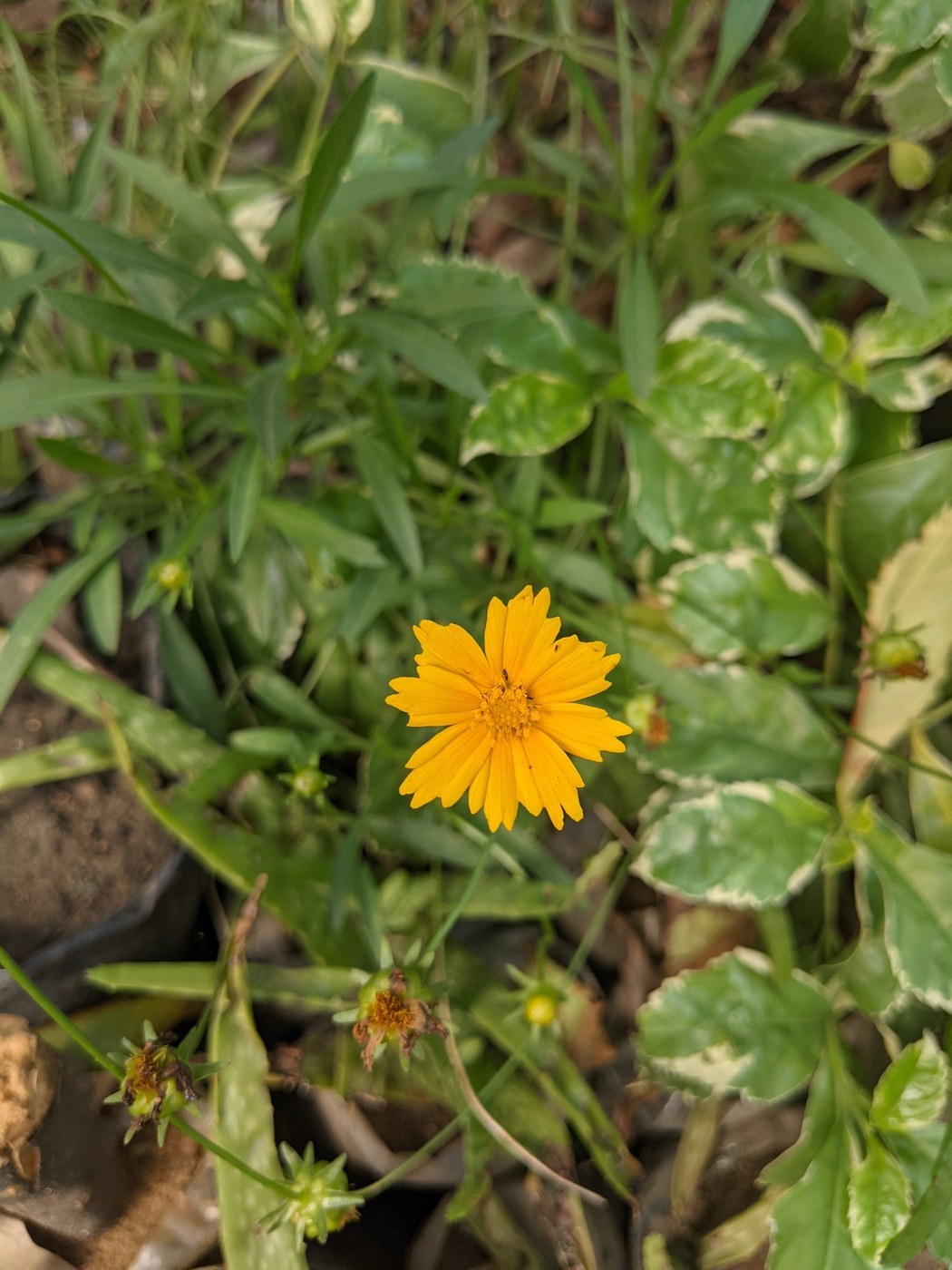
Key Identifying Features
Tickseed (Coreopsis species) is a group of sunny North American daisies in the aster family. General identifying traits across the genus:
- Bright yellow daisy flowers (sometimes with a maroon center or red banding), with ray florets typically notched or toothed at the tip.
- A double row of bracts (involucre) at the back of the flower head — an inner and outer set.
- Flat, dark, oval seeds resembling ticks, the source of the common name (Greek koris = bug).
- Upright or bushy plants, 30–120 cm (1–4 ft) depending on species.
Leaves & Stems
Leaves are opposite on slender, often wiry stems. Leaf shape varies widely by species: some, like Threadleaf Coreopsis (C. verticillata), have very fine, needle-like divided leaves; others, like Lance-leaved Coreopsis (C. lanceolata), have simple lance-shaped basal leaves; and Plains Coreopsis (C. tinctoria) has finely divided ferny foliage. Stems are usually smooth and may branch toward the top.
Flowers & Fruit
Flowering spans late spring through summer and into fall. Heads are 2.5–6 cm across, with usually 8 ray florets surrounding a yellow or brown-purple disc. The squared-off, toothed (often three-lobed) ray tips are a strong genus marker. Fruits are flat, thin, dark achenes, sometimes winged or with two tiny prongs — said to look like flat ticks.
How to Tell It Apart from Look-Alikes
- Black-eyed Susan (Rudbeckia) has rough hairy leaves, a raised brown dome center, and untoothed rays.
- Sunflowers (Helianthus) are coarser, taller, and lack notched ray tips.
- Bidens / Beggarticks are close relatives but seeds have prominent barbed prongs that cling to clothing.
- Coreopsis stands out by its notched ray tips, opposite leaves, double bract rows, and flat tick-like seeds.
Where You'll Find It
Tickseeds grow in prairies, open woods, roadsides, sandy fields, and gardens across North America. They love full sun and well-drained soil and tolerate drought and poor ground. Many species are widely cultivated as long-blooming, pollinator-friendly garden perennials and annuals.
Quick ID Checklist
- Yellow daisy flowers with notched/toothed ray tips
- Usually 8 ray florets, head 2.5–6 cm
- Double row of bracts behind the head
- Opposite leaves (thread-like to lance-shaped by species)
- Flat, dark tick-like seeds
- Sunny, dry meadows, roadsides, gardens
Frequently asked questions
Why is it called Tickseed?
The flat, dark, oval seeds resemble ticks (insects). The scientific name Coreopsis comes from Greek words meaning 'bug-like,' also referring to the seeds.
How do I tell Tickseed from Black-eyed Susan?
Tickseed usually has smooth opposite leaves and notched, squared-off ray tips, while Black-eyed Susan has rough hairy leaves, a raised dark dome center, and smooth rounded rays.
Are all Tickseeds yellow?
Most are golden-yellow, but several species and cultivars have maroon centers or red-and-yellow banding (like Plains Coreopsis), and a few garden forms are pink or red.
Why do Tickseed leaves look so different between plants?
Coreopsis is a large genus — leaves range from thread-fine (threadleaf) to lance-shaped (lance-leaved). Use the flower's notched rays and double bracts as the consistent ID, not leaf shape alone.