
Tiger Jaws Identification Guide
Identify Tiger Jaws (Faucaria tigrina) by its paired triangular leaves edged with soft, tooth-like spines that look like a snapping jaw.
Read the full Tiger Jaws encyclopedia entry →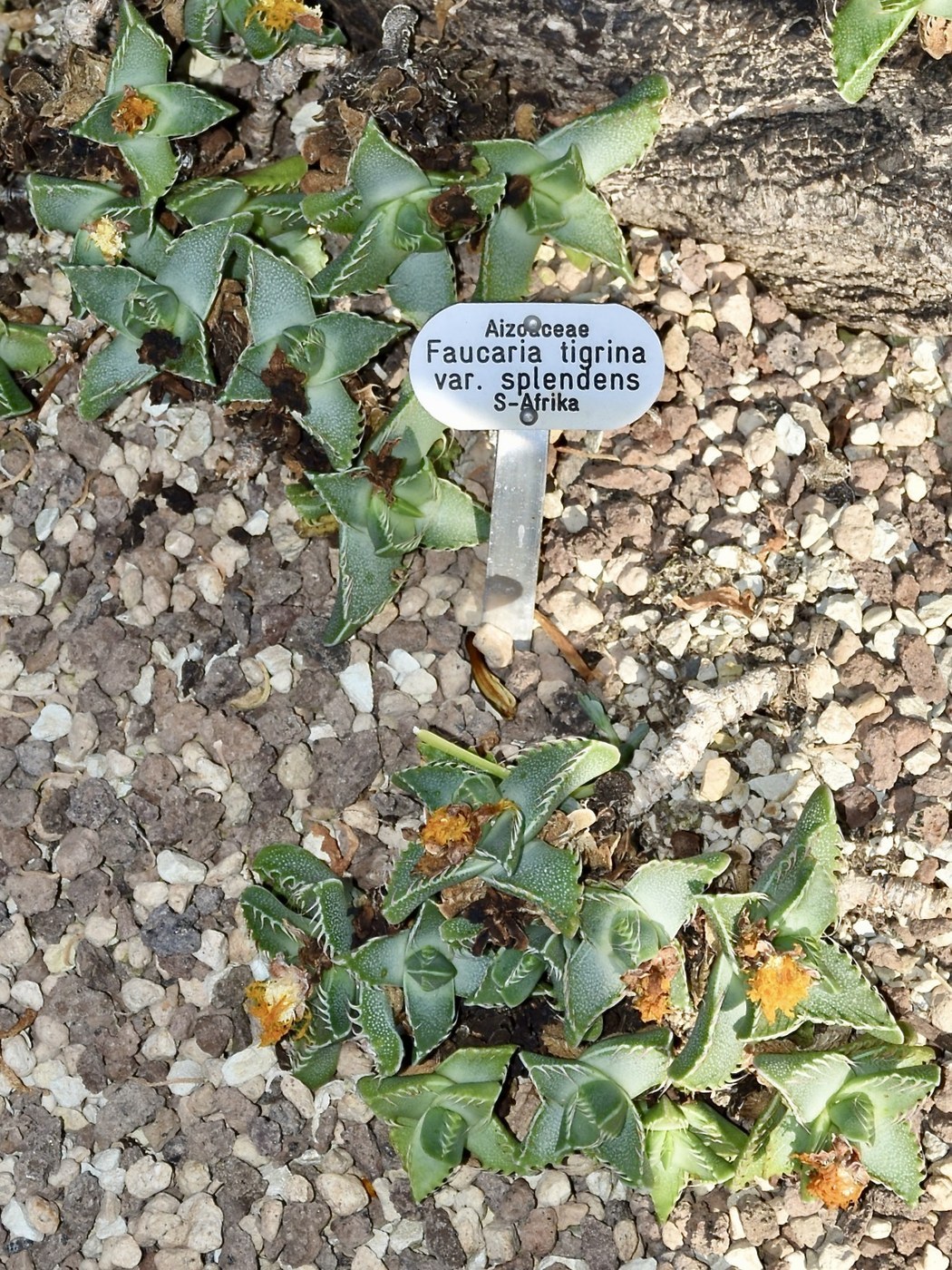
Key Identifying Features
Tiger Jaws (Faucaria tigrina) is a small clumping succulent whose fleshy, triangular leaves are lined with soft, recurved teeth along the margins, so each opposing pair looks like a set of open, toothy jaws. It stays low and compact, forming rosette-like clusters only a few inches tall and wide.
- Paired, triangular-to-rhombic leaves arranged in cross-shaped opposite pairs
- Soft, fang-like teeth along each leaf margin (the "jaws")
- Leaves thick, gray-green to green, often dotted with tiny white spots (tubercles)
- Compact, clumping rosette habit
Leaves & Stems
Leaves are stout, succulent, and boat-shaped, broad at the toothed mouth and keeled beneath. The marginal teeth are soft and bristle-tipped, not truly sharp — they bend rather than puncture, so they look fiercer than they are. New leaf pairs emerge at right angles to the previous pair. The surface is frequently speckled with small raised white dots, enhancing the tiger-like look. There is virtually no visible stem.
Flowers & Fruit
In autumn, Tiger Jaws produces large, bright yellow, daisy-like flowers that open in the afternoon and close at night, sometimes nearly covering the small plant. The shiny yellow blooms are a strong ID clue and contrast vividly with the toothed green leaves. Fruit is a small capsule.
How to Tell It Apart from Look-Alikes
- Faucaria felina / other Faucaria: Very similar toothed jaws; F. tigrina typically has more numerous teeth (often 9–10 per side) and conspicuous white leaf dots.
- Aloe / Haworthia with toothed leaves: Those form larger rosettes and have firmer teeth and different (often tubular) flowers; Faucaria stays tiny with paired jaw-like leaves and yellow daisy flowers.
- Stomatium and other mesembs: Related toothed succulents; flower color/time and leaf shape distinguish them, but the paired-jaw silhouette is the genus clue.
Where You'll Find It
Native to the Eastern Cape of South Africa, growing in semi-arid, rocky grassland. It is a popular, easy windowsill succulent worldwide, grown in bright light, gritty well-drained soil, and dry winters. Hardy to about USDA zones 9–11; elsewhere a houseplant. Overwatering causes the jaws to bloat and split, so keep it lean.
Quick ID Checklist
- Paired triangular leaves forming open "jaws"
- Soft, fang-like teeth along the margins
- Gray-green leaves speckled with white dots
- Low, clumping; large yellow daisy flowers in autumn
- South African mesemb; keep dry
Frequently asked questions
Are the teeth sharp?
No. The fang-like marginal teeth are soft and bristle-tipped — they bend when touched and look much fiercer than they actually are, so the plant is safe to handle.
When does it flower?
Tiger Jaws blooms in autumn, producing large, shiny yellow daisy-like flowers that open in the afternoon and close in the evening.
Why are the leaves splitting or looking bloated?
That's usually overwatering. As a dry-climate mesemb it stores water in its leaves; too much causes them to swell and split. Water sparingly and use gritty, fast-draining soil.
What are the white spots on the leaves?
They are small raised tubercles (dots) on the leaf surface, a normal feature of Faucaria tigrina that adds to its tiger-like appearance.