
Trout Lily Identification Guide
Identify Trout Lily (Erythronium) by its mottled brown-green leaves and nodding, reflexed yellow or white lily flowers. This guide covers its spring-ephemeral habit and colony growth.
Read the full Trout Lily encyclopedia entry →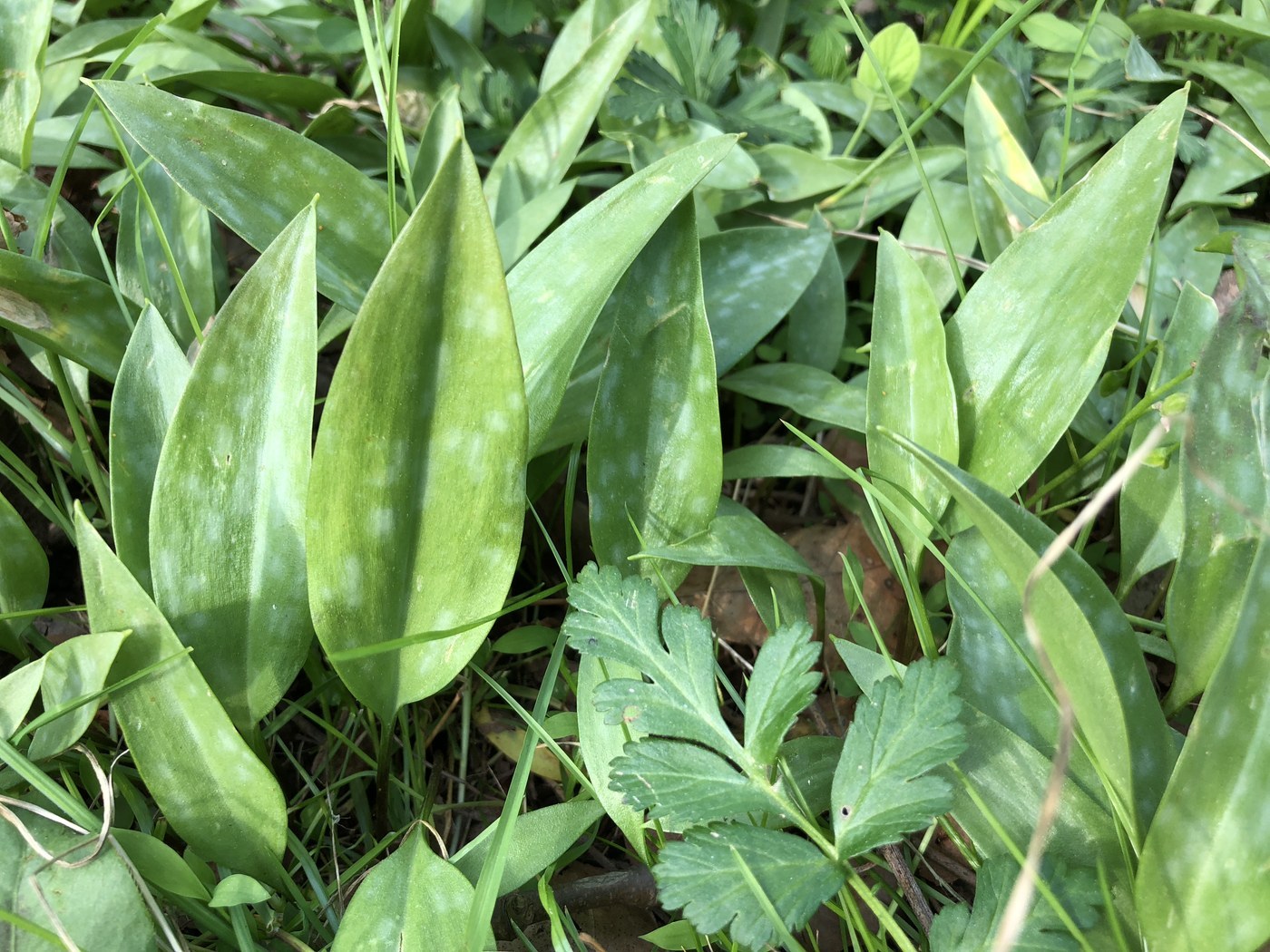
Key Identifying Features
Trout Lily (genus Erythronium), also called dogtooth violet or fawn lily, is a small spring woodland wildflower named for its mottled leaves that resemble a brook trout's markings. Flowering plants are only 4 to 10 inches (10 to 25 cm) tall and produce a single nodding lily flower with strongly reflexed petals.
- Two mottled brown-and-green leaves (flowering plants)
- A single nodding flower with backward-curving petals
- Flowers usually yellow (E. americanum) or white (E. albidum)
- Forms large colonies on the forest floor
Leaves & Stems
Flowering plants have two basal leaves, while non-flowering plants have just one. The leaves are elliptical, smooth, and distinctively mottled with purplish-brown blotches over green, giving the trout-like pattern. A single smooth, leafless flower stalk rises between the leaves. The plant grows from a small underground corm.
Flowers & Fruit
The solitary flower nods downward and has six tepals (3 petals + 3 sepals) that curve sharply backward (reflexed), exposing six stamens. Color is typically bright to pale yellow (often bronze-tinged outside) or white with a yellow center, depending on species. Blooming is brief, in early spring (March to May). The fruit is a small capsule. Colonies can be vast but only a fraction bloom in a given year.
How to Tell It Apart from Look-Alikes
- Spring beauty (Claytonia): grows nearby in the same woods but has flat pink-striped flowers and grass-like leaves.
- Dogtooth violet name confusion: it is not a violet; violets have heart-shaped leaves and irregular flowers.
- Other Erythronium: western fawn lilies are larger; the mottled leaves remain the common thread.
The mottled paired leaves plus a single nodding, reflexed lily flower are the surest identifiers.
Where You'll Find It
Trout Lily carpets rich, moist deciduous woodlands and floodplains across eastern North America (with relatives in the West). It is a spring ephemeral, appearing, blooming, and dying back before the trees leaf out. Look for it in early spring in big mottled-leaf colonies, most of which are non-flowering single leaves.
Quick ID Checklist
- Mottled brown-green leaves (trout-like)
- Two leaves = flowering; one leaf = not
- Single nodding flower with reflexed tepals
- Yellow or white blooms
- Forms large woodland colonies
- Early spring ephemeral
Frequently asked questions
Why is it called trout lily?
Because its leaves are mottled with purplish-brown blotches over green, resembling the speckled markings of a brook trout. The pattern is one of the easiest ways to spot the plant even before it blooms.
Why do so many trout lilies have only one leaf and no flower?
Single-leaved plants are immature or non-flowering; only plants with two leaves bloom. Trout lilies form huge colonies from corms, and in any given spring only a small fraction produce flowers.
Is trout lily the same as a violet?
No. Although it is sometimes called dogtooth violet, it is a member of the lily family, not a true violet. Its nodding, reflexed six-tepal flower is clearly lily-like, not violet-shaped.
When and where does it bloom?
It blooms in early spring, roughly March to May, in rich, moist deciduous woodlands and floodplains, then dies back as a spring ephemeral before the forest canopy fills in.