
Turmeric Identification Guide
Recognize turmeric by its vivid orange-fleshed rhizome, large broad oblong leaves, and cone-like flower spike with pink-tipped bracts. Includes how to separate it from ginger and other Curcuma species.
Read the full Turmeric encyclopedia entry →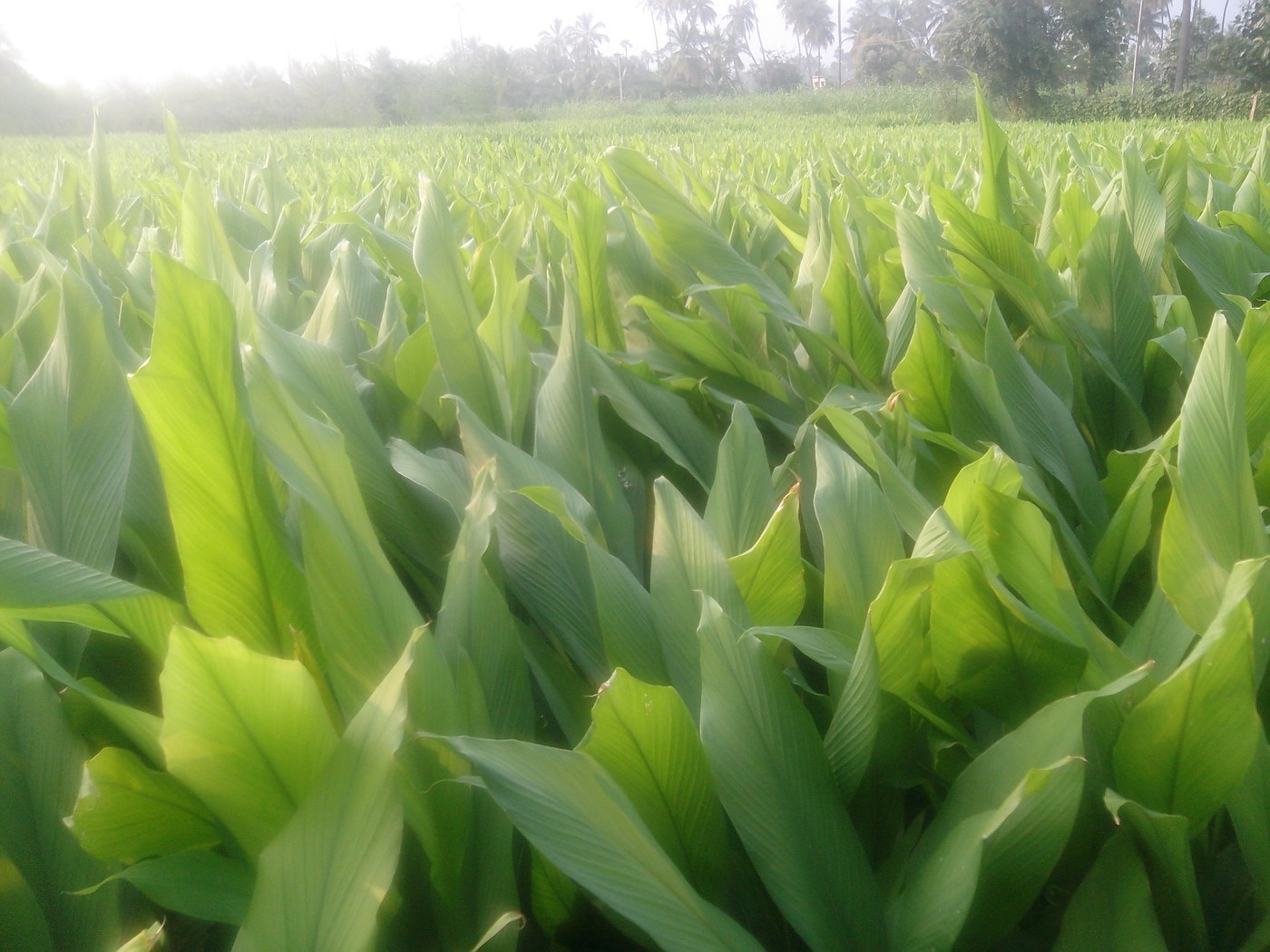
Key Identifying Features
Turmeric (Curcuma longa) is a tropical perennial in the ginger family (Zingiberaceae). Its unmistakable feature is the rhizome with vivid deep-orange interior that stains everything yellow. Above ground it forms clumps of large, broad, oblong leaves up to 1 m tall, and a striking cone-shaped flower spike topped with pink or white bracts.
Leaves & Stems
- Leaves are large, oblong to elliptic-lanceolate, 30-115 cm long, much broader than ginger's.
- They are smooth, deep green, with a prominent midrib and fine parallel veins.
- The leaves arise from a base of overlapping sheaths forming a pseudostem.
- The rhizome is finger-like and branching, dull brown skin outside, bright orange inside, with an earthy peppery aroma.
Flowers & Fruit
- The inflorescence is a dense cone-like spike rising on its own stalk, 10-20 cm tall.
- It carries overlapping green bracts lower down topped by a showy coma of pink, white, or pale-tipped sterile bracts.
- Small pale-yellow tubular flowers nestle between the lower bracts.
- True fruit/seed is rarely formed; it reproduces by rhizome.
How to Tell It Apart from Look-Alikes
- Ginger (Zingiber officinale) has narrower lance-shaped leaves and a pale yellow rhizome interior, versus turmeric's bright orange.
- Mango ginger (Curcuma amada) and zedoary (Curcuma zedoaria) are close relatives with paler interiors and different aromas (raw-mango or camphor).
- Canna lilies can resemble the foliage but have showy iris-like flowers and lack an aromatic orange rhizome.
- The decisive test is the bright orange, deeply staining rhizome flesh.
Where You'll Find It
Turmeric is grown across South and Southeast Asia and other tropical regions, and in pots/greenhouses elsewhere. It needs warm temperatures, high humidity, partial shade, and rich, moist, well-drained soil. It is a cultivated crop, not naturally wild.
Quick ID Checklist
- Rhizome with bright orange staining flesh
- Large broad oblong leaves to ~1 m
- Cone-shaped flower spike with pink/white top bracts
- Earthy peppery aroma from cut rhizome
- Clump-forming pseudostems
Frequently asked questions
How do I tell turmeric from ginger?
Cut the rhizome: turmeric is bright orange inside and stains your fingers yellow, while ginger is pale yellow. Turmeric also has broader, larger leaves than ginger's narrow lance-shaped ones.
What does the turmeric flower look like?
It forms a cone-shaped spike on its own stalk with overlapping green bracts topped by showy pink or white sterile bracts, and small pale-yellow flowers tucked between the lower bracts.
Why is turmeric used as a dye?
Its rhizome contains curcumin, a strongly pigmented compound, which is also why the orange flesh stains skin, cloth, and cutting boards bright yellow.
Can turmeric grow in cool climates?
Only with help. It is a tropical plant needing warmth and humidity, so in temperate areas it is grown in pots brought indoors or in heated greenhouses.