
Velvet Calathea Identification Guide
Identify the Velvet Calathea (Goeppertia / Calathea rufibarba) by its wavy-edged leaves with a soft fuzzy underside and feathery texture. Includes look-alike comparisons.
Read the full Velvet Calathea encyclopedia entry →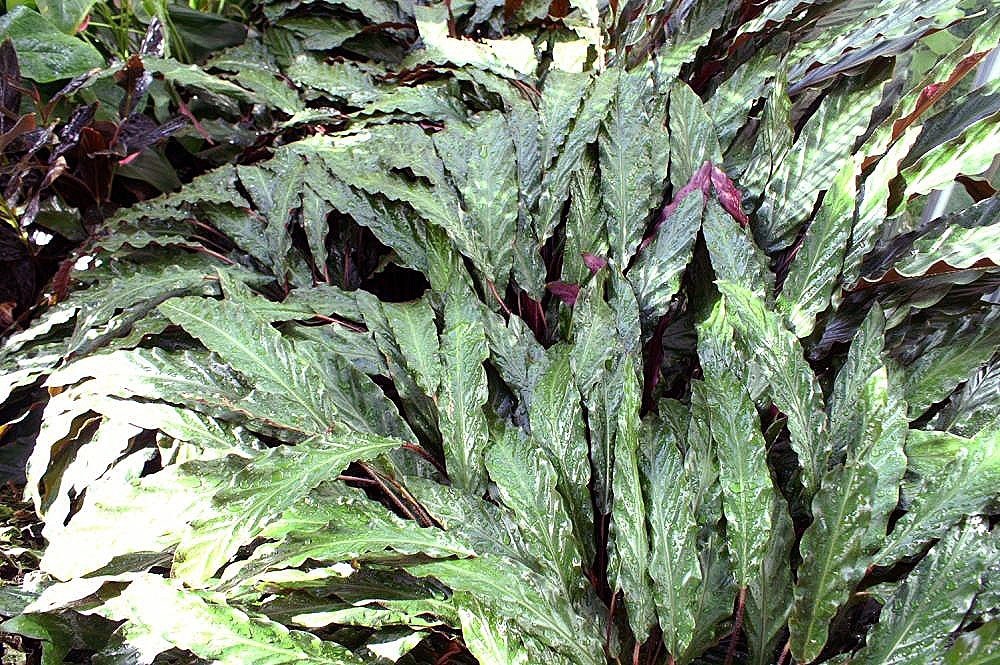
Key Identifying Features
The Velvet Calathea (Goeppertia rufibarba, syn. Calathea rufibarba, also called Furry Feather Calathea) is a prayer plant recognized by its long, narrow, wavy-margined leaves that are fuzzy and velvety to the touch, especially underneath, with burgundy-red fuzz on the undersides and stems.
- Long, lance-shaped leaves with wavy (undulate) edges
- Soft, velvety, fuzzy texture on leaf undersides
- Deep maroon-purple undersides and reddish leaf stalks
- Prayer-plant movement (leaves rise at night)
Leaves & Stems
Leaves are elongated and feather-like, deep green on top with a distinctly rippled, wavy margin. Unlike most patterned calatheas, the upper surface is fairly plain green rather than boldly striped; the drama is in the texture. The undersides are reddish-purple and covered in fine fuzz (the epithet rufibarba means "red-bearded"), and the petioles are slender, red, and also fuzzy. Plants grow upright in clumps to 2-3 feet, with leaves that fold upward in the evening, a hallmark of the Marantaceae family.
Flowers & Fruit
Indoors it rarely flowers, but may produce small yellow-orange blooms low among the foliage. The plant is grown for its foliage and texture, not flowers, and ornamental fruit is not produced indoors.
How to Tell It Apart from Look-Alikes
- Other Calatheas (e.g., 'Orbifolia', 'Medallion') have bold patterned, smooth leaves; Velvet Calathea is set apart by its fuzzy texture and plain green tops.
- Rattlesnake Plant (Goeppertia insignis) also has wavy narrow leaves but bears dark spots/markings and a smooth surface.
- Maranta (prayer plant) trails and has patterned leaves, not the upright fuzzy form.
The velvety feel + wavy edge + red fuzzy underside trio is diagnostic.
Where You'll Find It
Native to Brazilian rainforests, it is grown as a humidity-loving houseplant in bright indirect light. It needs consistent moisture and warmth and dislikes drafts. It is commonly sold as 'Wavestar' or simply Furry Feather.
Quick ID Checklist
- Long, narrow leaves with wavy edges
- Velvety/fuzzy texture, especially underneath
- Maroon-purple undersides and red fuzzy stems
- Plain green tops (no bold pattern)
- Leaves fold up at night (prayer-plant habit)
If the leaves feel like soft suede and have red fuzzy backs, it is Velvet Calathea.
Frequently asked questions
Why do the leaves feel fuzzy?
The undersides and stems are covered in fine soft hairs, giving a velvety feel. This texture is the defining trait of Calathea rufibarba.
Why are the tops plain green when other calatheas are patterned?
Velvet Calathea is grown for texture rather than markings. Its plain green tops with wavy edges and fuzzy red undersides distinguish it.
Do the leaves really move?
Yes. Like other prayer plants, the leaves rise and fold upward at night and lower during the day in response to light.
Why are the leaf stems reddish?
The red, fuzzy petioles are natural. The name rufibarba means red-bearded, referring to this coloring.