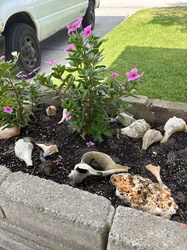
Vinca Identification Guide
How to identify Vinca by its glossy paired leaves, five-petaled pinwheel flowers, and milky sap — covering both annual Madagascar periwinkle and trailing perennial periwinkle.
Read the full Vinca encyclopedia entry →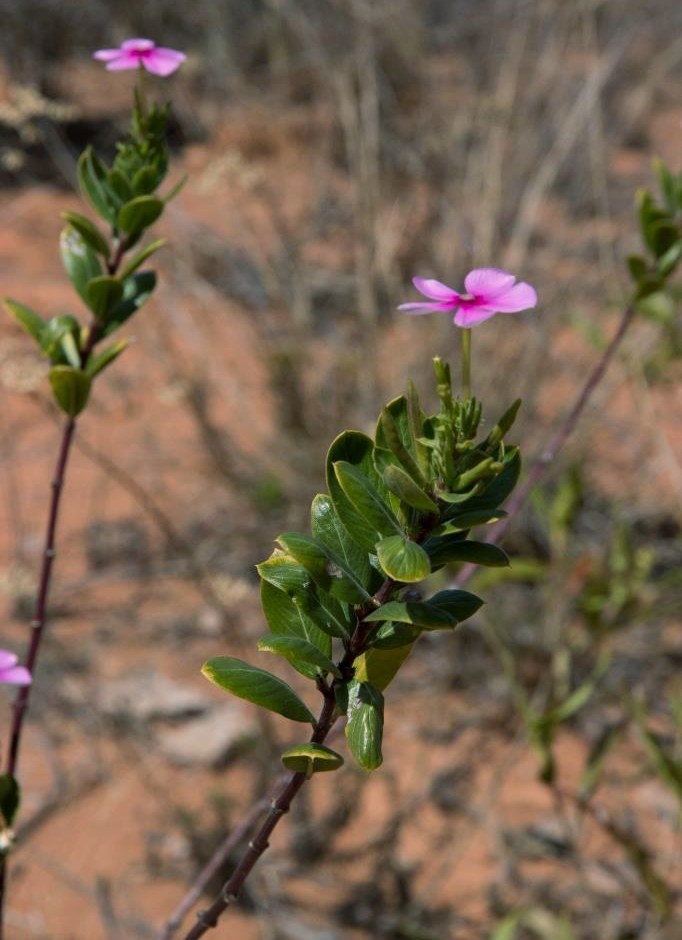
Key Identifying Features
The name Vinca covers two related but different plants, both in the dogbane family (Apocynaceae) with glossy paired leaves, milky sap, and flat five-petaled "pinwheel" flowers:
- Annual vinca / Madagascar periwinkle (Catharanthus roseus) — an upright bedding annual
- Perennial vinca / periwinkle (Vinca minor and V. major) — a trailing evergreen groundcover
A reliable shared clue is the five overlapping petals fused at the base into a short tube, forming a propeller-like bloom, plus opaque white sap that oozes from a broken stem or leaf.
Leaves & Stems
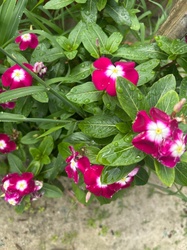
Leaves are opposite, simple, oval to lance-shaped, untoothed, and distinctly glossy with a pale midrib.
- Annual vinca: deep green leaves, upright bushy stems 6-18 in (15-45 cm) tall
- Vinca minor: small leaves ~1 in, slender trailing stems that root at nodes
- Vinca major: larger leaves up to 3 in, often with fine hairs on leaf margins
Stems of the perennial types are wiry and creeping, forming dense evergreen mats.
Flowers & Fruit
Each flower is a flat disc 1-2 in (2.5-5 cm) across with five asymmetric petals that pinwheel around a small central eye. Annual vinca comes in white, pink, rose, and red, often with a contrasting eye; perennial periwinkles are typically blue-violet (V. minor) or larger lilac-blue (V. major). Fruits are slender paired follicles, though they often go unnoticed.
How to Tell It Apart from Look-Alikes
- Impatiens: also used as shade annuals but has spurred flowers and translucent, brittle stems with no milky sap.
- Phlox: five petals too, but petals are separate to the base and leaves are not glossy.
- Annual vs perennial vinca: if it's upright and bushy in full sun, it's Catharanthus; if it's trailing, evergreen, and shade-loving with blue flowers, it's true Vinca.
Where You'll Find It
Annual vinca is a tough heat- and drought-tolerant bedding plant for sunny beds and containers. Perennial periwinkle is a common groundcover under trees and on banks, staying green through winter; V. minor and V. major are considered invasive in some regions because their rooting stems spread aggressively.
Quick ID Checklist
- Glossy, paired (opposite) untoothed leaves
- Milky white sap from cut stems
- Flat 5-petaled pinwheel flowers with a small eye
- Upright + sun-loving = annual vinca (Catharanthus)
- Trailing + evergreen + blue flowers = perennial periwinkle (Vinca)
Frequently asked questions
Are annual vinca and periwinkle the same plant?
No. Annual vinca is Catharanthus roseus, an upright sun-loving bedding annual. Periwinkle (Vinca minor/major) is a trailing evergreen groundcover. They look similar but belong to different genera.
What does the milky sap tell me about the plant?
Both vincas exude an opaque white sap from a broken stem or leaf. This milky sap is a shared trait of the dogbane family and a handy clue for confirming the genus.
How do I tell Vinca minor from Vinca major?
Vinca major has noticeably larger leaves (up to 3 in) with fine hairs along the edges and bigger flowers; V. minor has smaller, hairless leaves about 1 inch long.
Why is my trailing vinca taking over the garden?
Perennial periwinkle roots wherever its stems touch soil, forming dense mats. This vigor makes it a good groundcover but also potentially invasive in mild climates.
Vinca identified by the community
Recent Vinca specimens identified with Plant Identifier.