
Virginia Pine Identification Guide
Identify Virginia Pine (Pinus virginiana) by its short, twisted needles in pairs, scrubby branchy form, and persistent small prickly cones.
Read the full Virginia Pine encyclopedia entry →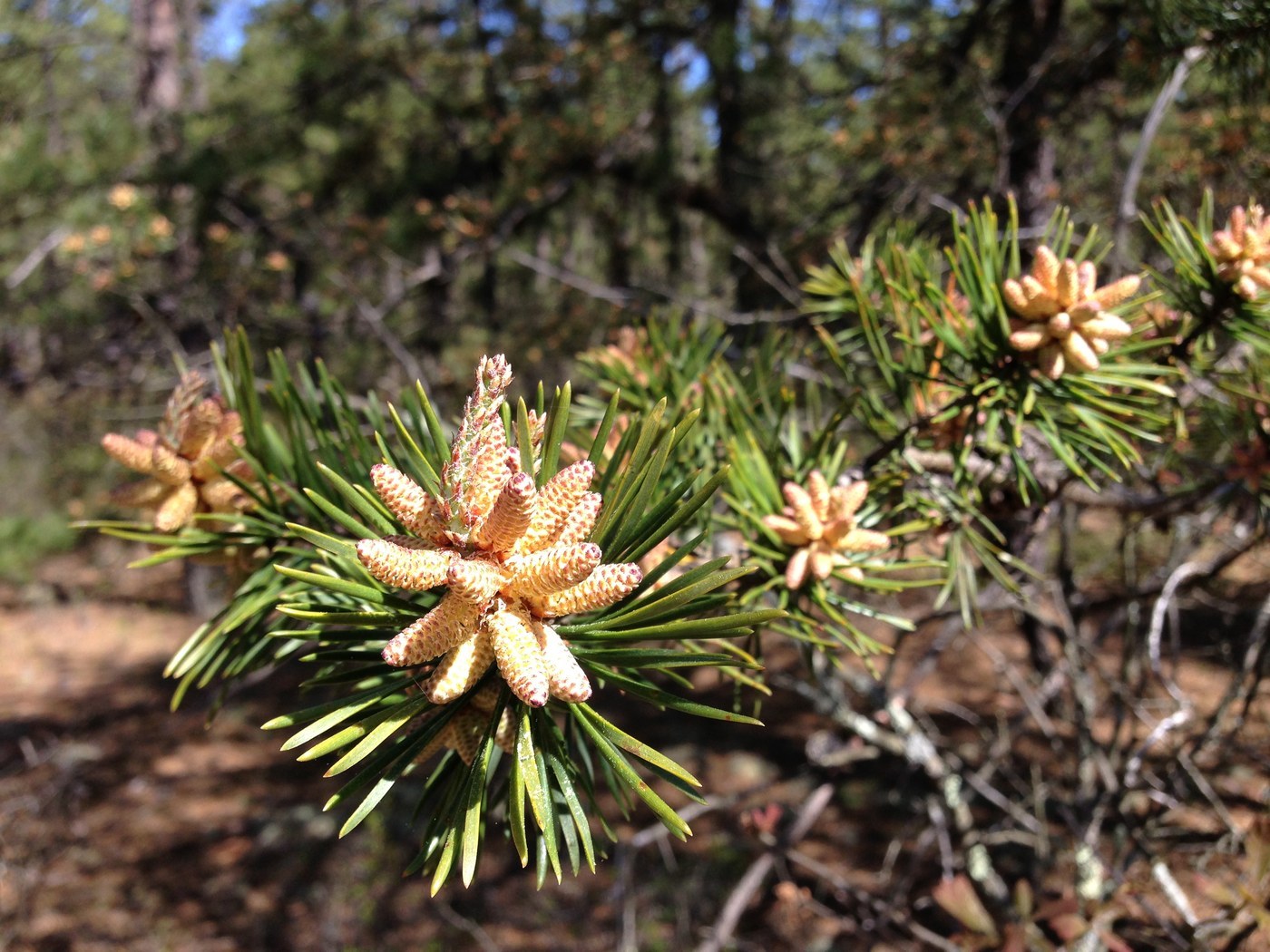
Key Identifying Features
Virginia Pine (Pinus virginiana), also called scrub pine, is a small to medium eastern pine of poor soils and old fields. It is recognized by its short, twisted needles in pairs, scraggly, irregular crown, and abundance of small, prickly cones that cling to the branches for years.
- Short needles (1.5–3 in) in bundles of two, often twisted
- A scrubby, open, branchy habit, frequently with a crooked trunk
- Persistent dead branches low on the trunk
- Small, sharp-prickled cones that stay on the tree
Leaves & Stems
Needles grow in fascicles of two, are short (about 1.5–3 inches), stiff, and noticeably twisted or contorted, yellow-green to gray-green. The short, twisted, paired needles are the quickest tell. Young twigs often have a purplish or glaucous (waxy gray) bloom, another helpful clue. The bark is thin, reddish-brown, and breaks into small scaly plates; lower dead branches commonly persist.
Flowers & Fruit
Cones are small, 1.5–2.8 inches, egg-shaped, reddish-brown, and each scale bears a slender sharp prickle. They open at maturity but remain attached to the branches for many years, often in clusters, giving older trees a cone-laden look. Pollen cones are small and orange-brown in spring.
How to Tell It Apart from Look-Alikes
- Shortleaf Pine has slightly longer needles often in bundles of two and three and small cones, plus distinctive resin pits in the bark; Virginia's needles are consistently in twos and more twisted.
- Pitch Pine has needles in threes and tufts sprouting from the trunk.
- Table Mountain Pine has heavy cones with stout, hooked spines.
- The short twisted 2-needle bundles + purplish twigs + scrubby form + persistent small cones combination is classic Virginia Pine.
Where You'll Find It
Virginia Pine is native to the eastern United States, from New York and Pennsylvania south through the Appalachians and Piedmont to Georgia and Alabama. It is a pioneer of abandoned fields, eroded clay soils, and dry ridges, often forming dense even-aged stands and widely grown for Christmas trees.
Quick ID Checklist
- Short, twisted needles in 2s (1.5–3 in)
- Scrubby, branchy crown, crooked trunk
- Twigs often purplish/waxy
- Small prickly cones persisting for years
- Eastern U.S. old fields and poor dry soils
Frequently asked questions
How do I quickly recognize Virginia Pine?
Short, twisted needles in pairs on a scrubby, branchy tree with small prickly cones that stay attached for years is the classic Virginia Pine signature.
What is the difference between Virginia Pine and Shortleaf Pine?
Virginia Pine has consistently paired, twisted, shorter needles, while Shortleaf Pine often bears needles in twos and threes, has longer needles, and shows small resin pits in its bark.
Why is it called scrub pine?
It readily colonizes poor, eroded, and abandoned land where few trees thrive, growing into scrubby, irregular forms — hence the name.
Are the purplish twigs a reliable clue?
Yes, young Virginia Pine twigs often have a purplish or waxy gray bloom, which is a helpful supporting feature alongside the short twisted needles.