
Whale's Tongue Agave Identification Guide
Identify the Whale's Tongue Agave (Agave ovatifolia) by its wide, cupped, powdery blue-gray leaves forming a large symmetrical rosette with toothed margins.
Read the full Whale's Tongue Agave encyclopedia entry →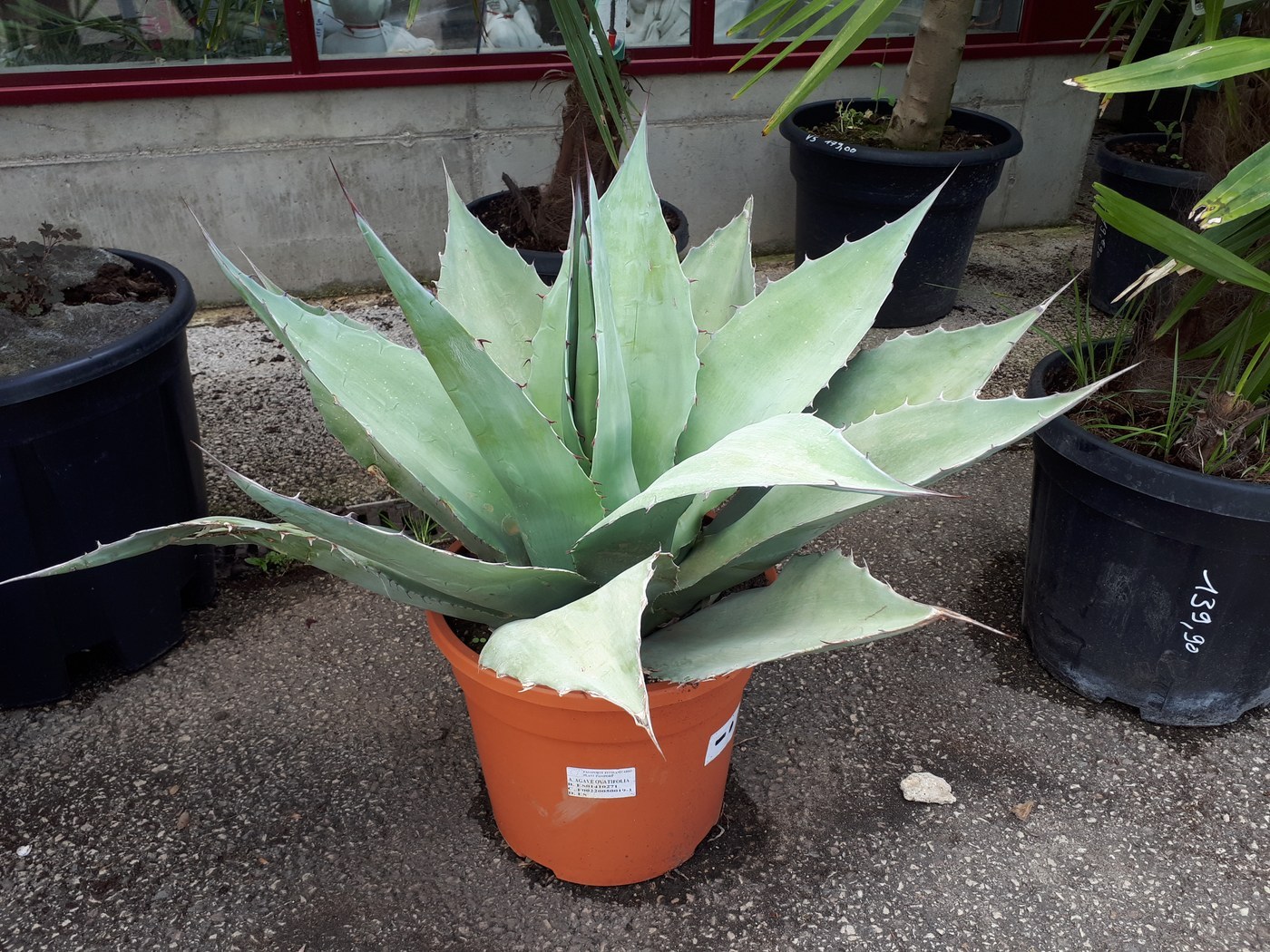
Key Identifying Features
The Whale's Tongue Agave (Agave ovatifolia) is a large, handsome agave named for its broad, cupped, gray-blue leaves that resemble a whale's tongue. It forms a wide, symmetrical, solitary rosette of unusually wide leaves, making it one of the most prized ornamental agaves for bold, architectural plantings.
- Broad, wide, ovate leaves that are distinctly cupped (channeled)
- Powdery blue-gray to silver-gray (glaucous) color
- Large, symmetrical, single (non-clumping) rosette, often 3-5 feet wide
- Toothed leaf margins and a sharp terminal spine
Leaves & Stems
The leaves are the standout trait: notably wide and short relative to their length, with a deep cupped or spoon-like channel down the upper surface — the "whale's tongue" shape. They are a beautiful chalky powder-blue to silvery gray, holding a heavy glaucous bloom. The margins bear regular teeth, and each leaf ends in a stout, sharp terminal spine. The species name ovatifolia means "oval-leaved," referencing the broad leaf shape. The rosette is solitary (it rarely produces offsets), forming a single tidy dome with little to no above-ground trunk.
Flowers & Fruit
After many years a mature rosette throws up a massive flower spike 10-15+ feet tall, branching into horizontal panicles bearing greenish-yellow flowers. Like all agaves it is monocarpic: the rosette dies after blooming. Because it seldom offsets, propagation is mainly by seed. Flowering is infrequent, so leaf shape and color are the practical identifiers.
How to Tell It Apart from Look-Alikes
- Agave parryi: also blue-gray and symmetrical, but leaves are smaller, more spoon-tipped and clustered, and it offsets freely; Whale's Tongue has much wider, cupped leaves and stays solitary.
- Agave americana: larger, with longer, recurving, less cupped leaves and abundant pups; lacks the broad whale-tongue shape.
- Agave guiengola: broad and pale too, but with a flatter leaf and different toothing; Whale's Tongue is bluer and more deeply cupped.
Where You'll Find It
Native to the Sierra Lincoln of Nuevo León, Mexico, where it grows on high-elevation limestone slopes (giving it good cold tolerance). It is widely planted as a landscape specimen in warm-temperate to subtropical gardens (USDA zones 7b-11) and is a favorite focal plant in xeriscapes and modern desert-style designs.
Quick ID Checklist
- Broad, wide, cupped (channeled) leaves
- Powder-blue to silver-gray glaucous color
- Large, symmetrical, solitary rosette (rarely pups)
- Toothed margins and a sharp terminal spine
- Whale-tongue leaf silhouette
- Tall branched flower spike; dies after flowering
Tip: The wide, deeply cupped, powder-blue leaves on a solitary rosette distinguish it from the narrower-leaved, freely clumping blue agaves like A. parryi and A. americana.
Frequently asked questions
Why is it called Whale's Tongue Agave?
Its leaves are unusually broad and deeply cupped, resembling the shape of a whale's tongue. This wide, channeled, powder-blue leaf is the plant's most distinctive feature.
Does Whale's Tongue Agave produce pups?
Rarely. Unlike many agaves, A. ovatifolia is usually solitary and seldom offsets, so it's typically propagated from seed. A solitary rosette is itself an identification clue.
Is it cold-hardy?
It is relatively cold-tolerant for an agave because it comes from high-elevation limestone slopes in northeastern Mexico, generally surviving in USDA zones 7b and warmer with good drainage.
How do I tell it from Agave parryi?
Agave parryi has smaller, more spoon-tipped leaves and offsets freely, while Whale's Tongue Agave has much broader, deeply cupped leaves and stays as a single large solitary rosette.