
Willow Oak Identification Guide
How to recognize willow oak by its distinctive narrow, willow-like leaves, small acorns, and form. Covers leaves, bark, fruit, look-alikes, and habitat.
Read the full Willow Oak encyclopedia entry →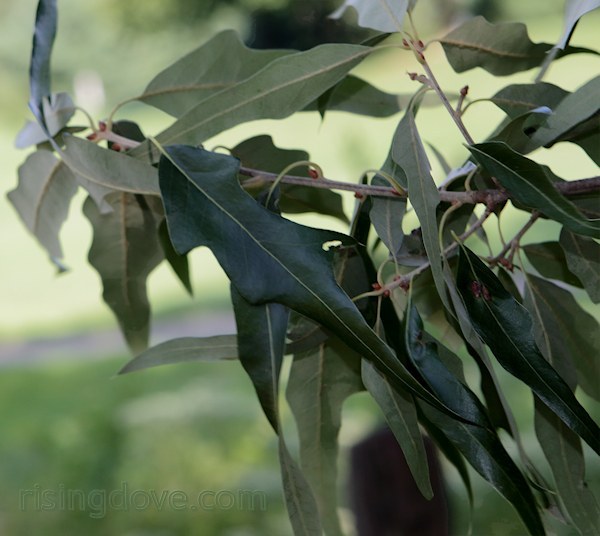
Key Identifying Features
Willow oak (Quercus phellos) surprises many people because it does not look like a typical oak at all. Instead of broad lobed leaves, it carries slender, willow-shaped leaves with smooth, unlobed margins. It is a member of the red oak group, confirmed by the tiny bristle tip at the leaf apex and acorns that mature in two seasons. Mature trees form a tall, straight trunk with a rounded, dense crown, often reaching 60-100 feet.
Leaves & Stems
- Leaves are narrow and lance-shaped, typically 2-5 inches long and only about a half-inch wide.
- Margins are entire (untoothed and unlobed), with a single sharp bristle tip at the end — the giveaway that this is a red-group oak.
- The upper surface is light to medium green and glossy; the underside is paler and may have a few hairs.
- Foliage turns yellow to pale russet-bronze in fall and often hangs on late.
- Twigs are slender and reddish-brown; buds are small, sharply pointed, and reddish-brown, clustered at the twig tip as in all oaks.
Flowers & Fruit
- Spring brings drooping yellow-green catkins of male flowers; female flowers are tiny and inconspicuous.
- Acorns are very small, about a half-inch, nearly round, light brown, with a thin, shallow, saucer-like cap covering only the top.
- Acorns take two years to mature, so you may see two sizes on a branch.
How to Tell It Apart from Look-Alikes
- True willows (Salix) also have narrow leaves but bear capsules with cottony seeds, not acorns, and have toothed (finely serrate) margins. Willow oak leaves are untoothed and tipped with a bristle.
- Laurel oak (Quercus laurifolia) has wider, more leathery leaves that are sometimes slightly lobed near the tip and persist later into winter.
- Shingle oak (Quercus imbricata) has broader, oblong leaves with a rounded base.
- Water oak (Quercus nigra) has spatula-shaped leaves that are widest near the rounded tip, not uniformly narrow.
Where You'll Find It
Willow oak is native to the southeastern and south-central United States, thriving in moist bottomlands, floodplains, and stream banks. It tolerates compacted urban soils and is widely planted as a street and shade tree in the South and mid-Atlantic. Look for it lining city avenues and parking lots where its uniform crown and clean foliage are valued.
Quick ID Checklist
- Narrow, willow-like leaves with smooth, unlobed margins
- A single bristle tip at the leaf apex (red oak group)
- Small, nearly round acorns with shallow saucer caps
- Clustered, pointed reddish buds at twig tips
- Tall straight trunk, dense rounded crown
- Wet bottomlands or used as a Southern street tree
If you find an oak whose leaves look like a willow's but the tree drops acorns, you are almost certainly looking at willow oak.
Frequently asked questions
Why are willow oak leaves so narrow if it's an oak?
Willow oak simply evolved slender, unlobed leaves; the bristle tip at the leaf apex and the acorns confirm it is a true oak in the red oak group despite the willow-like shape.
How can I separate willow oak from an actual willow?
Check the fruit and margins: willows produce seed capsules with cottony fluff and have finely toothed leaf edges, while willow oak produces acorns and has smooth, untoothed leaf edges tipped with a tiny bristle.
How big are willow oak acorns?
They are unusually small for an oak, only about a half-inch, nearly round, light brown, with a thin shallow cap, and they take two years to ripen.
Where is willow oak commonly planted?
It is a popular street and shade tree across the southeastern and mid-Atlantic United States because it tolerates urban soils and forms a clean, uniform, rounded crown.