
Witchgrass Identification Guide
How to identify witchgrass (Panicum capillare), a hairy summer annual grass famous for its huge, fluffy, tumbleweed-like seedhead. Covers its softly hairy leaves and sheaths and diffuse airy panicle.
Read the full Witchgrass encyclopedia entry →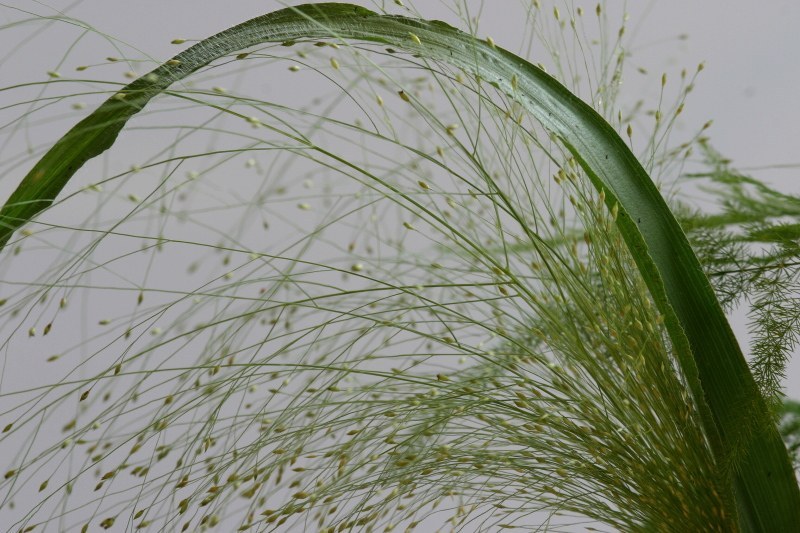
Key Identifying Features
Witchgrass (Panicum capillare) is a warm-season annual grass best known for its enormous, lacy seedhead that can make up nearly half the plant's height. The whole plant is conspicuously soft-hairy, and at maturity the open seedhead often breaks off and tumbles in the wind, scattering seed. Look for a bushy, light-green annual with very hairy leaf sheaths and a delicate, much-branched flower cluster.
- Densely hairy leaf blades and sheaths (velvety to the touch)
- A huge, diffuse, airy panicle with thread-like branches
- Membranous ligule fringed with short hairs
- Plants usually 1 to 2.5 feet tall, often branching at the base
- Mature seedhead detaches and tumbles
Leaves & Stems
The leaf blades are flat, fairly broad (up to about half an inch wide), and covered with long, soft hairs on both surfaces. The leaf sheaths are especially noticeable, clothed in dense spreading hairs that you can feel easily when sliding fingers along the stem. At the collar there is a ligule made of a fringe of fine hairs. Stems are smooth above but the plant overall feels fuzzy and soft. Plants often branch and spread at the base, forming a leafy lower clump topped by the airy seedhead.
Flowers & Fruit
The inflorescence is a large, open, finely branched panicle that can be 4 to 16 inches long and nearly as wide, accounting for one-third to one-half of the plant. The branches are extremely fine, almost hair-like (hence capillare), giving a cloudy, gauzy appearance. Tiny spikelets sit at the branch tips. As seeds ripen, the panicle turns straw-colored, becomes brittle at the base, and snaps off to tumble across the ground. Flowering occurs from midsummer through fall.
How to Tell It Apart from Look-Alikes
- Fall panicum (Panicum dichotomiflorum): Mostly hairless with a smooth, often zig-zag stem; its panicle is open but less feathery and the plant is not velvety.
- Old witchgrass/other Panicums: Distinguish by hairiness; witchgrass is unusually shaggy on the sheaths.
- Foxtails: Form a single dense bristly spike, never an airy cloud.
- Barnyardgrass: Has no ligule and a coarse, bristly branched head rather than a fine, diffuse one.
The combination of velvety-hairy sheaths plus an enormous gossamer seedhead that tumbles is essentially unique among common annual grasses.
Where You'll Find It
Witchgrass colonizes dry, disturbed, sandy or gravelly ground: cultivated fields, gardens, roadsides, railways, vacant lots, and overgrazed pastures. It tolerates poor, droughty soils and full sun, and is widespread across North America as a weed of crops and waste places.
Quick ID Checklist
- Bushy summer annual grass, 1 to 2.5 ft
- Soft-hairy blades and densely hairy sheaths
- Ligule of hairs at the collar
- Giant, lacy, much-branched panicle (half the plant)
- Mature seedhead breaks off and tumbles
- Dry, sandy, disturbed soils in full sun
Frequently asked questions
Why is it called witchgrass?
The name comes from the way the large, brittle seedhead breaks off at maturity and tumbles across the ground in the wind, almost seeming to fly, while scattering its seed.
What is the most distinctive feature of witchgrass?
The enormous, fine, cloud-like panicle that makes up roughly a third to half of the plant, combined with conspicuously hairy leaf sheaths.
How do I separate witchgrass from fall panicum?
Feel the sheaths. Witchgrass is densely soft-hairy and velvety, while fall panicum is essentially hairless with smooth, sometimes zig-zagging stems.
Does witchgrass have a ligule?
Yes, it has a ligule made of a fringe of short hairs at the leaf collar, unlike barnyardgrass which has no ligule at all.