
Wood Betony Identification Guide
Recognize wood betony (Betonica/Stachys officinalis) by its crinkled, scalloped basal leaves and dense terminal spikes of reddish-purple flowers.
Read the full Wood Betony encyclopedia entry →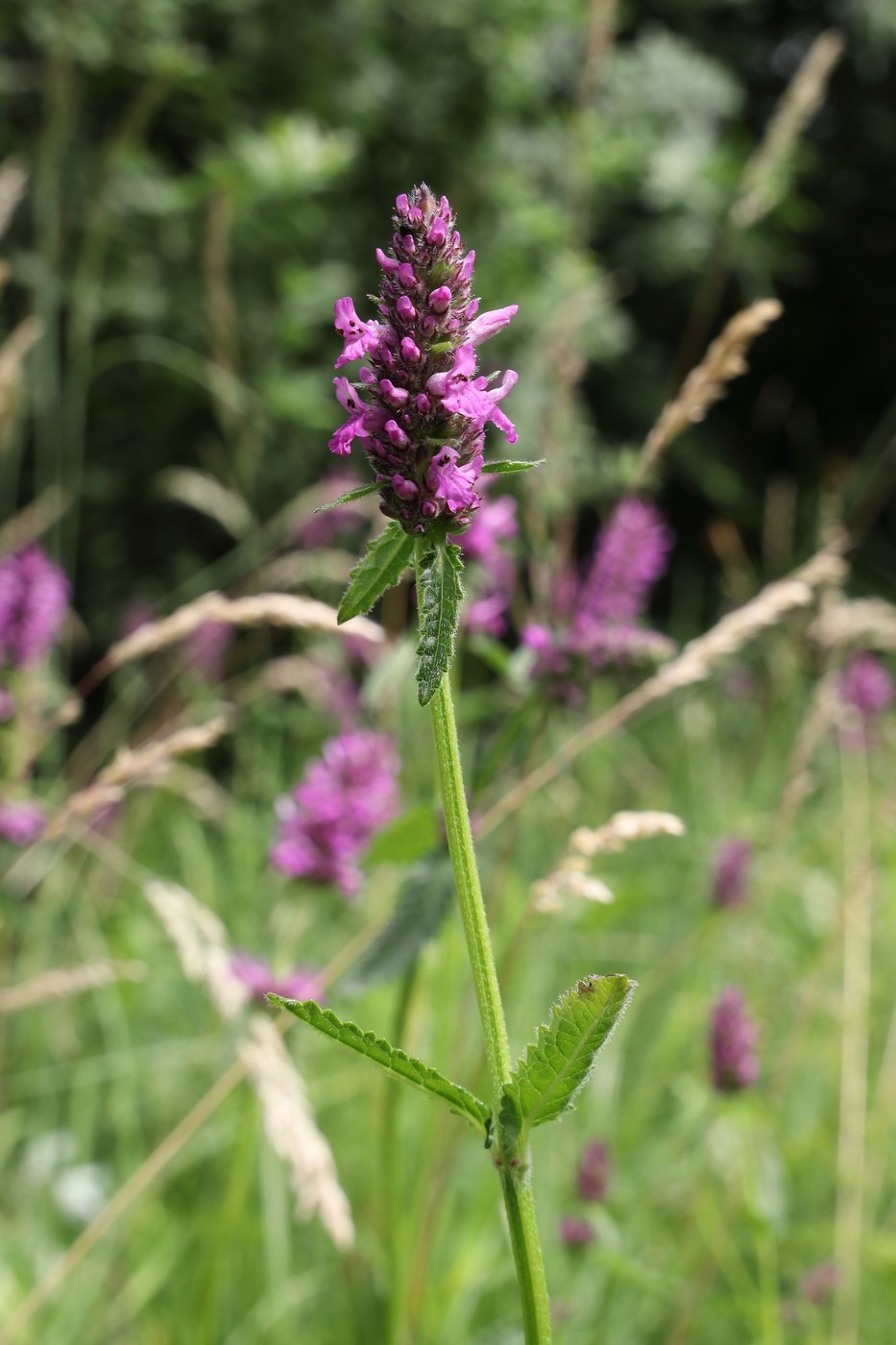
Key Identifying Features
Wood betony (Betonica officinalis, formerly Stachys officinalis) is a clump-forming perennial of the mint family that you can spot by its rosette of wrinkled, blunt-toothed leaves topped by tall, near-leafless stems carrying a dense oblong spike of magenta-purple flowers.
- Upright flower stems 1-2 ft (30-60 cm) tall
- Square stems typical of the mint family
- Most foliage in a basal rosette; few stem leaves
Leaves & Stems
Leaves are oblong to heart-shaped at the base, with a distinctly scalloped or bluntly toothed (crenate) margin and a deeply wrinkled, textured surface. They are slightly rough and hairy, dark green, and held on long stalks in a ground-level rosette. The flowering stem is square in cross-section (a mint-family hallmark) and carries only one or two small pairs of nearly stalkless leaves, leaving a long bare section below the flower head. Despite being in the mint family, wood betony is only faintly aromatic.
Flowers & Fruit
In early to midsummer, each stem ends in a short, dense, cylindrical spike of flowers, often with a small gap below the main cluster. Individual flowers are reddish-purple to bright magenta, about 1/2 in (1-1.5 cm) long, and two-lipped - the upper lip hooded, the lower lip three-lobed and spreading. The tubular calyx has pointed teeth. After flowering, small brown nutlets form within the persistent calyx.
How to Tell It Apart from Look-Alikes
- Hedge woundwort (Stachys sylvatica): Has triangular, pointed, more nettle-like leaves and a strong smell; betony's leaves are blunt-toothed and nearly scentless.
- Self-heal (Prunella vulgaris): Shorter, with a squat flower head and more entire leaves.
- Foxglove or purple loosestrife: Taller with different flower structure; betony's two-lipped mint flowers and basal rosette set it apart.
- The reliable combination is a basal rosette of crinkled, scalloped leaves plus a near-leafless square stem ending in a dense magenta spike.
Where You'll Find It
Wood betony grows in grasslands, open woods, heaths, hedge banks, and meadow edges, favoring lighter, slightly acidic soils in sun or light shade. It is native across Europe and grown in wildflower and herb gardens elsewhere.
Quick ID Checklist
- Basal rosette of oblong, heart-based, scallop-toothed, wrinkled leaves
- Square stems with very few leaves
- Dense oblong spike of magenta two-lipped flowers in summer
- 1-2 ft tall in grassland or open woodland
- Faint or no minty smell
Frequently asked questions
How do I distinguish wood betony from other mint-family plants?
Look for the ground-level rosette of crinkled, blunt-toothed leaves combined with a tall, nearly leafless square stem ending in a dense magenta flower spike - a combination unique among common mint relatives.
Is wood betony aromatic like other mints?
Only faintly. Unlike many minty relatives, betony has little scent, so a strong smell points to a look-alike like hedge woundwort instead.
What color are wood betony flowers?
Reddish-purple to bright magenta, two-lipped, and packed into a short cylindrical spike at the top of the stem.
Where is the best place to find wood betony?
In grasslands, open woodland, heaths, and grassy banks on lighter, somewhat acidic soils, often in full sun to light shade.