
Yew Identification Guide
How to identify yews by their flat soft dark needles, reddish flaky bark, and bright red fleshy berry-like arils.
Read the full Yew encyclopedia entry →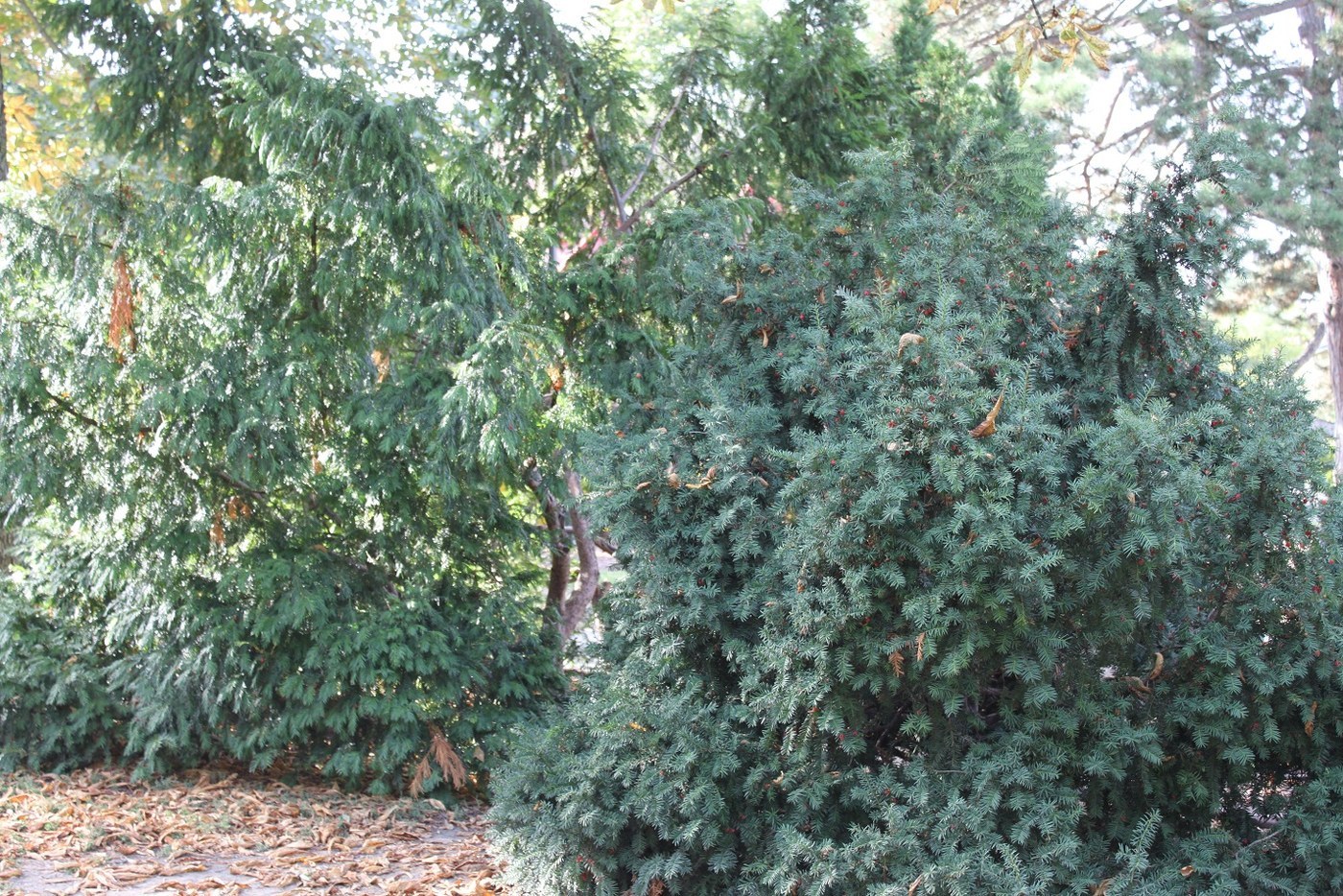
Key Identifying Features
Yews (Taxus spp.) are evergreen conifers grown as shrubs and small trees, instantly recognized by their flat, soft, dark green needles and bright red, cup-like fleshy 'berries' (arils) with an open end exposing a single seed. Unlike pines and spruces, yews bear no woody cones. Foliage is dense and dark, and the bark is thin, reddish-brown, and flaky.
- Flat, soft, dark green needles with a pointed but not stiff tip
- Two-ranked needle arrangement along green twigs
- Red, fleshy, open-ended arils (not true berries, not cones)
- Reddish, peeling bark
Leaves & Stems
Needles are linear, flat, 1/2-1 inch long, arranged in two flattish rows (two-ranked) along the green shoots, dark glossy green above and paler green (not chalky-white) beneath. They are soft and flexible, not sharp to grip. Twigs stay green for a year or two. The bark is thin, scaly, reddish-brown to purplish, flaking off in patches—a good winter clue. Yews tolerate heavy shearing, so landscape plants are often dense, formal hedges.
Flowers & Fruit
Yews are usually dioecious (separate male and female plants). Male plants release pollen from small pale cones in spring. Female plants produce the distinctive fruit: a single seed surrounded by a fleshy, bright red, cup-shaped aril that is open at the tip, exposing the dark seed. These appear in late summer to fall and are the easiest identification feature.
How to Tell It Apart from Look-Alikes
- Hemlock (Tsuga): also flat soft needles, but with two white bands beneath, tiny stalks, and small woody cones (yew has none).
- Fir (Abies): flat needles but stiffer, with white bands below and upright woody cones.
- Junipers: scale/needle foliage and blue berry-like cones, not flat two-ranked needles.
- Plum yew (Cephalotaxus): longer needles and olive-like green-to-purple fruit.
The flat soft two-ranked needles, green twigs, no cones, and red open-ended arils confirm a true yew.
Where You'll Find It
Yews are among the most common evergreen foundation shrubs and hedges in temperate gardens (especially Japanese yew, Taxus cuspidata, and English yew, T. baccata). In the wild they grow in shaded forests and on limestone; English yew is famous in old European churchyards. They thrive in shade to sun and well-drained soil.
Quick ID Checklist
- Evergreen with flat, soft, dark green needles in two rows
- Needles green (not white-banded) beneath
- Green young twigs, reddish flaky bark
- No woody cones
- Bright red, open-tipped fleshy arils on female plants
Frequently asked questions
How do I tell a yew from a hemlock?
Flip a needle: hemlock has two whitish bands underneath and produces small woody cones, while yew needles are uniformly green below and yews bear red fleshy arils instead of cones.
Do all yews have red berries?
No. Yews are usually separate male and female plants, so only female plants produce the red arils. Male plants only shed pollen and never fruit.
Why do yews not have pine cones?
Yews belong to a conifer family that produces a single seed wrapped in a fleshy aril rather than a woody cone. The absence of cones combined with flat soft needles is a key ID trait.
What does yew bark look like?
Yew bark is thin, scaly, and reddish-brown to purplish, flaking off in patches. This is a helpful clue in winter when combined with the flat, soft, two-ranked needles and green young twigs.