
Yucca Palm Identification Guide
How to recognize the Yucca Palm (often Yucca elephantipes/Y. gigantea) by its thick cane trunk, fountain of stiff sword leaves, and growth habit.
Read the full Yucca Palm encyclopedia entry →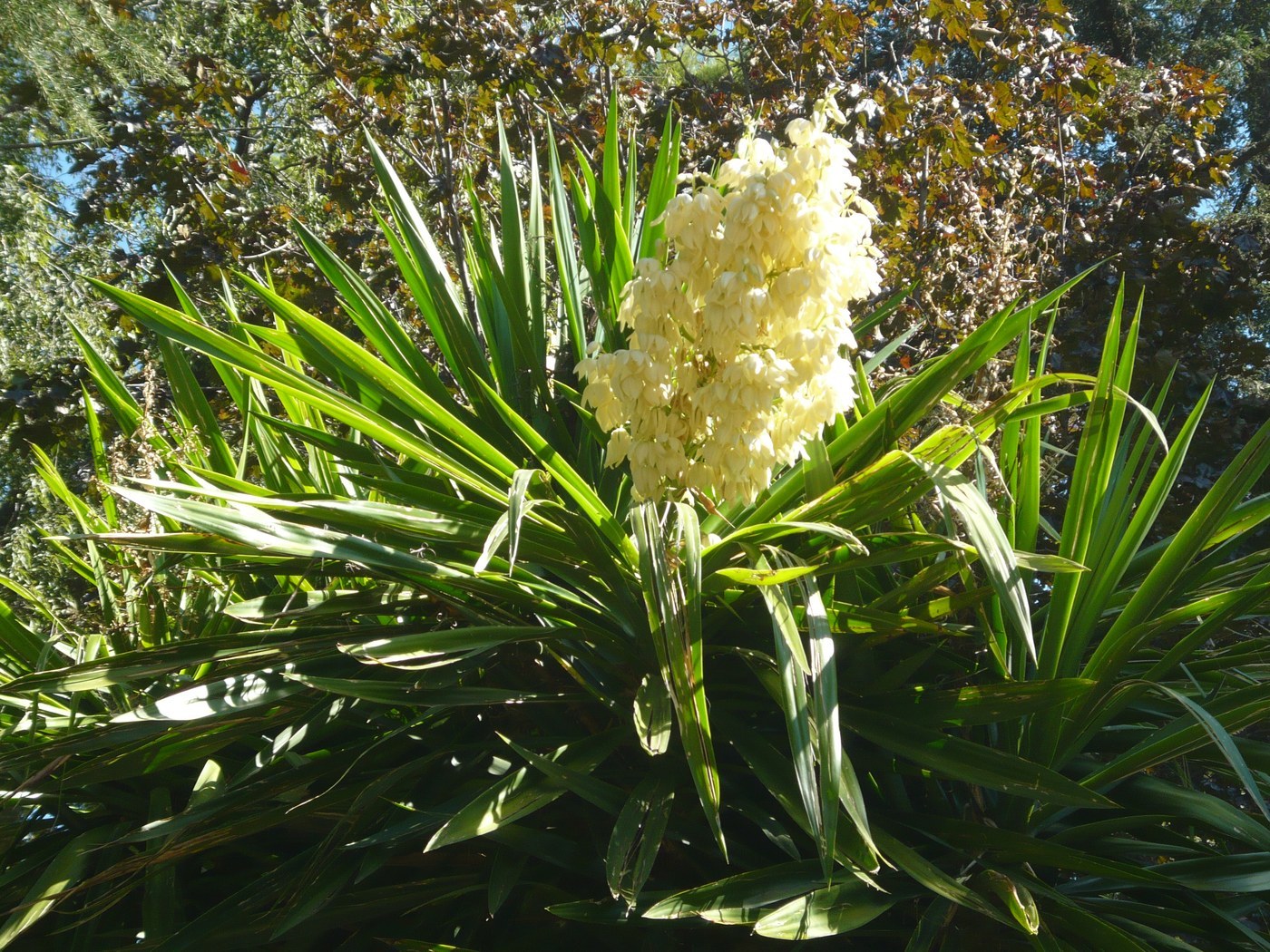
Key Identifying Features
The Yucca Palm is not a true palm at all but a member of the asparagus family (Asparagaceae), most commonly the spineless yucca, Yucca gigantea (syn. Y. elephantipes). You recognize it instantly by a thick, woody, often swollen-based trunk topped with one or more rosettes of long, sword-shaped leaves that radiate out like a fountain.
- Cane-like trunk: pale grey-brown, corky, frequently sold as several stacked logs of different heights in one pot
- Rosette of stiff, strap leaves at each growing tip
- Swollen, elephant-foot base on mature specimens (the source of the name elephantipes)
- Slow, upright, tree-like habit
Leaves & Stems
Leaves are 40–100 cm long, 5–7 cm wide, linear to sword-shaped, tapering to a point. In the popular Y. gigantea the leaf tips are soft and bendable — not the rigid, skin-piercing spine found on outdoor species like Y. aloifolia (Spanish bayonet). Leaf color is mid- to deep-green, sometimes with a faint glaucous bloom; variegated cultivars carry creamy-yellow margins. The leaf edges are smooth or very finely toothed, never deeply spiny. Old leaves brown and droop, forming a skirt before they drop, leaving diamond-shaped leaf scars on the trunk.
Flowers & Fruit
Indoors, flowering is rare. Mature plants outdoors produce a tall, branched panicle of pendulous, creamy-white, bell-shaped flowers held above the foliage in summer. Each flower is waxy and cup-like; the fruit is a fleshy capsule.
How to Tell It Apart from Look-Alikes
- vs. Dragon Tree (Dracaena): Dracaena leaves are thinner, glossier and often striped red/pink; yucca leaves are stiffer, broader and matte
- vs. Cordyline: cordyline leaves are softer and frequently colorful; yucca foliage is rigid and green
- vs. true palms: palms have fronds that are pinnate or fan-shaped, never a simple rosette of one-piece sword leaves
- vs. spiny outdoor yuccas: rigid, sharply pointed leaf tips indicate Y. aloifolia or Y. gloriosa, not the indoor spineless type
Where You'll Find It
As a houseplant the Yucca Palm is everywhere — homes, malls and offices — prized for tolerating low light and neglect. Outdoors it grows in USDA zones 9–11 as a landscape specimen and is native to Mexico and Central America.
Quick ID Checklist
- Thick woody cane trunk, often multiple stacked logs in one pot
- Fountain-like rosette of stiff, sword-shaped green leaves
- Soft (not stabbing) leaf tips on the common indoor species
- Smooth leaf edges, faint white fibers sometimes peeling along margins
- Swollen elephant-foot base on older plants
Frequently asked questions
Is the Yucca Palm actually a palm?
No. Despite the name it belongs to the asparagus family (Asparagaceae). Its sword-shaped rosette leaves and woody cane are unlike a true palm's fronds.
How do I know if my yucca has stiff spiny tips?
The common indoor species, Yucca gigantea (elephantipes), is the spineless yucca with soft, bendable leaf tips. Rigid, sharply pointed tips indicate an outdoor species like Yucca aloifolia.
How can I tell a yucca from a dracaena?
Yucca leaves are stiffer, broader and matte green, and grow from a thick corky cane. Dracaena leaves are thinner, glossier and often have red or pink stripes.
Why are the lower leaves browning and drooping?
That is normal aging. Old leaves brown and form a skirt before dropping, leaving diamond-shaped scars on the trunk — a useful yucca ID trait.