
Zebra Cactus Identification Guide
Identify Haworthiopsis fasciata by its compact rosette of stiff, dark-green pointed leaves banded with raised white zebra stripes, a succulent often mistaken for aloe.
Read the full Zebra Cactus encyclopedia entry →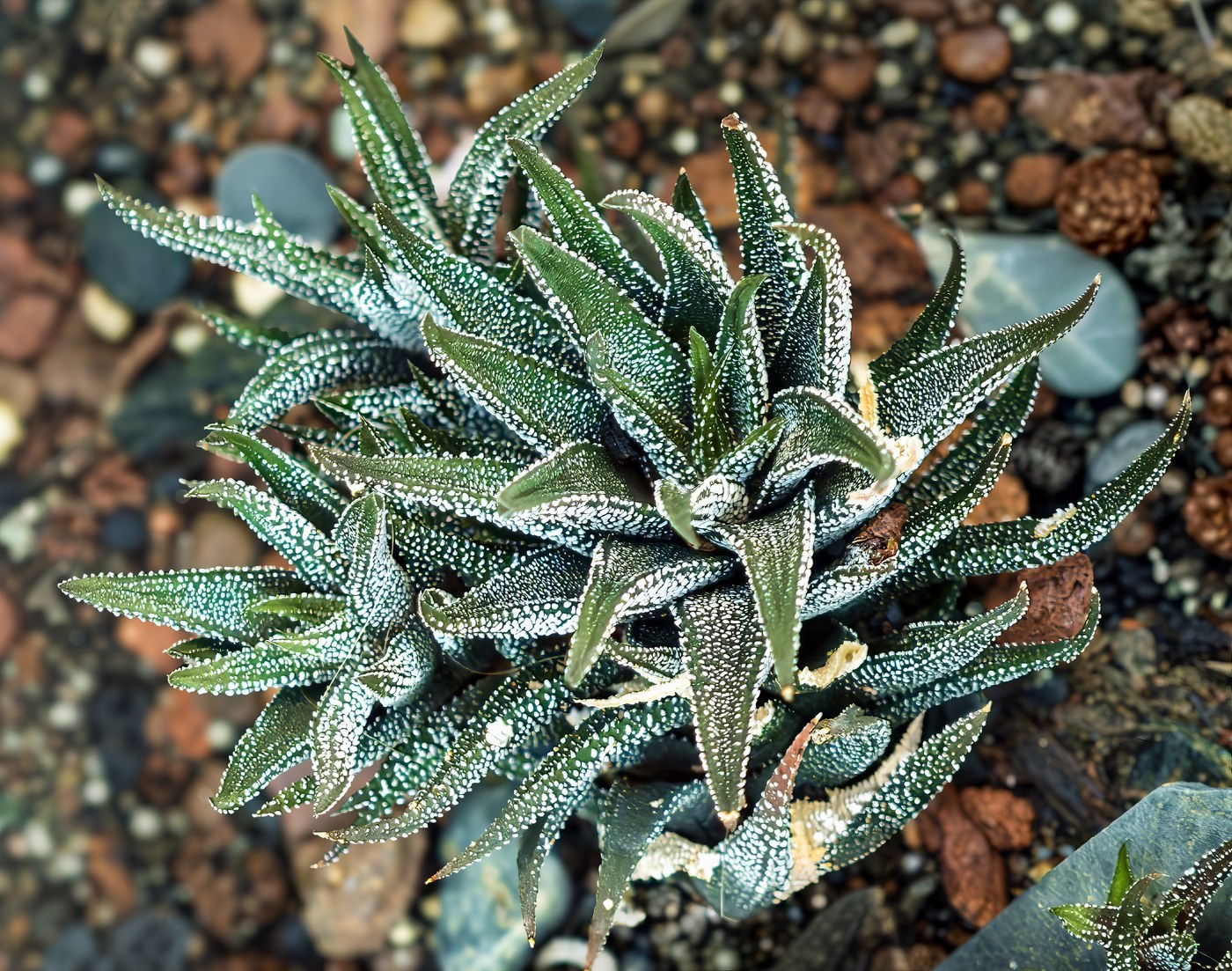
Key Identifying Features
The Zebra Cactus (Haworthiopsis fasciata, formerly Haworthia fasciata) is not a true cactus but a small succulent forming a tight rosette of stiff, upright, pointed leaves marked with raised white horizontal bands resembling zebra stripes.
- Compact rosette, usually only 8-12 cm wide
- Leaves stiff, narrow, triangular, tapering to a point
- Dark green with raised white "tubercle" stripes banding the outside of each leaf
- No spines; leaves are firm but not sharp-edged
Leaves & Stems
The leaves are thick, fleshy, and incurved, arranged in a neat rosette. Their outer (lower) surface carries the bold raised white bands of bumpy tubercles, while the inner (upper) surface is usually smooth and plain green, an important detail separating it from a near-twin species. The leaf is firm and keeps a sharp point but is not dangerous.
The plant is nearly stemless, forming clumps by producing offsets (pups) around the base. It is a slow grower, staying small for years, which is why it is a favorite windowsill succulent.
Flowers & Fruit
Mature plants send up a thin, tall flower stalk (inflorescence) bearing small, tubular, white to pinkish flowers with brownish-green stripes. The flowers are modest and the stalk far exceeds the rosette in height. Flowering is occasional indoors. Fruit is a small dry capsule. The striped foliage, not the flowers, is the identifier.
How to Tell It Apart from Look-Alikes
- Haworthiopsis attenuata is extremely similar but has white tubercles/bands on BOTH leaf surfaces and often broader, more spreading leaves, whereas H. fasciata has a smooth inner leaf surface and firmer, more inward-curving leaves.
- Aloe (e.g. Aloe aristata/Aristaloe) has softer, often toothed-margin leaves and gel-filled flesh; haworthias have firm, non-toothed leaves with raised dots.
- True cacti have areoles and spines, which this plant lacks entirely.
- The small dark-green rosette with raised white zebra bands and a smooth upper leaf face points to zebra haworthia.
Where You'll Find It
Native to the Eastern Cape of South Africa, growing in rocky, arid scrub, often tucked among stones in partial shade. Sold worldwide as a tough, beginner-friendly windowsill succulent, happy in bright indirect light and gritty, fast-draining soil.
Quick ID Checklist
- Small, compact rosette of stiff leaves
- Dark green leaves with raised white horizontal bands
- White stripes mainly on the outer leaf surface
- Stemless, clumping with offset pups
- Tall thin stalk of small white tubular flowers
Frequently asked questions
Is the zebra cactus actually a cactus?
No. Despite the name it is a Haworthiopsis, a South African succulent in the asphodel family. True cacti have areoles and spines, which this plant lacks.
How do I tell Haworthiopsis fasciata from the similar attenuata?
H. fasciata has white raised bands mainly on the outer leaf surface with a smooth green inner face, while H. attenuata has white tubercles on both surfaces and often broader, more spreading leaves.
How is it different from a small aloe?
Aloes have softer, gel-filled leaves often with toothed or spiny margins, while the zebra cactus has firm leaves studded with raised white dots and no marginal teeth.
What are the little plants around the base?
Those are offsets, or pups, that the rosette produces to form a clump. They can be separated and potted to propagate new zebra cacti.