
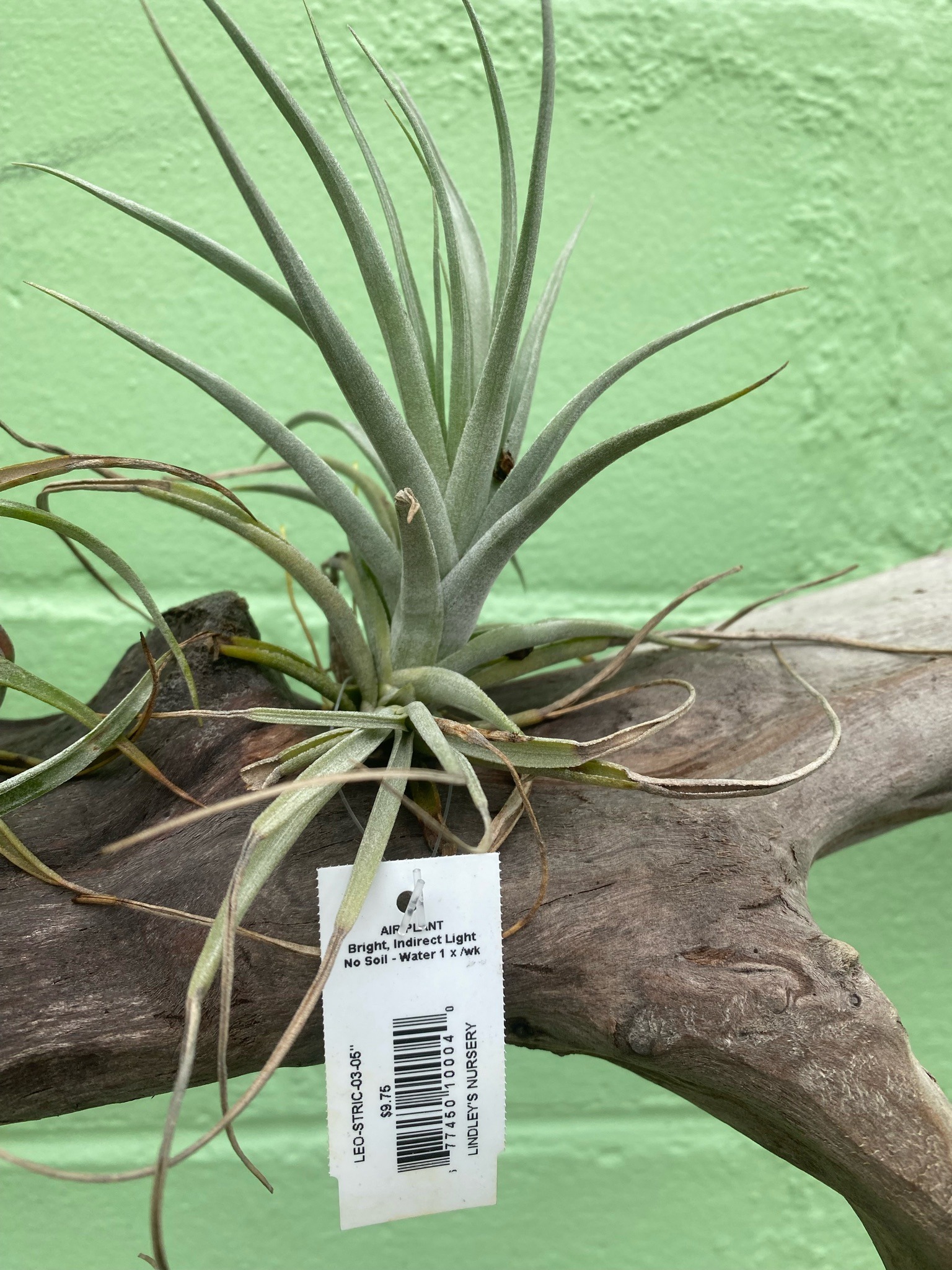
Air Plant
Tillandsia stricta
An epiphyte with stiff, silver-green to grey-green tapering leaves arranged in a symmetrical rosette, mounted on a piece of driftwood.
- Light
- Bright indirect light for several hours daily; avoid prolonged direct hot sun.
- Water
- Submerge the plant in room temperature water for 20-30 minutes once a week, shake off excess water, and invert to dry completely; increase frequency in very dry environments.
- Growth
- Perennial epiphyte forming a single rosette that grows slowly to a mature height and spread of about 4 to 8 inches.
Care instructions
Provide bright indirect light, submerge or mist thoroughly once to twice a week allowing complete drying within four hours, mount without soil, and apply a very diluted epiphyte or bromeliad fertilizer monthly during spring and summer.
Growing details
Sunlight
Bright indirect light for several hours daily; avoid prolonged direct hot sun.
Watering
Submerge the plant in room temperature water for 20-30 minutes once a week, shake off excess water, and invert to dry completely; increase frequency in very dry environments.
Soil
Not applicable as it is an epiphyte and grows without soil; typically mounted on wood, bark, or stone.
Hardiness zone
USDA hardiness zones 9 to 11, grown primarily indoors or in frost-free tropical environments.
Growth habit
Perennial epiphyte forming a single rosette that grows slowly to a mature height and spread of about 4 to 8 inches.
Bloom season
Blooms in spring or summer, producing a central pink or red bract with tubular blue or purple flowers.
Propagation
Propagated by separating offsets or pups that grow from the base of the parent plant after flowering once they reach about one-third the size of the parent.
Common pests & issues
Rot caused by trapped water in the center of the rosette if not dried upside down, and tip browning caused by low humidity or tap water high in mineral content.
Similar species
Tillandsia aeranthos and Tillandsia cyanea; Tillandsia stricta can be distinguished by its stiffer, straighter leaves and distinctly triangular, upright floral bracts.