
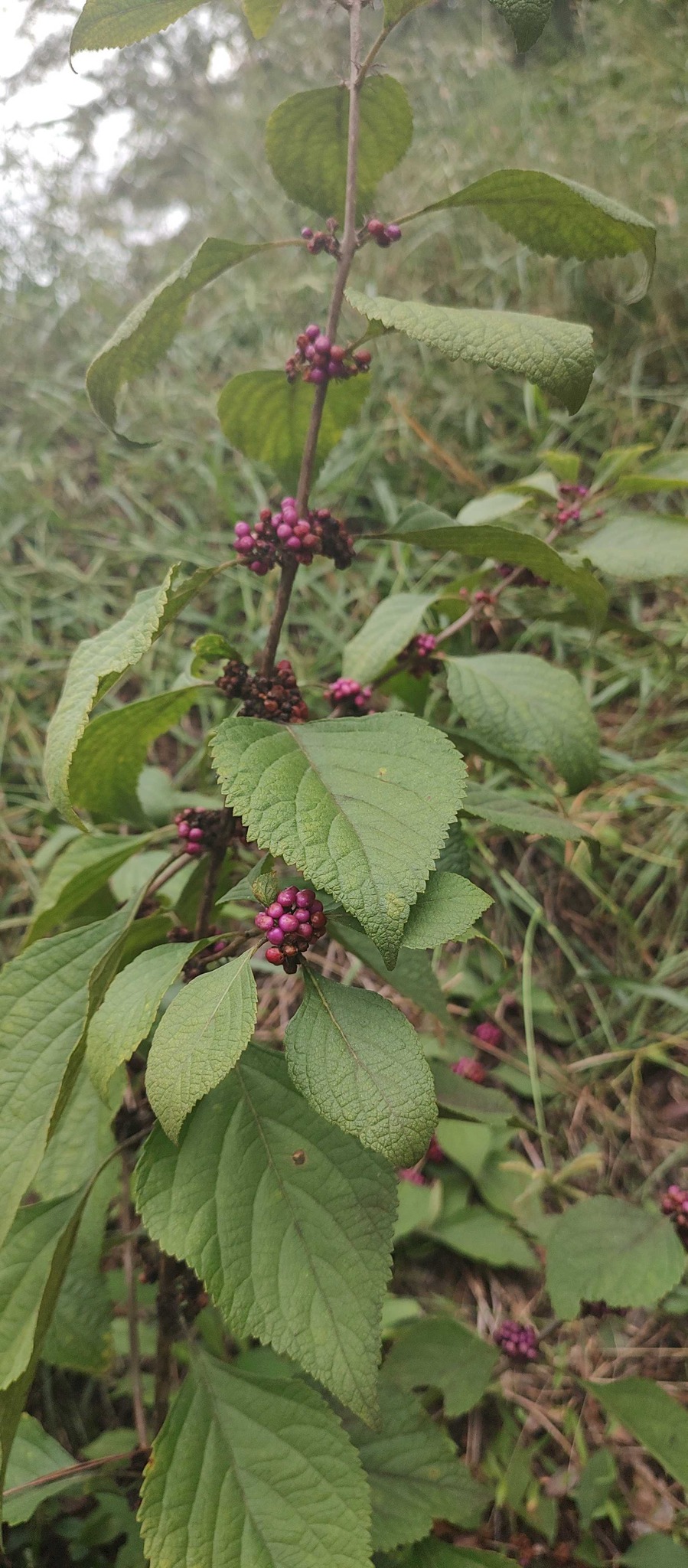
American Beautyberry
Callicarpa americana
A loosely branched deciduous shrub recognized by its opposite, ovate leaves with serrated margins and striking clusters of vibrant purple spherical structures encircling the stems in autumn.
- Light
- Full sun to partial shade, requiring at least 4 to 6 hours of direct sunlight daily for optimal development and vibrant coloration.
- Water
- Moderate water needs; water deeply when the top few inches of soil feel dry. Once established, it tolerates dry spells well, though prolonged drought may reduce the production of its characteristic structures.
- Growth
- Deciduous perennial shrub with an upright, arching growth habit. Typically reaches a mature height and spread of 3 to 6 feet with a moderate growth rate.
Care instructions
Plant in full sun to partial shade in well-draining soil. Water regularly during the first growing season to establish a deep root system, after which it exhibits good drought tolerance. Prune back hard in late winter or early spring before new growth appears, as flowers and subsequent structures form on new wood.
Growing details
Sunlight
Full sun to partial shade, requiring at least 4 to 6 hours of direct sunlight daily for optimal development and vibrant coloration.
Watering
Moderate water needs; water deeply when the top few inches of soil feel dry. Once established, it tolerates dry spells well, though prolonged drought may reduce the production of its characteristic structures.
Soil
Adaptable to a wide range of soil types including clay, loam, and sand, provided they have good drainage. Prefers slightly acidic to neutral pH ranging from 6.0 to 7.0.
Hardiness zone
USDA Hardiness Zones 6 through 10, showing good adaptability across varying climates within these ranges.
Growth habit
Deciduous perennial shrub with an upright, arching growth habit. Typically reaches a mature height and spread of 3 to 6 feet with a moderate growth rate.
Bloom season
Flowers appear in the late spring to mid-summer, featuring small, inconspicuous clusters of pale pink to lavender blossoms, followed by prominent, brightly colored purple spherical formations persisting into winter.
Propagation
Easily propagated via softwood cuttings taken in late spring or summer, hardwood cuttings in winter, or by sowing seeds in autumn or spring after a period of cold stratification.
Common pests & issues
Generally resistant to major pests and diseases. Occasionally affected by leaf spot or fungal issues in overly damp conditions, which can be mitigated by ensuring proper air circulation and adequate spacing.
Similar species
Distinguished from other shrubs by its distinct clusters of purple spherical formations directly surrounding the leaf nodes. Often compared to other Callicarpa species, but Callicarpa americana typically features larger leaves and more vibrant cluster density.