
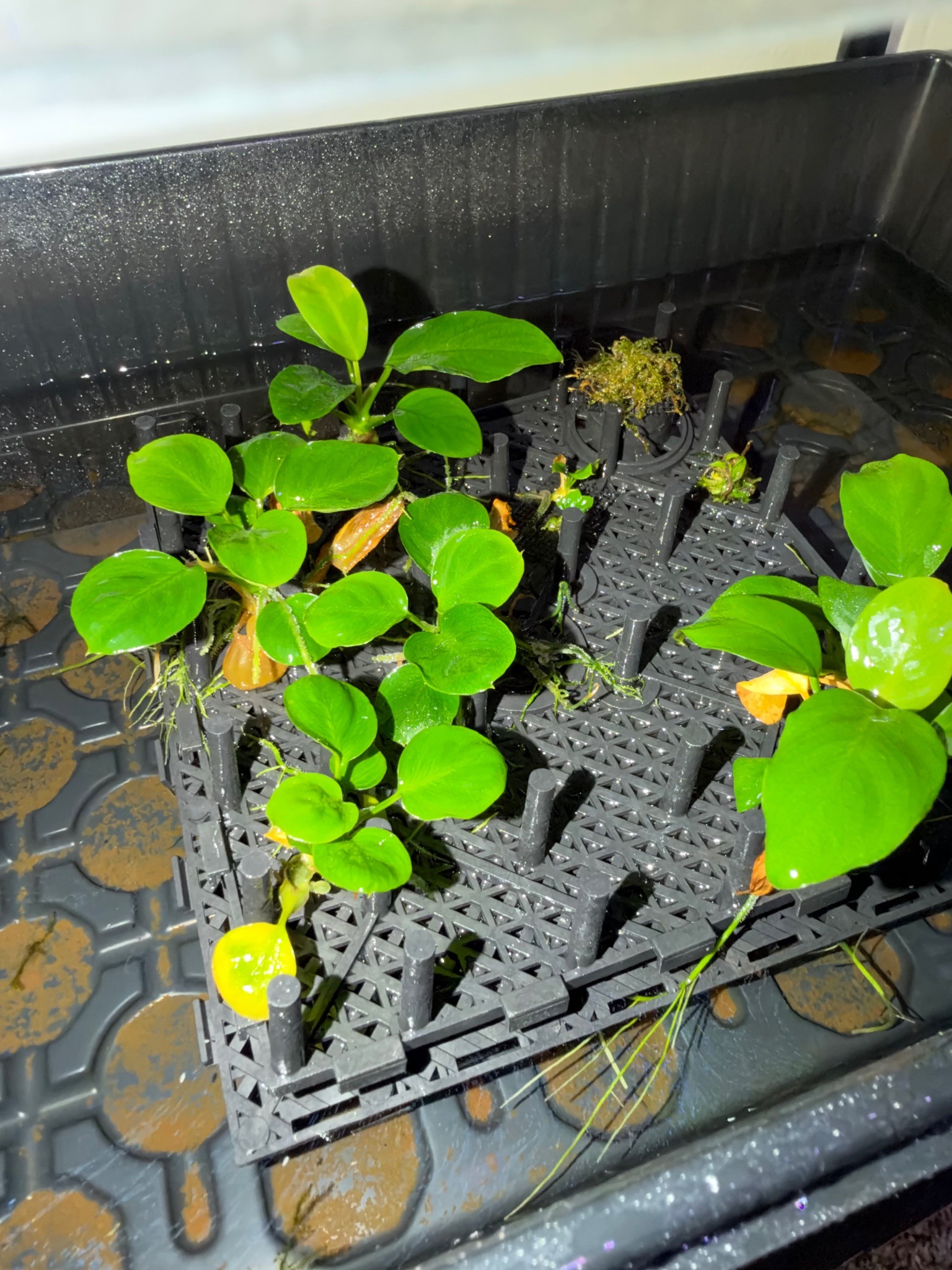
Anubias
Anubias barteri
Anubias barteri is a hardy, aquatic to semi-aquatic perennial plant featuring thick, creeping rhizomes and dark green, leathery, glossy leaves of varying shapes depending on the specific variety.
- Light
- Low to moderate indirect light, approximately 4 to 8 hours daily if cultivated under artificial aquarium or terrarium lighting.
- Water
- Requires constant immersion in water or very high humidity environments, as the foliage and root systems are adapted to aquatic or marginal riverine habitats.
- Growth
- Slow-growing aquatic perennial with a creeping rhizome; mature height and spread typically range from 5 to 18 inches depending on the specific cultivar.
Care instructions
Grow submerged or emersed in water or high-humidity setups. Attach the rhizome to driftwood, rocks, or a mesh grid rather than burying it in dense substrate to prevent rotting. Provide moderate to low artificial or indirect natural light and a source of aquatic nutrients.
Growing details
Sunlight
Low to moderate indirect light, approximately 4 to 8 hours daily if cultivated under artificial aquarium or terrarium lighting.
Watering
Requires constant immersion in water or very high humidity environments, as the foliage and root systems are adapted to aquatic or marginal riverine habitats.
Soil
Not applicable for traditional soil; grows attached to hard surfaces or porous substrates in aquatic or hydroponic setups with a neutral pH range of 6.0 to 7.5.
Hardiness zone
USDA Hardiness Zones 10 through 12 if grown outdoors; primarily maintained as an indoor aquarium or terrarium plant.
Growth habit
Slow-growing aquatic perennial with a creeping rhizome; mature height and spread typically range from 5 to 18 inches depending on the specific cultivar.
Bloom season
Rarely blooms when fully submerged, but can produce a small, white or yellowish spathe and spadix when grown emersed.
Propagation
Propagated by cutting or dividing the rhizome into sections, ensuring that each division retains several healthy leaves and attached roots.
Common pests & issues
Prone to algae growth on slow-growing leaves under excessive lighting; can suffer from rhizome rot if buried too deeply in substrate.
Similar species
Cryptocoryne species, which generally feature softer leaves emerging directly from a basal rosette rather than a creeping woody rhizome.