
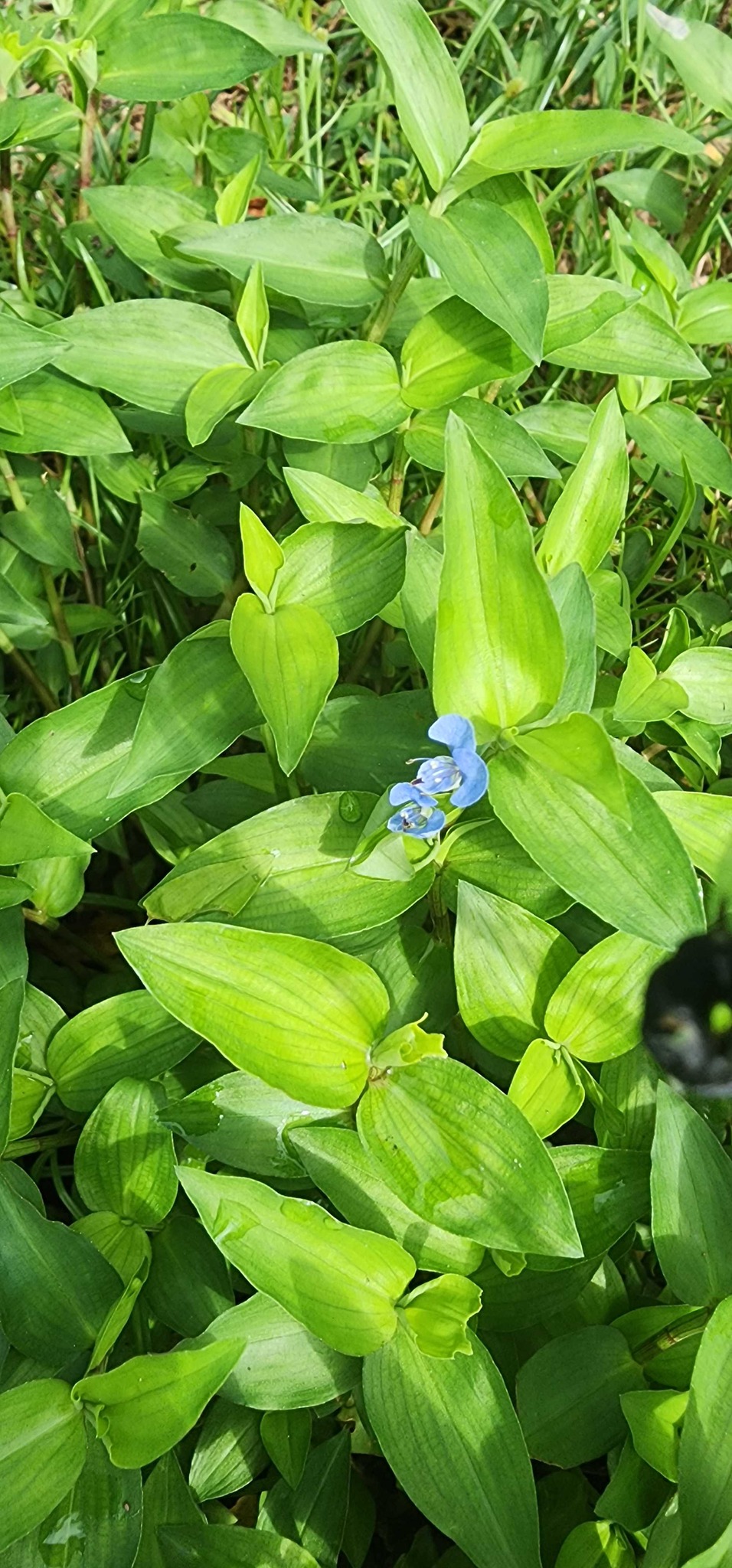
Asiatic dayflower
Commelina communis
A low-growing, herbaceous annual plant featuring bright green, alternate, lance-shaped leaves with parallel veins, clasping sheaths at the nodes, and distinctive small blue flowers with two prominent upper petals and a reduced white lower petal.
- Light
- Full sun to partial shade, approximately 4 to 6 hours of direct or filtered sunlight daily.
- Water
- Prefers consistently moist soil. Water deeply when the top inch of soil feels dry. Moderate drought tolerance once established, but extended dry spells will reduce vegetative vigor.
- Growth
- Low-growing, creeping, or ascending herbaceous annual with succulent stems that root at the nodes where they touch the ground, reaching a height of 15 to 60 centimeters and spreading outward freely.
Care instructions
Grow in moist, well-draining soils with partial shade to full sun. Provide regular moisture during dry periods. Feeding is generally not necessary as it adapts well to various soil fertility levels.
Growing details
Sunlight
Full sun to partial shade, approximately 4 to 6 hours of direct or filtered sunlight daily.
Watering
Prefers consistently moist soil. Water deeply when the top inch of soil feels dry. Moderate drought tolerance once established, but extended dry spells will reduce vegetative vigor.
Soil
Adaptable to a wide range of soil types including loam, sand, and clay, provided they have good drainage. Prefers a neutral to slightly acidic pH range of 6.0 to 7.0.
Hardiness zone
USDA zones 3 through 9 as an annual or tender perennial depending on regional climate.
Growth habit
Low-growing, creeping, or ascending herbaceous annual with succulent stems that root at the nodes where they touch the ground, reaching a height of 15 to 60 centimeters and spreading outward freely.
Bloom season
Blooms from early summer through autumn with small, ephemeral bright blue flowers emerging from folded, heart-shaped spathes.
Propagation
Propagates easily by seeds dispersed naturally or through stem cuttings placed in moist soil or water where roots quickly develop at the nodes.
Common pests & issues
Generally resilient, though occasionally prone to fungal leaf spots in overly damp, stagnant conditions, and can be susceptible to slugs or snails grazing on succulent stems.
Similar species
Differs from other Commelina species primarily by its distinct blue petals with the lower petal being significantly smaller and whitish, and the smooth spathe margins that are fused at the base.