
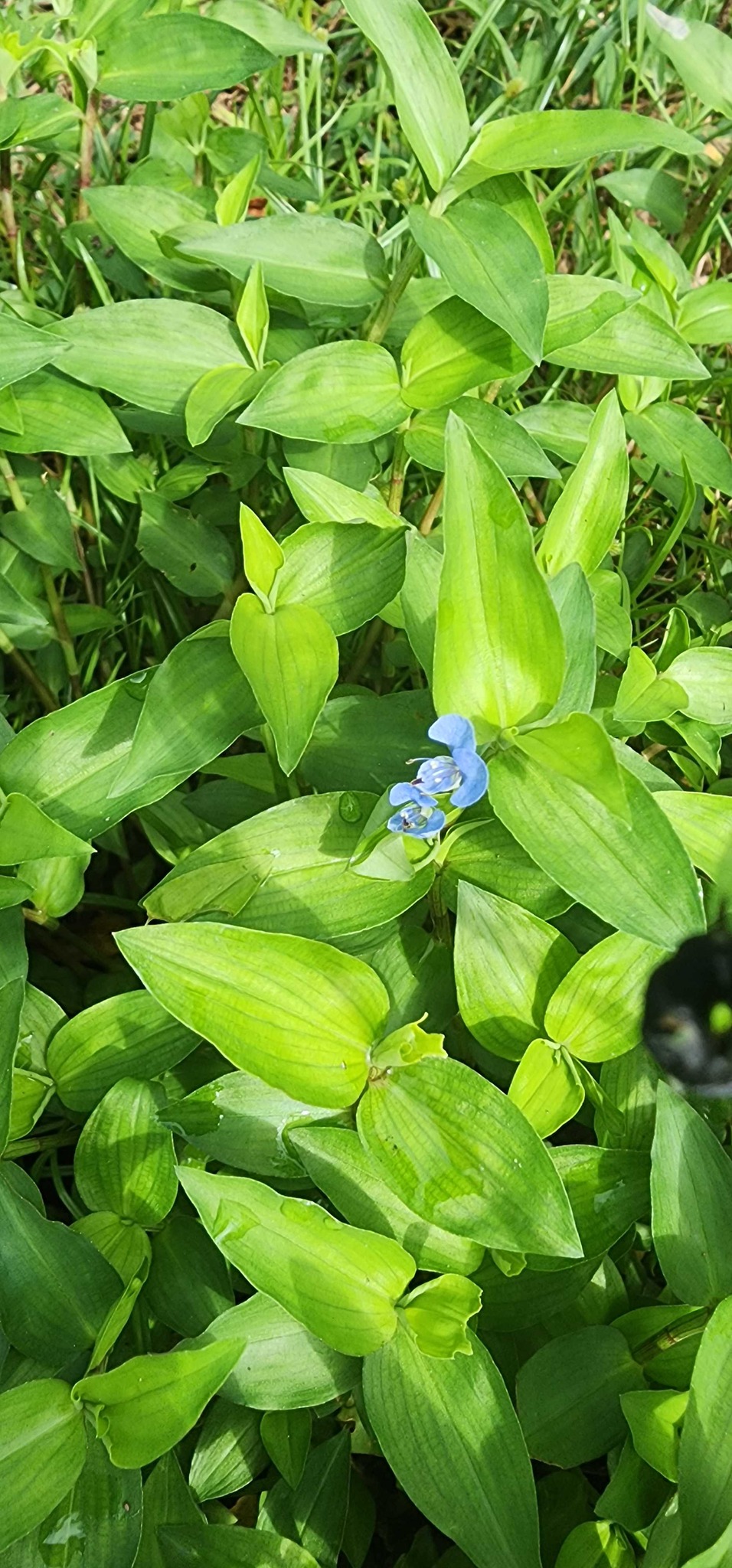
Asiatic dayflower
Commelina communis
An herbaceous annual weed featuring bright blue flowers with two prominent upper petals and a smaller, less conspicuous lower petal, accompanied by lance-shaped leaves with parallel veins and clasping sheaths along branching, succulent-like stems.
- Light
- Full sun to partial shade, requiring at least 4 to 6 hours of direct sunlight daily for optimal flowering.
- Water
- Prefers regular moisture. Water moderately when the soil begins to dry out. It tolerates brief dry spells but performs best with consistent watering.
- Growth
- Low-growing, prostrate or creeping annual herb with stems that root at the nodes where they touch the ground, reaching a height of 6 to 18 inches and spreading widely.
Care instructions
Provide full sun to partial shade with consistently moist, well-draining soil. Water when the top inch of soil feels dry. Fertilization is generally not necessary as it thrives well in typical garden soils without extra nutrients.
Growing details
Sunlight
Full sun to partial shade, requiring at least 4 to 6 hours of direct sunlight daily for optimal flowering.
Watering
Prefers regular moisture. Water moderately when the soil begins to dry out. It tolerates brief dry spells but performs best with consistent watering.
Soil
Adaptable to various soil types including sandy, loamy, or clay soils, provided they have good drainage. Prefers a neutral pH range between 6.0 and 7.0.
Hardiness zone
USDA zones 3 through 9, functioning typically as an annual plant across these temperate regions.
Growth habit
Low-growing, prostrate or creeping annual herb with stems that root at the nodes where they touch the ground, reaching a height of 6 to 18 inches and spreading widely.
Bloom season
Blooms from early summer through autumn, producing small, distinctive bright blue flowers lasting for only a single day each.
Propagation
Propagates easily by seeds dispersed naturally or by stem cuttings that readily develop roots at the nodes when placed in moist soil or water.
Common pests & issues
Generally resilient, but may occasionally be affected by fungal leaf spots or root rot if grown in poorly draining, waterlogged soil. Slugs and snails may occasionally feed on the foliage.
Similar species
Can be confused with Virginia dayflower (Commelina virginica), which can be distinguished by having three equal-sized blue petals rather than two large petals and one tiny lower petal.