
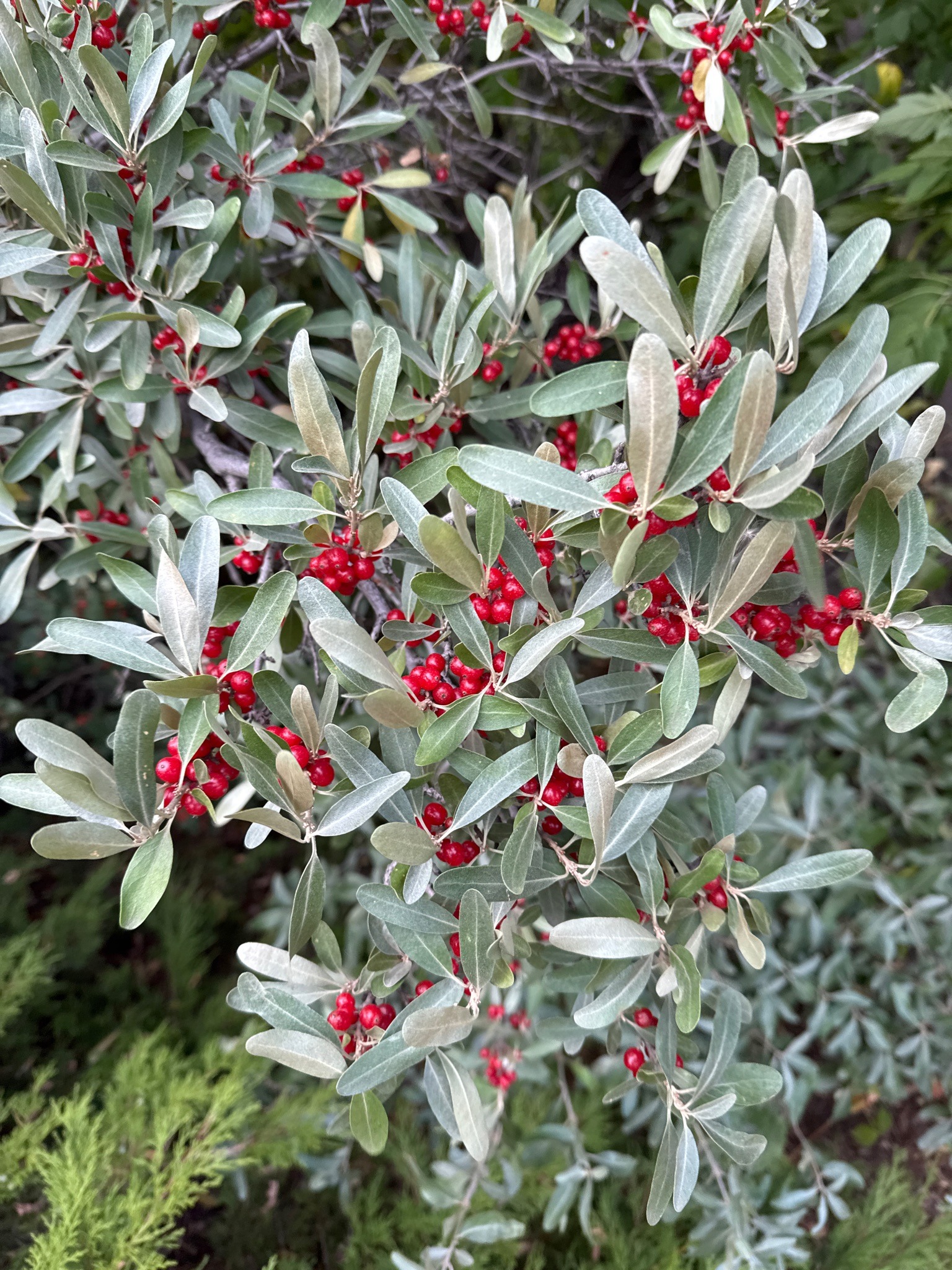
Autumn Olive
Elaeagnus umbellata
A deciduous shrub or small tree featuring alternate, oblong to elliptic leaves with distinct silvery-green upper surfaces and silvery-white, scaly undersides. It produces clusters of small, fragrant flowers followed by abundant round red fruits dotted with silver scales.
- Light
- Full sun preferred, with a minimum of 6 hours of direct sunlight daily; tolerates partial shade.
- Water
- Requires regular watering when first planted to establish a deep root system. Once established, it is extremely drought-tolerant and rarely needs supplemental irrigation, avoiding overly saturated soils.
- Growth
- Perennial shrub or small multi-stemmed tree, growing rapidly to a mature height and spread of 10 to 20 feet.
Care instructions
Provide full sun to partial shade in well-draining soil. Water deeply during establishment, after which the plant exhibits high drought tolerance. Fertilization is generally unnecessary as it fixes its own nitrogen.
Growing details
Sunlight
Full sun preferred, with a minimum of 6 hours of direct sunlight daily; tolerates partial shade.
Watering
Requires regular watering when first planted to establish a deep root system. Once established, it is extremely drought-tolerant and rarely needs supplemental irrigation, avoiding overly saturated soils.
Soil
Adaptable to a wide range of soil types including sandy, loamy, and clay soils, as long as drainage is good. Prefers a neutral to slightly acidic pH range of 6.0 to 7.5.
Hardiness zone
USDA hardiness zones 3 through 8, demonstrating strong cold hardiness and heat tolerance.
Growth habit
Perennial shrub or small multi-stemmed tree, growing rapidly to a mature height and spread of 10 to 20 feet.
Bloom season
Flowers in mid-spring, producing small, highly fragrant, yellowish-white tubular flowers clustered along the branches.
Propagation
Propagated easily from seeds, hardwood cuttings taken in winter, or softwood cuttings in summer. Stratification of seeds is beneficial for improving germination rates.
Common pests & issues
Generally resistant to major insect pests and severe plant diseases, though occasionally susceptible to twig blight or root rots in poorly draining soils.
Similar species
Russian Olive (Elaeagnus angustifolia), which features narrower, more lance-shaped silvery leaves and yellowish fruits rather than round red ones.