
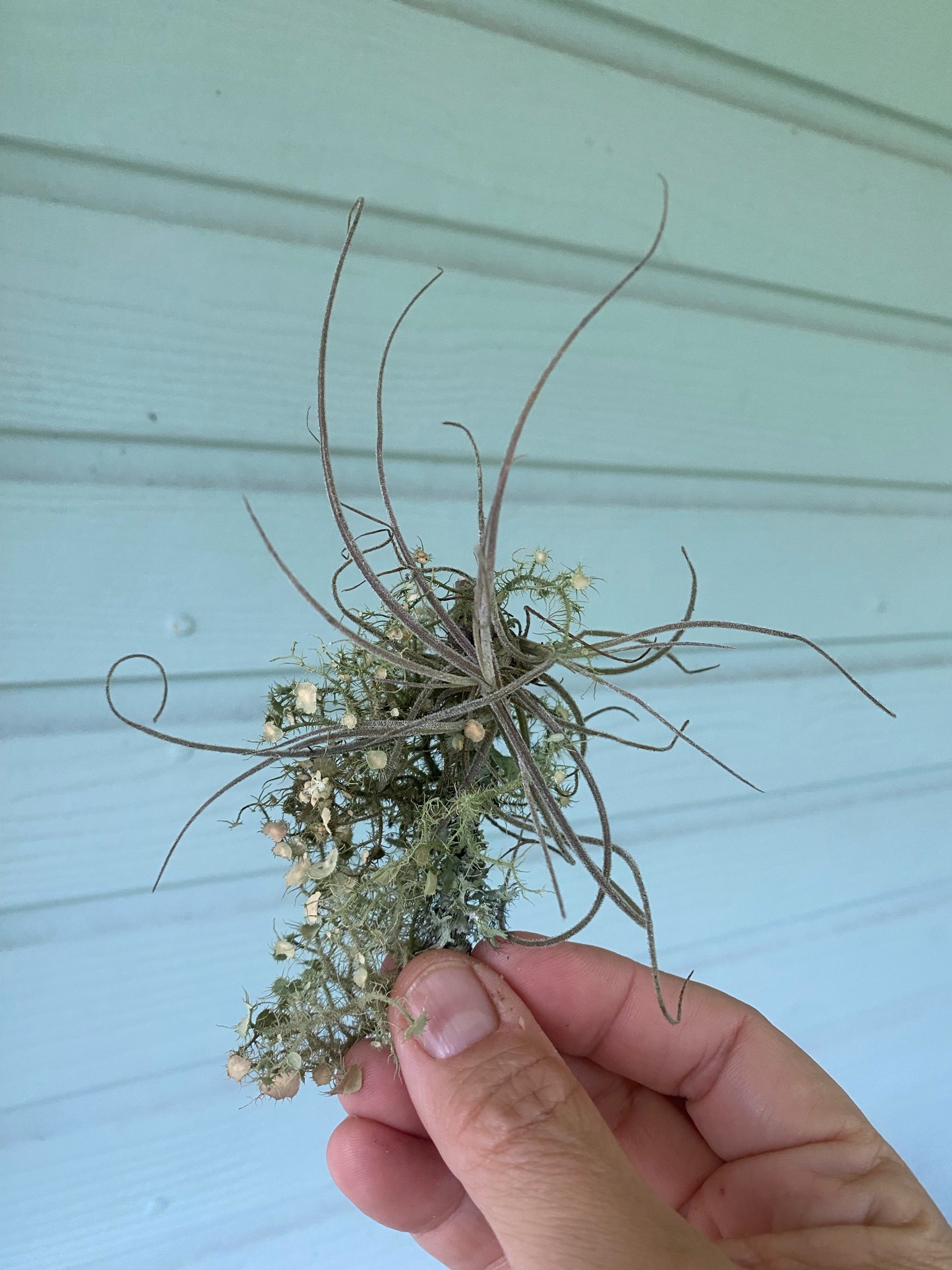
Ball Moss
Tillandsia recurvata
An epiphyte with narrow, curving, grey-green leaves covered in tiny scales, growing in ball-like clumps often attached to tree branches.
- Light
- Bright indirect light to partial sun, approximately 6 to 8 hours per day
- Water
- Mist frequently or submerge the entire plant in water for 15-20 minutes every week, allowing it to dry out completely between waterings.
- Growth
- Perennial epiphyte forming rounded clusters or clumps, typically ranging from 3 to 12 inches in diameter with a slow growth rate.
Care instructions
Mount on a piece of bark or wood, provide bright indirect light, mist thoroughly with water 2-3 times a week, and ensure good air circulation.
Growing details
Sunlight
Bright indirect light to partial sun, approximately 6 to 8 hours per day
Watering
Mist frequently or submerge the entire plant in water for 15-20 minutes every week, allowing it to dry out completely between waterings.
Soil
Epiphytic, does not require soil; grows attached to surfaces with specialized anchoring roots.
Hardiness zone
USDA hardiness zones 8 through 11
Growth habit
Perennial epiphyte forming rounded clusters or clumps, typically ranging from 3 to 12 inches in diameter with a slow growth rate.
Bloom season
Spring to early summer, producing small, pale blue or violet flowers on a slender stalk.
Propagation
Propagated by separating offsets or 'pups' that form around the base of the mature plant, or from seed.
Common pests & issues
Generally resilient, but susceptible to rotting if left in standing water or lacking sufficient air movement.
Similar species
Spanish Moss (Tillandsia usneoides), which has a hanging, pendant growth habit rather than forming rounded tufts.